
Metronidazole and Nifuroxazide: An Overview and Considerations for their Use Against Diarrhea of Infectious Origin in Children and During Pregnancy
Received Date: June 27, 2026 Accepted Date: August 08, 2026 Published Date: August 12, 2026
doi:10.17303/jaaa.2026.3.101
Citation: Carlos F. Amábile-Cuevas (2026) Metronidazole and Nifuroxazide: An Overview and Considerations for their Use Against Diarrhea of Infectious Origin in Children and During Pregnancy. J Antibiot Antimicrob Agents 3: 1-11
Abstract
Nifuroxazide, an antibacterial nitrofuran, has its presence and activity limited to the intestinal tract after oral administration; metronidazole, on the other hand, is widely distributed in the body, but active only under anaerobic conditions against bacteria and protozoa. Both are prodrugs, and their conversion to reactive intermediates occurs almost exclusively within microbial cells, minimizing the risk to human cells. Although nifuroxazide poses no risks during pregnancy and in children due to its lack of systemic activity, concerns persist regarding the use of metronidazole in these conditions. These concerns stem from an incomplete understanding of the drug's mechanism of action and from isolated studies of questionable quality, while abundant evidence of its safety during pregnancy should outweigh the fears. Given that nifuroxazide, alone or in combination with metronidazole, is an effective and safe option for the empirical management of diarrheal diseases of infectious origin, it is important to address any persistent doubts about its safety in children and during pregnancy. The evidence gathered in this review points to the virtual absence of risks.
Keywords: metronidazole, nifuroxazide, safety, pregnancy, children.
Introduction
When antimicrobials are needed to treat diarrheal diseases, especially if the etiology is unknown, it is preferable to select drugs with a sufficiently broad spectrum, including bacteria and protozoa; and with minimal impact upon the gut microbiota. Nifuroxazide, an antibacterial agent, alone or in combination with metronidazole, an antiprotozoal agent, has been used for decades with efficacy and safety. However, concerns remain about its effects during pregnancy and in pediatric patients, even though it has also been used successfully in these conditions.
The clinical evidence required for marketing a new drug, since 1961—following the thalidomide crisis, rarely includes minors or pregnant women. Upon entering the market, precautionary recommendations are included in the Prescribing Information (PI), based on in vitro observations and experiments on animals. Over the years, clinical evidence accumulates regarding pediatric and/or pregnancy use, which should serve to either confirm or revise these recommendations. However, by then the drug's patent has expired, and with it, the financial interest at the company that held the patent. In the absence of such interest, the PI is often not updated, allowing outdated recommendations, lacking clinical support, to persist indefinitely. Many medications commonly used during pregnancy and/or in pediatrics are not indicated (or are clearly contraindicated) in these conditions, according to their PIs.
The Food and Drug Administration (FDA) of the US had five drug categories, according to their use during pregnancy: A, for which no risk has been demonstrated in humans; B, for which no risks were found in animals, but there are no extensive studies in humans (or there were effects in animals, but they were not replicated in human studies); C, for which there were adverse effects in animals (or no studies were conducted in animals) and there are no studies in humans; D, for which there is evidence of risks in humans, but the benefits may outweigh the risks; and X, for which there is clear evidence of fetal abnormalities in animals or humans, and the risk is higher than the potential benefits [1].
Since May 2008, there had been proposals for replacing this classification, and since December 2014, it is no longer included on drug labels, “because [the categories] are often viewed as confusing and overly simplistic and don’t effectively communicate the risk” [2]. This is certainly true, but the classification was not replaced with something better. For the purposes of this review, it is worth mentioning that metronidazole was included in class B, and nifuroxazide was never classified because it is not sold in the USA.
This paper will review general aspects of metronidazole and nifuroxazide, especially those related to their safety during pregnancy and in pediatric patients.
Metronidazole: Basic Pharmacology
Metronidazole (Figure 1), a synthetic nitroimidazole inspired by azomycin (a natural product of soil Streptomyces spp., and also of Pseudomonas spp.) is a very broad-spectrum antimicrobial. Initial interest in the molecule arose after its activity against Trichomonas vaginalis, a protozoan, was found; subsequent research also revealed effect against Giardia duodenalis (also known as G. lamblia or G. intestinalis) and Entamoeba histolytica, other protozoans. Further studies demonstrated activity against anaerobic bacteria, such as Fusobacterium spp. and Bacteroides spp.; the list of susceptible bacteria now includes Prevotella spp., Fusobacterium spp., Veillonella spp., Clostridium spp. (and the recently renamed Clostridioides difficile), also anaerobes; the microaerophilic Helicobacter pylori; and the facultative anaerobe Gardnerella vaginalis [3]. Thus, the previous statement about the “broad spectrum” does not refer to the typical clinical use of the term, but to the effect of metronidazole upon very diverse microorganisms, prokaryotes and eukaryotes, strict and not-so-strict anaerobes. However, it should be added that the anaerobes Lactobacillus spp., which are an important component of the human intestinal microbiota, are intrinsically resistant to metronidazole, so at least that part of the gut bacterial population remains after metronidazole treatment.
Metronidazole is a prodrug; the active form of metronidazole results from the reduction of the nitro group under anaerobic conditions, which was presumed since the 1970s [4], but could not be demonstrated until much later. In bacteria, the electron needed for this reduction comes from the pyruvate oxidase complex, which decarboxylates pyruvate and transfers electrons to ferredoxin or flavodoxin. The resulting anionic nitro radical binds to DNA, causing single-strand breaks that lead to cell death. In Giardia, as in Trichomonas, the reaction occurs in the hydrogenosome, the organelle where carbohydrate fermentation takes place. However, in the former, thioredoxin reductase does not play a role in the activation of metronidazole, and other pathways have been implicated, including a nitro reductase, as occurs with nitrofurans (see below). In Entamoeba, on the other hand, it is a thioredoxin reductase that is involved, rather than ferredoxin [3]; as well as an entirely different pathway, mediated by a malate decarboxylase that, in this protozoan, is particularly similar to its bacterial counterpart [5]. In any case, the formation of the reactive intermediate that damages DNA is the common theme, even in H. pylori, in which an oxygen-insensitive oxidoreductase is the one that forms the toxic metabolite under microaerophilic conditions [3]. It should be added that these pathways do not exist in human cells, so the reactions summarized here, and their toxic products, are only found inside microorganisms.
The minimum inhibitory concentrations (MICs) of metronidazole against anaerobic bacteria range from 0.13 to 0.5 μg/mL for Gram-positive bacteria, and are almost invariably below 1 μg/mL for Gram-negative bacteria [3]. Anti-protozoal activity is measured differently: concentrations capable of inhibiting 50% (IC50) of the viability of a standardized culture; for clinical strains of E. histolytica, the IC50 is 6.5 μM ([6]; approximately equivalent to 1.1 μg/mL), and for G. intestinalis the IC50 is 0.78-1.56 μg/mL (although these values are the same for strains causing infections that are susceptible and resistant to treatment, which calls into question the relevance of the parameter; [7]). Bacterial resistance to metronidazole has been known since the 1970s, especially in Bacteroides spp. It is usually associated with nim genes, which encode a reductase that forms amino groups instead of the reduced nitro group, the reactive intermediate. Efflux mechanisms, mutations in pyruvate oxidoreductase, and overexpression of SOS, a DNA repair gene, have also been characterized. Amongst protozoa, resistance has not been found in clinical isolates of E. histolytica; however, it has been found in Giardia, where decreased levels of pyruvate/ferredoxin oxidoreductase (so that the reactive intermediate is not formed), or the substitution of nitroreductase 1, which forms the toxic derivative, with nitroreductase 2, which forms less toxic amines, are the mechanisms identified to date [3]. Metronidazole is administered orally, as a single dose of 2 g, or 2 g/day for giardiasis, or 200-250 mg/8 h for infections caused by anaerobic bacteria. An oral dose of 100 mg leads to a maximum plasma concentration (Cmax) of 20 μg/mL, a time to Cmax (tmax) of 2.8 h, and a half-life (t1/2) of 8.5 h. It has a volume of distribution (V) of 50 L for a 70-kg adult. It is eliminated in the urine, mainly in metabolized form [8]. Fecal concentrations of metronidazole, which would be relevant when used against intestinal infections, have been a subject of controversy: in healthy volunteers, orally administered metronidazole is not detected in feces because it is rapidly absorbed, which could question its efficacy against intestinal infections. But in patients with diarrhea, the concentrations in wet stool, adding the base drug and the hydroxylated metabolite which is also active, range from 1.9 to 13.3 μg/g, after three days of treatment with 400 mg orally (Figure 2), with the variation depending on the number of bowel movements per day [9]. Thus, the diarrhea for which metronidazole is used is necessary for it to have significant concentrations in stools.
Nifuroxazide: Basic Pharmacology
There is little pharmacological information available on nifuroxazide (Figure 3) (as well as general information: 208 articles in PubMed, from 1972 to the present, compared to 24,822 on metronidazole, from 1960 to the present). It is a synthetic nitrofuran, the same as nitrofurantoin, and very likely shares the same mechanism of action, which will be discussed shortly. An issue absent from the literature is the pharmacokinetics, plasma or otherwise, of nifuroxazide. The purported rationale for this absence is that the drug is not absorbed from the digestive tract, similar to other antibiotics such as neomycin and rifaximin, also used against intestinal infections [10]. There is, however, evidence in animal models that nifuroxazide is partially absorbed (<50%), but the absorbed fraction virtually disappears before reaching the systemic circulation due to extensive first-pass metabolism [10]. When radiolabeled nifuroxazide was administered to rats, 17% of the dose (10 mg/kg, which is about twice the dose used therapeutically in humans) was eliminated in the urine as metabolites, and 20% of the radioactivity recovered in feces, corresponding to 67% of the dose, was unchanged nifuroxazide; most of the radioactivity remained in the gastrointestinal lumen [11]. Other sources state, more vaguely, that “over 99% of orally administered nifuroxazide remains in the intestines” [12]. In any case, nifuroxazide would not have relevant systemic effects, as it is undetectable in plasma after oral administration.
Nifuroxazide also has a broad spectrum of activity, ranging from typical enteropathogenic bacteria, which are relevant to its primary indication [13], to other bacteria such as Mycobacterium tuberculosis, protozoa such as Trypanosoma spp. and Leishmania spp., [14] and even flatworms such as Schistosoma mansoni [15]. Importantly, it has also been proposed for the management of C. difficile-associated diarrhea [12]. Furthermore, there is recent interest in nifuroxazide for its anti-tumor activity, and its repurposing against cancer has been considered [16].
Given the absence of nifuroxazide in systemic blood, plasma pharmacokinetics cannot be discussed. However, from the study with labeled nifuroxazide administered to rats, 38% of a 10-mg/kg dose appeared in feces in the 0-24 h interval, and an additional 29% in the 24-48 h interval [11]. Although the digestive systems of rats and humans are very different, in an attempt to calculate concentrations in feces when nifuroxazide is administered to humans, a typical dose of 400 mg for a 70 kg adult, who defecates on average 125 g/day, would have 1200 μg/g of nifuroxazide in feces. This concentration is substantially higher than the MIC90 of the drug on various enteropathogens: 0.197 μg/mL for Campylobacter, 25 μg/mL for Shigella, 50 μg/mL for Salmonella, 100 μg/mL for E. coli and Yersinia enterocolitica [17] (Figure 4).
Regarding its mechanism of action, it is assumed to be similar to that of nitrofurantoin, which is also a prodrug. In the case of antibacterial activity, particularly against Escherichia coli, the activation of nitrofuratoin depends on nitroreductase enzymes (encoded by the nfsA and nfsB genes), which normally catalyze the divalent reduction of various nitrosated compounds that can generate intracellular superoxide radicals (O2·⁻). Paradoxically, these enzymes, which are important for bacterial viability under aerobic conditions, convert nitrofurantoin into a reactive intermediate. The byproducts of this intermediate, also free radicals, cause damage to different structures of the bacterial cell, including DNA, ribosomes, and the respiratory chain. To complete the paradox, the loss of these enzymes obviously results in resistance to nitrofurantoin, which is rare because bacteria lacking nitroreductases are particularly fragile [18]. Nitrofurantoin resistance in clinical isolates of community-acquired urinary tract infections does not exceed 10% [19]. Returning to nifuroxazide, studies in volunteers who received it at doses of 800–1200 mg/day for six days found no resistant organisms after treatment; nor, of course, is there cross-resistance with other antimicrobials [20].
Nifuroxazide, administered orally to humans, has been found, since 1985, to have little effect on the intestinal bacterial load [21], indicating that the treatment has little impact on the microbiota. This notion is reinforced by a very recent metagenomic study, reporting that nitrofurantoin is among the antibiotics least likely to alter the intestinal microbiota, in contrast to fluoroquinolones, clindamycin, or flucloxacillin [22]. Considering that we are discovering every day new ways in which the microbiota affects our health, especially negatively if we alter these microbial communities, qualitatively or quantitatively, it is a particular advantage of an antibiotic that its impact on the microbiota is minimal.
Clinical Indications
As its activity is limited to the intestinal tract, nifuroxazide is only used against intestinal infections, which usually lead to diarrhea.
Metronidazole is indicated for very diverse conditions, due to its anti-anaerobic activity, which makes it useful against infections caused by strict anaerobic bacteria, or by facultative bacteria under poor oxygenation. These indications are beyond the scope of this text. The use of metronidazole in gastrointestinal tract conditions includes chemoprophylaxis for colorectal surgery and appendectomy, C. difficile diarrhea, reduction of gut bacterial load, as monotherapy or in combination with ciprofloxacin in inflammatory bowel diseases, and as part of combination therapy against H. pylori. Metronidazole plays an important role in the management of E. histolytica amebiasis, whether causing colitis, liver abscesses, or brain abscesses; It is also useful in the management of giardiasis, although a small number of cases, especially those acquired in India, may be refractory to treatment; and in diarrhea caused by Blastocystis spp., and Balantidium coli (it also leads to the eradication of Dientamoeba fragilis, but with no difference versus placebo in symptom remission; [3]).
Safety
The safety of metronidazole during pregnancy is a clear example of the premise mentioned in the Introduction. While some PI state that “there is inadequate evidence of the safety of metronidazole in pregnancy but it has been in wide use for many years without apparent ill consequence” (https://www.medicines.org.uk/emc/product/12817/smpc#gref); in other countries the PI often states that “it is advisable that administration of metronidazole be avoided in pregnant patients and be withheld during the first trimester of pregnancy” (IP for pms-METRONIDAZOLE, 500 mg capsules, Pharmascience, Canada), of plainly list the first trimester of pregnancy under the list of contraindications (IP for Flagyl®, metronidazole, 250 and 500 mg tablets, Sanfer, Mexico). These notions go against those of the Category B to metronidazole did belong, which only reflect that, although animal studies do not reveal fetal harm, there were no well-controlled studies demonstrating safety in pregnant women [23].
From an incomplete understanding of metronidazole's mechanism of action, one might infer that it has mutagenic or teratogenic potential; after all, its antimicrobial effect results, among other things, from DNA damage, as discussed earlier. This simplistic view overlooks the fact that metronidazole is a prodrug that requires anaerobic conditions for its conversion to an active form; virtually all of our cells, and particularly fetal cells, have a distinctly aerobic metabolism. Furthermore, the pathways necessary for the reduction of metronidazole to its toxic byproduct occur only in microorganisms, as previously reviewed. Thus, the reactive intermediate of metronidazole is formed exclusively in microbial cells that colonize an anaerobic niche. In a review on the genotoxicity of metronidazole, while summarizing the extensive evidence of mutagenicity in bacteria, it highlights the absence of these effects in cultured mammalian cells, in animal models, or in clinical studies [24]. However, when in doubt, caution and a review of the evidence are preferable.
A widely cited Canadian study reporting a 70% increased risk of miscarriage with metronidazole use during the first trimester of pregnancy has significant limitations. It is a retrospective analysis of 8,702 cases of miscarriage before 20 weeks, compared to 87,020 controls, selected from 182,369 pregnancies. The study was designed to explore the effect of any antimicrobial treatment (13% of the selected cases received antimicrobials). The overall miscarriage rate was 4.7% (meaning metronidazole use would purportedly raise it to 8%), but the number of patients who received metronidazole is very small and not clearly stated: the report does not specify whether patients that received metronidazole were included among the 344 cases and controls getting “antiprotozoal” drugs, or the 312 who received "another" antibiotic (i.e., other than the predominant classes). In any case, conclusions are drawn from a very small number of spontaneous abortions allegedly related to metronidazole. The authors themselves state that the severity of the infection may have been a confounding factor, among several others that were not documented in the medical records [25]. Nevertheless, this study is the only reference in a recent review for the recommendation against using oral metronidazole during the first trimester of pregnancy [26].
In contrast, a study specifically designed to explore the safety of metronidazole (oral or IV) during pregnancy compared 922 women who received the antibiotic (348 during the first trimester) with 1,974 who did not. The group as a whole experienced 11.8% preterm births, 9.3% low birth weight infants, and 1.8% congenital anomalies, none of which were associated with metronidazole, either during the first or subsequent trimesters [23]. This is one of the most recent studies, but by no means the only one to reach the same conclusion:
- A US study of 1,387 pregnant women who received metronidazole, matched with an equal number who did not, found no increased risk of anomalies [27];
- Another, Hungarian study, which examined 17,300 women who had babies with malformations, matched with 30,663 with normal babies, found a non-significant increase of 0.03 cases per 1,000 above the normal 1/1,000 for cleft palate that could be associated with metronidazole [28];
- A 1995 meta-analysis that included seven studies, six of them with women exposed to metronidazole during the first trimester, found no increased teratogenic risk from this treatment [29];
- Finally, a Danish study that analyzed medical records of 124 women who took metronidazole during pregnancy, compared with 13,327 controls, found that congenital abnormalities occurred in 2.4% of those exposed and 5.2% of the controls; six (4.8%) of those who took metronidazole (including four, out of 84, who took it during the first trimester) had preterm births, compared with 6% of the controls [30].
Interestingly, all this literature, which predates the Canadian study mentioned abobe, and the review on antibiotic use in pregnancy, is not cited in either of these two articles. Perhaps the best summary of the situation is provided by the review on metronidazole included in Kucers’ The Use of Antibiotics: “There is no evidence that the drug is teratogenic in animal or human experiments, but it may increase the rate of spontaneous mutation in certain aerobic bacteria in vitro. In humans, there is no evidence of adverse outcomes with the use of metronidazole during pregnancy” [3].
Regarding the safety of metronidazole in children, it has been widely used both, orally (at 15-50 mg/kg/day dosage) and intravenously (7.5 mg/kg BID or TID). Even premature infants can receive metronidazole safely, although a dosage reduction is suggested for malnourished children, that have impaired the drug’s metabolism. The standard treatment for giardiasis, for instance, is 5 mg/kg three times a day for five days [3].
The safety of nifuroxazide is much easier to discuss: since it has no systemic presence after oral administration, it is considered safe and without adverse effects [31], including in pediatrics and during pregnancy. No carcinogenic capacity or other significant toxicity was found in mouse studies [16]. Another genotoxicity study in mice, at doses 25 times higher than those used in humans, and 50% of the maximum tolerable dose for the animals, yielded negative results [32]. Generally speaking, the main adverse effect of nifuroxazide is skin reactions [20].
Nitrofurantoin, which was used as a representative of nitrofurans in other sections of this text (and which was also in FDA category B), is recommended not to be used in the last month of pregnancy or in the first month of life of the newborn. The precaution arises from the risk of fetal hemolytic anemia, resulting from the erythrocytes’ enzyme systems being immature, leading to glutathione instability; or, in neonates, from the risk of glucose-6-phosphate dehydrogenase deficiency, potentially causing toxic nitrofurantoin derivatives to accumulate [33]. Assuming that nifuroxazide behaves the same as nitrofurantoin, this would be the only risk during pregnancy and in pediatrics, which is mitigated by recalling, once again, that the drug has no systemic presence.
Final Considerations
A common paradox in medicine is the caution with which efficacy findings on new drugs are received when they have only been tested in vitro or in laboratory animals, contrasting sharply with the ease with which safety findings from non-clinical experiments are extrapolated. This safeguard is actually very important: it is necessary to wait for clinical evidence to be gathered before introducing or modifying a therapy. But once the evidence has been obtained, resistance to change does a disservice to both medicine and patients. The field of antibiotics is one in which myths and misconceptions have persisted for a long time [34]. As reviewed here, nifuroxazide and metronidazole are drugs with decades of clinical use, which are of great value in the management of diarrheal diseases of infectious origin. While nifuroxazide has always been considered safe due to its lack of systemic presence, metronidazole was initially considered a risk during pregnancy because of its mechanism of action. However, current evidence indicates that it can be used throughout pregnancy with no risks other than the adverse effects associated with its use in any other condition. The reasons for precautionary warnings persisting in regulatory documents seem to be due more to administrative inertia than to clinical experience.
- Law R, Bozzo P, Koren G, Einarson A (2010) FDA pregnancy risk categories and the CSP, do they help or are they a hindrance? Can Fam Phys. 56: 239-41.
- Food and Drug Administration. Questions and answers on the pregnancy and lactation labeling rule. 2014 Available from: https://www.fda.gov/drugs/labeling-information-drug-products/questions-and-answers-pregnancy-and-lactation-labeling-rule
- Chua KYL (2018) Metronidazole. In: Grayson ML, ed. Kucers' The use of antibiotics, 7th ed. Boca Raton: CRC Press, 1807-49.
- Beaulieu BBJ, McLafferty MA, Koch RL, Goldman P (1981) Metronidazole metabolism in cultures of Entamoeba histolytica and Trichomonas vaginalis. Antimicrob Agents Chemother. 20: 410-4.
- Chakrabarty A, Dutta D, Baidya M, Dutta A, Das AK, Ghosh SK (2025) Metronidazole activation by a deeply entangled dimeric malic enzyme in Entamoeba histolytica. Pathogens. 14: 277.
- Bansal D, Sehgal R, Chawla Y, Mahajan RC, Malla N (2004) In vitro activity of antiamoebic drugs against clinical isolates of Entamoeba histolytica and Entamoeba dispar. Ann Clin Microbiol Antimicrob. 3: 27.
- Nohynkova E, Perglerova A, Korenkova V, Tumova P (2025) Metronidazole and Giardia: in vitro viability assay under microaerobic conditions indicates a multifactorial basis for metronidazole treatment failure. J Global Antimicrob Resist. 45: 157-63.
- Amábile Cuevas CF, Nivón Bolán I (2019) Diccionario de infectología y microbiología clínica, 2a ed. Mexico City: Ed. Medicina y Mercadotecnia.
- Bolton RP, Culshaw MA (1986) Faecal metronidazole concentrations during oral and intravenous therapy for antibiotic associated colitis due to Clostridium difficile. Gut. 27: 1169-72.
- Fernandes MB, Gonçalves JE, Tavares LC, Storpirtis S (2014) Caco-2 cells permeability evaluation of nifuroxazide derivatives with potential activity against methicillin-resistant Staphylococcus aureus (MRSA). Drug Dev Ind Pharm. 41: 1066-72.
- Labaune JP, Moreau JP, Byrne R (1986) Comparative physiological disposition of two nitrofuran anti-microbial agents. Biopharm Drug Dispos. 7: 431-41.
- Rahimić J, Alibegović E, Lekić L, Boras MM, Džidić-Krivić A, Farhat EK, et al. (2025) Evaluating vancomycin monotherapy and dual therapy with nifuroxazide for medium-severe Clostridioides difficile infection. Antibiotics. 14: 400.
- Bailly C (2019) Toward a repositioning of the antibacterial drug nifuroxazide for cancer treatment. Drug Discov Today. 24: 1930-6.
- Delgado-Maldonado T, Navarrete-Carriola DV, Vázquez-Jiménez LK, Paz-González AD, Wan B, Franzblau S, et al. (2025) Nifuroaxozide and 4-hidroxybenzhydrazone derivatives ans new antiparasitic (Trypanosoma cruzi and Leishmania mexicana) and anti-Mycobacterium tuberculosis agents. Pharmaceutics. 17: 621.
- Roquini V, Mengarda AC, Cajas RA, Martins-da-Silva MF, Godoy-Silva J, Santos GA, et al. (2023) The existing drug nifuraxozide as an antischistosomal agent: in vitro, in vivo, and in silico studies of macromolecular targets. Microbiol Spectr. 11: 01393-23.
- Liu L, Ma C, Ji J, Gao R, Li D (2025) Role of antidiarrheal agents nifuroxazide in antitumor multi-target anticancer, multi-mechanism anticancer drug. Oncol Lett. 29: 260.
- Vanhoof R, Coignau H, Stas G, Butzler JP (1981) Evaluation of the in vitro activty of nifuroxazide on enteropathogenic microorganisms: determination of bacteriostatic and bactericidal concentrations and disk susceptibility. Acta Clin Belg. 36: 126-9.
- Amábile-Cuevas CF, Arredondo-García JL (2013) Nitrofurantoin, phenazopyridine, and the superoxide-response regulon soxRS of Escherichia coli. J Infect Chemother. 19: 1135-40.
- Arredondo-García JL, Amábile-Cuevas CF (2008) High resistance prevalence towards ampicillin, co-trimoxazole and ciprofloxacin, among uropathogenic Escherichia coli isolates in Mexico City. J Infect Developing Countries. 2: 350-3.
- Karłowicz-Bodalska K, Głowacka K, Boszkiewicz K, Han S, Wiela-Hojeńska A (2019) Safety of oral nifuroxazide --analysis of data from a spontaneous reporting system. Acta Pol Pharm. 76: 745-51.
- Leonard F, Andremont A, Tancrede C (1985) In vivo activity of nifurzide and nifuroxazide in intestinal bacteria in man and gnotobiotic mice. J Appl Bacteriol. 58: 545-53.
- Baldanzi G, Larsson A, Sayols-Baixeras S, Dekkers KF, Hammar U, Nguyen D, et al. (2026) Antibiotic use and gut microbiome composition links from individual-level prescription data of 14,979 individuals. Nat Med. 32: 1351-61.
- Koss CA, Baras DC, Lane SD, Aubry R, Marcus M, Markowitz LE, et al. (2012) Investigation of metronidazole use during pregnancy and adverse birth outcomes. Antimicrob Agents Chemother. 56: 4800-5.
- Dobiáš L, Černá M, Rössner P, Šrám R (1994) Genotoxicity and carcinogenicity of metronidazole. Mutat Res. 317: 177-94.
- Muanda FT, Sheehy O, Bérard A (2017) Use of antibiotics during pregnancy and risk of spontaneous abortion. Can Med Assoc J. 189: E625-33.
- Nguyen J, Madonia V, Bland CM, Stover KR, Eiland LS, Keating J, et al. (2025) A review of antibiotic safety in pregnancy --2025 update. Pharmacotherapy. 45: 227-37.
- Piper JM, Mitchel EF, Ray WA (1993) Prenatal use of metronidazole and birth defects: no association. Obstet Gynaecol. 82: 348-52.
- Czeizel AE, Rockenbauer M (1998) A population based case-control teratologic study of oral metronidazole treatment during pregnancy. Br J Obstet Gynaecol. 105: 322-7.
- Burtin P, Taddio A, Ariburnu O, Einarson TR, Koren G (1995) Safety of metronidazole in pregnancy: a meta-analysis. Am J Obstet Gynecol. 172: 525-9.
- Sørensen HT, Larsen H, Jensen ES, Thulstrup AM, Schønheyder HC, Nielsen GL, et al. (1999) Safety of metronidazole during pregnancy: a cohort study of risk of congenital abnormalities, preterm delivery and low birth weight in 124 women. J Antimicrob Chemother. 44: 847-55.
- Husic-Selimovic A, Custovic N, Sivac N, Glamoclija U, Sukalo A, Mehic M (2022) Nifuroxazide has better efficacy than probiotic treatment in adult patients with acute diarrheal syndrome. Mater Sociomed. 34: 267-71.
- Quillardet P, Arrault X, Michel V, Touati E (2006) Organ-targeted mutagenicity of nitrofurantoin in Big Blue transgenic mice. Mutagenesis. 21: 305-11.
- Huttner A, Stewardson A (2018) Nitrofurans: nitrofurazone, furazidine, and nitrofurantoin. In: Grayson ML, ed. Kucers' The use of antibiotics, 7th ed. Boca Raton: CRC Press,1784-98.
- Amábile-Cuevas CF (2022) Myths and misconceptions around antibiotic resistance: time to get rid of them. Infect Chemother. 54: 393-408.
FIGURE 1
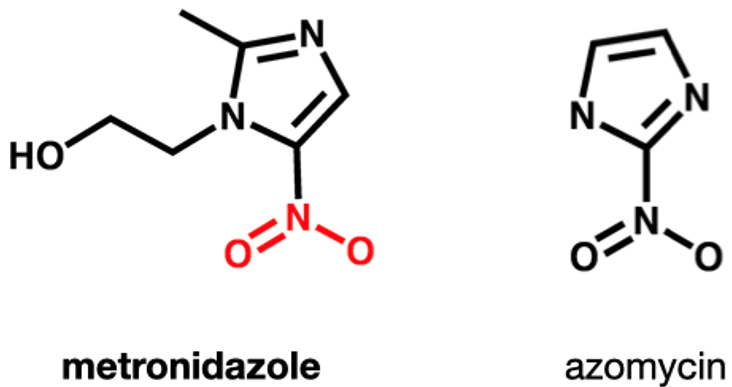
Figure 1: Structure of metronidazole. Left, the structure of metronidazole, patented in 1960; in red, the nitro group that undergoes the reduction that turns it into the active product. Right, azomycin, first reported in 1953, a natural product of soil bacteria of the genus Streptomyces, and also synthesized by the saprobe Pseudomonas.
FIGURE 2
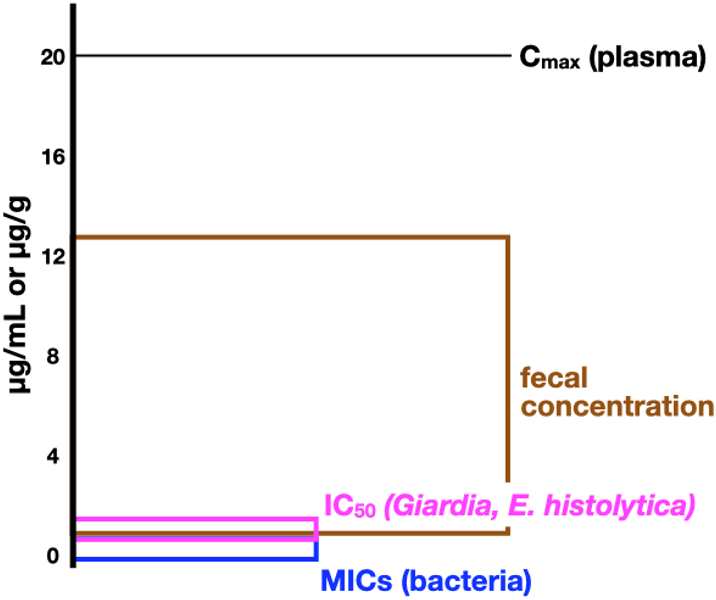
Figure 2: Plasma and fecal concentrations of metronidazole, and inhibitory concentrations against susceptible microorganisms. The relationship between the maximum plasma concentration (Cmax) after an oral dose of 100 mg is illustrated; the range of fecal concentrations (after three days of oral treatment with 400 mg/day, in patients with diarrhea); and the minimum inhibitory concentrations (MIC) for anaerobic bacteria (0.13-1.0 μg/mL) and the concentrations that inhibit 50% viability (IC50) for protozoa (0.78-1.56 μg/mL for Giardia, 1.1 μg/mL for E. histolytica).
FIGURE 3
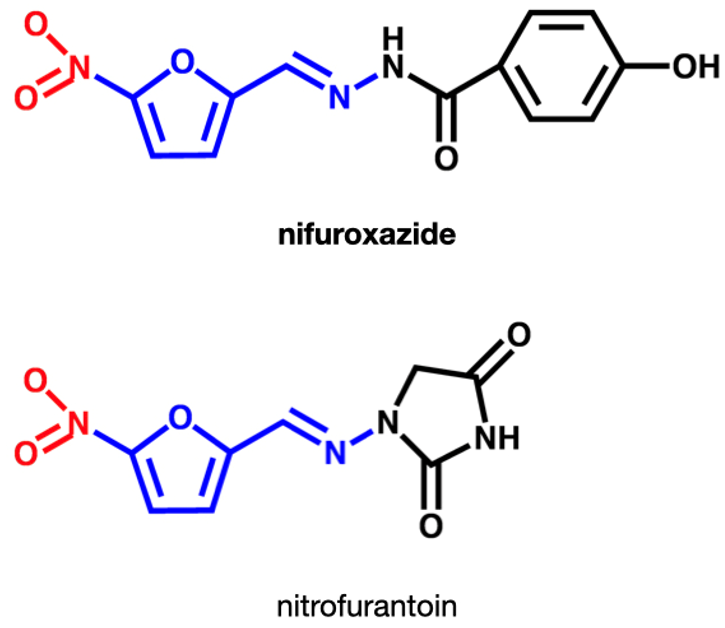
Figure 3: Structure of nifuroxazide. Two nitrofurans are illustrated, with the common pharmacophore in blue: above, nifuroxazide, patented in 1963; below, the best-known representative of the group, nitrofurantoin, patented in 1952. In red, the nitro group that is reduced by the action of reductases, converting them into reactive intermediates with antibacterial activity.
FIGURE 4
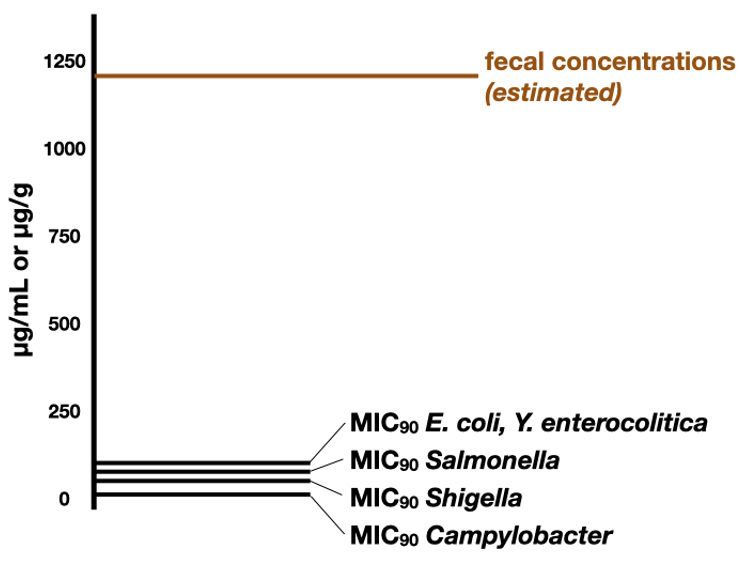
Figure 4: Fecal concentration of nifuroxazide, and inhibitory concentrations for susceptible microorganisms. The relationship between fecal concentrations (estimated from the fraction of the dose retained in the intestine of animals, the typical human dose, and the average weight of human feces) and the MICs for 90% (MIC90) of clinical isolates of various enteropathogenic bacteria is illustrated.
Figures at a glance