
Effect of Microbial Consortia and Fertilizers on Nutrient Dynamics of Soil under Soybean-Chickpea Cropping Sequence
Received Date: April 08, 2024 Accepted Date: May 08, 2024Published Date: May 11, 2024
doi:10.17303/jacs.2024.3.103
Citation: Syed Javed, Syed Ismail, Waiker SL, More SS (2024) Effect of Microbial Consortia and Fertilizers on Nutrient Dynamics of Soil under Soybean-Chickpea Cropping Sequence. J Adv Agron Crop Sci 3: 1-11
Abstract
The present investigation on Effect of microbial consortia and fertilizers on nutrient dynamics of soil under soybean-chickpea cropping sequencewas conducted during kharif and rabi seasons of 2020-21 and 2021-22 at research farmon Vertisol at the Research Farm, College of Agriculture, Vasant Rao Naik Marathwada Agriculture University Parbhani. Experimental treatments consist of four levels of laboratory evaluated microbial cultures (Rhizobium, Bacillus megaterium, Pseudomonas striata, Thiobacillus thioxidant) and uninoculated control and four levels of chemical fertilizers (100 % RDF, 75 % RDF, 50% RDF and Control i.e. (without fertilizers)). Seed treatment of soybean and chickpea was done with microbial consortia immediate before sowing and chemical fertilizers were applied at the time of sowing as per treatments.The interaction between microbial consortia inoculation and chemical fertilizers on soil chemical properties like soil pH, electrical conductivity, calcium carbonate, organic carbon content after harvest of both soybean and chickpea crops were found non-significant except organic carbon during 2021-22. After harvest of soybean and chickpea crops the soil available N, P and K and DTPA extractable Zn, Fe, Cu and Mn were significantly highest in treatment Rhizobium + Pseudomonas striata along with 100 % RDF. Similarly, chemical fertilizers also increased the soil availability of the macro nutrients i.e. N, P, K and also micronutrients i.e. DTPA extractable Zn, Fe, Cu and Mn when applied with 100 % RDF.
Keywords: Microbial consortia; Soybean; Chickpea; pH; EC; Nitrogen; Organic Carbon
Introduction
Soybean (Glycine max (L.) Merrill.) is an annual leguminous species cultivated mainly for its seed. It is used in a variety of industries, providing several products for human consumption, livestock feed and industrial purposes. Soybean seed consists of 35% carbohydrate, 5% ash, 40% protein and 20% oil; and is a major source of protein and oil for commercial products. It is also used to produce a high protein animal feed. About 40% of the world's edible vegetable oil comes from soybeans [1]. the soy proteins have the highest nutritional value of all the plant proteins for human food, being particularly high in lysine. Soybean thus is an essential commercial crop and is in the second largest position among cash crop in United States (Soybean Research Advisory Institute, 1984) with the majority of cultivation located in the Midwestern and southern United States [2]. Soybean ranks first among the major oilseed crops of the world and has now found a prominent place in India [3,4] reported that soybean has occupied first rank among oil seeds in India 2005 onwards. As per [5], the world market for food-grade soybeans was estimated as one million metric tons and continued to grow with the constant innovation of new commercial soy foods. Soybean originated from northeastern China about 4,000 years ago and is now grown worldwide.
Soybean is grown mainly in tropical, sub-tropical and temperate regions [6]. It is a water intensive crop, requiring substantial water to grow and produce [7]. Consequently, rising global temperatures and changing precipitation patterns pose a significant threat to soybean production, especiallyin under irrigated or rainfed areas [8]. It is known that under dry conditions or drought, soybean yield can reduce by more than 50 % causing substantial losses to farmers and growers [9]. Hence, drought is a significant climate risk that calls for effective mitigation strategies to sustain the supply to soybean worldwide. Recently [10] reported that long term drought stress in reproductive stages decreases biomass allocation to reproductive organs, thereby reducing seed weight. Symbiotic Rhizobium species associated with soybean root nodules benefit plant growth via mediating biological N fixation [11].
Further, Chickpea (Ciceri arietinum L.) is the second most important pulse crop globally, after common bean (Phaseolus vulgaris). It delivers benefits to farming systems that range from a smaller carbon footprint due to biological nitrogen fixation to improved soil health. Chickpea is a quality food source rich in proteins, minerals, vitamins and fibers that benefit the health of domestic stock and humans [12]. They can be an affordable source of staple grain for millions of the worlds poorest and are nutritious stock feed [13]. Chickpea is prominently grown under rainfed conditions on store soil water in arid and semiarid regions, and is an integral component of cereal-legume cropping systems in many countries. the global area of chickpea averages 13.0 million tonnes across 56 countries (2015-17) [14]. India is the largest global producer, consumer and importer of chickpea whereas Australia is the main exporter of desi-- type (outlined later) chickpea to India. India mostly imports desi chickpea but also emerges as an exporter to some Kabuli type over the past decade [15,16].
Biofertilizer usually applied in the form of consortium can play a role to enhance plant growth. this promotes the recovery of functional, beneficial microbial groups that are positively linked to soil fertility and replenishes the natural micro biome, which has been reduced by crop and stimulate plant growth promoting mechanism in both optimal conditions and under different types of biotic and abiotic stress [17]. Further, more consistent positive results may be obtained by inoculating plants with microbial with microbial consortia containing two or more beneficial microorganisms [15,18]. Bioinoculants based on microbial consortia may include bacteria of different species, while others may include both beneficial bacteria and fungi.
Materials and Methods
Field experiments on soybean and chickpea sequence were conducted at same site in two successive years during kharif-rabi 2020-21 and kharif-rabi 2021-22 at Research Farm of Department of Soil Science and Agril. Chemistry, Vasant Rao Naik Marathwada Agriculture University Parbhani (M.S.), India on Vertisol to Find Effect of microbial consortia and fertilizers on nutrient dynamics of soil under soybean-chickpea cropping sequence. Two factors were used in the experiment, viz. Factor A (Soybean): microbial Consortia inoculation (s) (S1 = Uninoculated control), S2 = Brady Rhizobium + Bacillus megaterium inoculation (Consortia I), S3 = Brady Rhizobium + Pseudomona Striata inoculation (Consortia II), S4 = Brady Rhizobium+Thiobacillus thiooxidant inoculation (Consortia III)) and Factor B(Soybean): Chemical fertilizers (T) (T1 – Control ( Without fertilizers )), T2 = 50% RDF, T3 = 75% RDF and.T4 = 100% RDF and viz. Factor A (Chickpea): microbial Consortia inoculation (s) (S1 = Uninoculated control), S2 = Mesorhizobium ciceri + Bacillus megaterium inoculation (Consortia I), S3 = Mesorhizobium ciceri + Psudomona striata inoculation (Consortia II), S4 = Mesorhizobium ciceri + Thiobacillus thiooxidant inoculation (Consortia III)) and Factor B(Chickpea): Chemical fertilizers (T) (T1 – Control ( Without fertilizers )), T2 = 50% RDF, T3 = 75% RDF and.T4 = 100% RDF. The experiment was laid out in a Randomized Block Design (RBD) with two factors and three replications. There were 16 treatment combinations and 3 replications with a total 48 unit plots. The unit plot size was 25.2 m 2 (4.50 m x 5.6 m). Spacing Row to row 45 cm and Plant to plant 7.5 cm for Soybean and 10 cm for Chickpea.The certi- fied seed of soybean (Cv. MAUS-162) and chickpea (Cv. Phule Vikram) was obtained from the Seed Cell, Vasantrao Naik Marathwada Krishi Vidyapeeth, Parbhani (M.S.) and used for sowing field experiments.
Seeds were sown at the rate of 75 kg ha-1 for Soybean and 50 kg ha-1 for Chickpea.The fertilizers were applied N: P2O5: K2O:S 30:60:30 kg ha-1 for Soybean and N: P2O5: K2O:S 25:50:0 kg ha-1 for Chickpea. Urea, single super phosphate and muriate of potash were used as fertilizer sources for field. The treatment wise quantity of chemical fertilizers was applied in each plot and covered with soil. Treatment wise dose of N, P2O5 and K2O was applied at the time of sowing to soybean. Treatmentwise dose of N, P2O5 and K2O was applied at the time of sowing to chickpea. The Rhizophos (Consortia of Rhizobium and Phosphate solubilizing bacteria) and microbial Consortia inoculation Rhizobium + Bacillus megaterium inoculation (Consortia I), Rhizobium + Pseudomona Striata inoculation (Consortia II) and Rhizobium + Thiobacillus thiooxidant inoculation (Consortia III) for soybean and chickpea was obtained from ICAR - All India Network Project on Soil Biodiversity – Biofertilizers and used for seed treatment @ 5 ml per kg of soybean seed and chickpea seed. Seed treatment was done before sowing. Seeds were dried in shed and used for sowing.
Results and Discussion
Soil pHThe effect of microbial consortia inoculation and chemical fertilizers on soil pH was found non-significant after harvest of soybean and chickpea crops. It was observed that there was slight decrease in soil pH after harvest of soybean and chickpea as compared to initial soil pH. The highest soil pH (8.02, 8.01 and 8.01, 8.01) was observed in uninocualted control and lowest in treatment Rhizobium + Pseudomona strita (S3) (7.83, 7.87 and 7.85 and 7.81, 7.82 and 7.81) during both experimental years.
Electrical Conductivity (dSm-1)Electrical conductivity (EC) was not found to be in- fluenced significantly due to effect of microbial consortia inoculation and chemical fertilizers treatments after harvest of soybean and chickpea crop (Table 4.45). It was observed that there was slight decrease in EC of soil over the initial value in all treatments during both the years. Interaction effect of microbial consortia inoculation and chemical fertilizers was not reached to the level of significance in influencing EC of soil. These results confirms the findings of [19-23].
Calcium Carbonate (per cent)Soil calcium carbonate content at harvest of soybean and chickpea. There was decrease in calcium carbonate content in all the treatments over the initial values during both the years of experiment and pooled mean after harvest of soybean and chickpea crop, respectively. However, the result of calcium carbonate of soil were found non-significant with effect of microbial consortia inoculation and chemical fertilizers treatments and pooled mean during both the years. The maximum decrease in calcium carbonate content was seen in Rhizobium + Pseudomona strita (4.97, 5.37 and 5.17 per cent and 5.38, 5.48 and 5.43 per cent) during both the years of experimentation and pooled mean, respectively. Similarly, the chemical fertilizers application treatment slightly decreased the percentage of calcium carbonate in 100 % RDF (5.40, 5.90 and 5.65 per cent and 5.67, 5.74 and 5.71 per cent) during 2020-21, 2021-22 and pooled mean, respectively. Application of microbial inoculation i.e. Rhizobium + Pseudomonas, Bacillus megaterium and Thobacillus thiooxidant maximise CO2 and organic acid and helps to dissolve some quantity of free calcium carbonate. Almost similar results were reported by [19,24].
Organic Carbon (g kg-1)The organic carbon markedly increased with effect of microbial consortia inoculation and chemical fertilizers. Further, significance gain in organic carbon was noted in with treatment (S3) Bradyrhizobium + Pseudomonas striata (6.19, 7.28 and 7.74 g kg-1 ) followed by Rhizobium + Bacillus megaterium (S2) (5.92, 6.50 and 6.21 g kg-1 ) and minimum values were noted in uninoculated control i.e. 5.20, 5.15 and 5.18 g kg-1 during both the experimentation years. Interaction effect of microbial consortia inoculation and chemical fertilizers on soil organic carbon after harvest of soybean and chickpea crop was found statistically significant and improved. The treatment Bradyrhizobium + Pseudomonas striata along with 100 % and 75 % RDF both treatments are equally good in increasing soil organic carbon (7.50 g kg-1 ).These findings are supported by [25] and are in similar line with [26], they proved the result that organic carbon at different stages was superior in RDF over treatment (50% N, P + Bioinoculants) and were maximum as comapred to other treatments. Application of bioinoculant consortium i.e. microbial consortia inoculation to seeds which is multiplied in soil and increased the activity of microbes in rhizosphere due to this better root penetration and improve soil organic carbon.
Available NitrogenThe microbial consortia inoculation and chemical fertilizers application improved the available nitrogen in soil after harvest of soybean and Chickpea. Maximum increase in nitrogen was from Bradyrhizobium + Pseudomonas striata (212.36, 244.34 and 228.35 k g kg -1 ) which was significantly superior over treatment Bradyrhizobium + Bacillus megaterium. Similarly, highest available nitrogen was noted in plot under 100 % RDF (180.06, 201.68 and 190.87 g kg -1 ) during both the years. The next best treatment after 100 % RDF and at par is treatment (T3) 75 % RDF (175.19,197.46 and 186.33 g kg -1 ) and lowest values of available nitrogen in soil were noticed in control i.e. without fertilizer treatment (172.00, 182.81 and 177.41 g kg -1 ) after harvest of soybean crop, respectively. Interaction effect between microbial consortia inoculation and chemical fertilizers on available soil nitrogen is presented in Table 3 and 4. Significant increment in available nitrogen was observed in treatment Bradyrhizobium + Pseudomonas striata and 100 % RDF fertilizer (215.98 and 256.83 Kg ha -1 ) during both the experimentation years. [29] reported that microbial consortium of actinobacteria, Rhizobium and PGPR inocualted in soybean plant showed higher N, P and K 92.39, 16.6 and 302 kg ha-1
Available PhosphorusThe higher and significant gain of phosphorus was observed in the treatment (S3) Bradyrhizobium + Pseudomonas striata (17.56, 22.72 and 20.14 kg ha -1 ) which was found at par with treatment Bradyrhizobium + Bacillus megaterium (16.74, 20.17 and 18.33 kg ha -1 ) in both the years of experimentation and pooled data. Similarly, chemical fertilizers also enhanced the soil available phosphorus significantly superior in the treatment (T4) 100 % RDF (16.93, 20.79 and 18.86 kg ha -1 ) followed by treatment (T3) 75 % RDF (16.69, 20.43 and 18.56 kg ha -1 ). However, significantly lowest values of soil available phosphorus were observed in treatment (T1) control i.e. without fertilizers. The interaction effect of microbial inoculants and chemical fertilizers on soil available phosphorus indicates that the treatment Bradyrhizobium + Pseudomonas striata along with 75 % RDF (17.74 kg ha -1 ) followed by Bradyrhizobium + Pseudomonas striata and 100 % RDF (17.65 kg ha -1 ) are having highest values and lowest in uninoculated control with treatment S1 (uninoculated control) during the experiment years. Soil microorganism play a key role in processing and transforming these organic forms of phosphorus into plant available forms. Hence, the Rhizobium and Pseudomonas spp. playing important role in available phosphorus to plant. These findings corroborates with reports of [27].
Available PotassiumMicrobial inoculation significantly increased available potassium in soil after harvest of soybean as compared to uninocualted control. The treatment of Bradyrhizobium + Pseudomonas striata showed highest values of available potassium (660.92, 692.83 and 676.87 kg ha -1 ) and was found statistically at par with Bradyrhizobium + Bacillus megaterium (589.42, 647.69 and 618.55 kg ha -1 ) during two years of experimentation as well as in pooled mean. Similarly, available soil potassium was found increased significantly with 100% RDF (611.75, 649.58 and 630.66 kg ha-1). interaction between microbial inoculants along with chemical fertilizers, statistically significant and better available potassium was noted in treatment Bradyrhizobium + Pseudomonas striata + 75 % RDF which was superior over other treatments (706.70 kg ha -1 ) followed by Bradyrhizobium + Pseudomonas striata with 100 % RDF (698.70 kg ha -1 ) during the year 2021-22. Soil available potassium after harvest of chickpea crop. The available soil potassium was noted significantly highest in treatment Mesorhizobium + Pseudomonas striata (659.98, 660.15 and 660.07 kg ha-1) which was found statistically at par with Mesorhizobium + Bacillus megaterium (641.12, 645.18 and 643.15 kg ha -1 ) during both the experimentation years and pooled data. Similarly, in case of chemical fertilizer dose also influenced potassium availability in soil and significantly higher values were observed in 100 % RDF applied plots (645.81, 638.82 and 642.32 kg ha -1 ) and lowest were in treatment (T1) control i.e. without fertilizer. [28] also found the significant increase in nutrient availability in soil due to the application of microbial inoculants in soybean. The treatment RDF + Rhizobium + Trichoderma viride showed highest availability of NP and K2O in soil compared to control.
Conclusion
From the above findings, it may be concluded that treatment Bradyrhizobium + Pseudomonas striata and 100 % RDF fertilizer performed the best results and Nitrogen, phosphorus, potassium and organic carbon increase with using treatmentBradyrhizobium + Pseudomonas striata (consortia I)and should be recommended.
- Hilderbrand DF, Phillips GC, Collins GB (1986) Soybean (Glycinemax (L.) Merr.). In : Bajaj, Y.P.S. (es.) Crops I. Biotechnology in Agriculture and Forestry, 2.
- Moore J, Collins G (1989) Somatic embryogenesis in soybean (Glycine max Merill L.) via somatic embryo cycling. Published July 1992. In vitro Cell Dev. Biology Plant, 28:153-60.
- Mahana SK, Meghavansi MK, Prasad Kamal (2005) Identification of pH tolerant Bradyrhizobium japonicum strains and their symbiotic effectiveness in soybean (Glycine max (L.) Merr.) in low nutrient soil. African Journal of Biotechnology, 4: 1-107.
- Mahana SK, Meghavansi MK, Prasad Kamal (2005) Identification of pH tolerant Bradyrhizobium japonicum strains and their symbiotic effectiveness in soybean (Glycine max (L.) Merr.) in low nutrient soil. African Journal of Biotechnology, 4: 1-107.
- Liu ZB, Hagen C, Cuilfoyle TJ (1997) A G-box binding protein from soybean binds to the El auxin response element in the soybean C.H. promoter and contains a proline-rich repression domain. Plant Physiology, 11: 397-407.
- FAO (2021) Land & Water [Online]. Available at: http://www.fao.org/landwater/databases-and-software/crop-information/soybean/en/
- Bhardwaj SF (1986) Consumptive use and water requirement of soybeans. Journal of Irrigation Drainage Engineering, 112: 157-63.
- Jin Z, Zhuang Q, Wang J, Archontoulis SV, Zobel Z, Kotamarthi VR (2017) The combined and separate impacts of climate extremes on the current and future US rainfedmaize and soybean productionunder elevated CO2. Global Change in Biology, 23: 2687-704
- Wei Y, Jin J, Jiang S, Ning S, Liu L (2018) Quantitative response of soybean development and yield to drought stress during different growth stages in the Huaibei plain, China. Agronomy 8: 97.
- Du Y, Zhao Q, Chen L, Yao X, Xie F (2020) Effect of drought stress at reproductive stages on growth and nitrogen metabolism in soybean. Agronomy, 10: 302.
- Jaiswal SK, Mohammed M, Ibny FYI, Dakora FD (2021) Rhizobia as a source of plant growth-promoting molecules: potential applications and possible operational mechanisms. Front Sustainable.Food System, 4: 311.
- Bohra A, Pandey MK, Jha UC, Singh B, Singh IP, et al. (2014) Genomics assisted breeding in four major pulse crops of developing countries: present status and prospects. Theoretical and Applied Genetics, 127: 1263-91.
- Bahera JM (2015) Future challenges and perspectives for applying microbial biotechnology in sustainable agriculture based on a better understanding of plant microbiome interactions. Journal of Soil Sciences and Plant Nutrients, 15: 261-82.
- FAOSTAT (2020) Crops and livestock products [Online]. Available at: http://www.fao.org/faostat/en/#data/QCL
- Sharma Subhas, Sharma Ravinder, Janwal Smriti (2020) Chickpea economy in India.
- Ahlawat IPS, Sharma Puroshottam, Singh Ummed (2016) Production, demand and import of pulses in India. Indian Journal of Agronomy, 61: 33-41.
- Woo Sheridan L, Pepe Olimpia (2018) Microbial consortia: Promising probiotics as plant bioinoculants for sustainable agriculture. Frontiersin Plant Science, 9: 1801.
- Zhang S, Merino N, Okamoto A, Gedalanga P (2018) Interkingdom microbial consortia mechanisms to guide biotechnological applications. Microbiology Biotechnology, 11: 833-47.
- Garge VK, totawat KL (2005) Heavy metal accumulation, movement and distribution in the soil profiles near zinc smelter effluent stream. Journal of Indian Society of Soil Science, 53: 141-4.
- Sharma KL, Subbaiah D, Solaiappan Jawahar U, Subramanian V, Mishra Pk, et al. (2009) Soil quality assessment under long term soil and nutrient management practices in Vertisols of Kovilpatti. Indian Journal of Dryland Agricultural Research and Development, 24: 8-19.
- Akbari P, Ghalavand A, Modarres Sanavy AM, Agha Alikhani (2011) the effect of biofertilizers nitrogen fertilizer and farm yard manure on grain yield and seed quality of sunflower (Helianthus annuus L.). Journal of Agricultural Technology, 7: 173-84
- Arbad BK, Syed Ismail, Shinde DN, Pareshi RG (2011) Effect of integrated nutrient management practices on soil properties and yield in sweet sorghum (Sorghum bicolor (L.) Moench) in Vertisol. An Asian Journal of Soil Science, 3: 329-32.
- Katkar RN, VK Kharche, BA Sonune, RH Wanjari, Singh M (2011) Long-term effect of nutrient management on soil quality and sustainable productivity under sorghum wheat crop sequence in Vertisol of Akola, Maharashtra. Agropedology, 22: 103-14.
- Bellaki Ma, Badanur VP (1997) Long term effect of integrated nutrient management on properties of Vertisol under dryland agriculture. Journal of Indian Society of Soil Science, 45: 438-42.
- Srikanth K, Srinivasamurthy CA, Siddaramappa R, Ramakrishnaparma (2000) Direct and residual effect of enriched composts, FYM, vermicompost and fertilizers on properties of an Alfisol. Journal of Indian Society Soil Science, 48: 496-9.
- Saini Lakhan Bharti, George PJ, Singh Swai Bhadana (2017) Effect of nitrogen management and biofertilizers on growth and yield of rapeseed (Brassica Campestris var.toria). Internanal Journal CurrentMicrobiology and Applied Science 6: 2652-8.
- Khan M, Zaidi SA, Wani (2007) Role of phosphate solubilizing microorganisms in sustainable agriculture – a review. AgronomySustain Development 27: 29-4.
- Kranti Kumar B, Syed Imail, K Manasa, Anuradha Powar (2017) Enhancement of nutrient availability in soil using microbial cultures in soyban grown on vertisol. International Journal Current Microbiologyand Applied Science, 6: 2802-7.
- Amule FC, Sirothiya P, Rawat AK, Mishra US (2018a) Effect of actinobacterial Rhizobium and plant growth promoting rhizobacteria consortium inoculation on rhizosphere soil proeperties in soybean in Jabalpur district of Madhya Pradesh. International Journal of Chemistry Sciences, 6: 583-6.
FIGURE 1
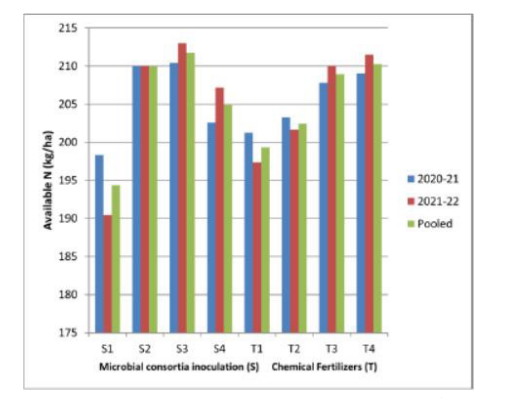
Figure 1: Effect of microbial consortia inoculation and chemical fertilizers on soil available nitrogen (kg ha-1) in Soybean and Chickpea
Tables at a glance
Figures at a glance