
Carbon Emissions Reductions from Changes to Reduced Tillage and Cover Crops: A Review of Experimental Results
Received Date: September 04, 2024 Accepted Date: October 04, 2024 Published Date: October 07, 2024
doi:10.17303/jacs.2024.3.304
Citation: Andrew M. Havens, Dr. Richard K. Perrin, Dr. Lilyan E. Fulginiti (2024) Carbon Emissions Reductions from Changes to Reduced Tillage and Cover Crops: A Review of Experimental Results. J Adv Agron Crop Sci 3: 1-6
Abstract
In the era of worsening climate change, reduction of carbon dioxide emissions produces a social good that provides universal benefits. In agriculture, switching from traditional tilling methods to no-till or planting a cover crop are both generally known to decrease carbon emissions, but the scientific literature on the amount of that reduction is varied and scattered. This information is vital for emissions reduction schemes in which agricultural producers are paid to employ one of these agronomic practices. We perform an extended literature review of field experiments that quantify the reduction in carbon emissions over a period of years, either by planting cover crops or by switching from standard tillage to no-till. This change in carbon emissions could be due to either increased carbon sequestration in the soil or to explicit reduction in carbon emissions. We report the findings as both average emission results and as inverse cumulative distribution functions of those outcomes. We also use the social cost of carbon, as determined by the United States Environmental Protection Agency, to evaluate the expected social benefits of these reductions in carbon emissions. Of the 77 experiments examining no-till we found that 90% reported reductions in emissions, and 86% produced sufficient social benefits to outweigh the entire average private cost of implementing the change. For the 189 experiments examining cover crops, 90% reported reductions in emissions, and 64.0% reported reductions sufficient to outweigh the average private cost of implementation.
Keywords: Carbon Emissions; Agronomic Practices; Reduced Tillage; Cover Crops
Introduction
A number of voluntary carbon market platforms (VCMPs) currently offer contracts to farmers to change their agronomic practices in exchange for payments warranted by reductions in greenhouse gases (GHG), measured by carbon dioxide equivalents. But the net reductions in carbon emissions due to a change in farming practice varies across fields and years, and that change cannot be directly measured in the field of a farmer-contractor. Therefore, VCMPs use proprietary models to estimate the change in carbon emissions due to a particular change in practice on a particular field of a prospective farmer contractor.
Actual changes in carbon emissions can be estimated, however, under experimental settings where net carbon emissions can be closely measured and compared under controlled conditions. The present paper examines the results from 266 published long-term experiments to identify the distribution of changes in carbon emission outcomes from adding cover crops and from making a change from conventional to reduced tillage.
It is important to note that for these experiments we report the average annual net change in carbon emissions rather than the change in the amount of carbon sequestered in the soil (soil organic carbon). The reports for each experiment do generally include the initial and subsequent levels of soil carbon for both the current practice and the improved practice. However, the numbers reported in this study reflect the reduction in carbon emissions under the improved practice compared to the current practice rather than the change in soil carbon sequestration which plays a role in emissions reductions.
The aim of this work is to synthesize and quantify the existing body of academic work measuring changes in soil carbon emissions from a change in agricultural practice. The results of the study were then used to illustrate how the social cost of carbon can be used to estimate social benefits from the change in practice, apart from any private benefits realized by the farmer.
Methods
In this study we searched for reports of field experiments of at least 6 years’ duration that estimated the change in carbon emissions by (1) switching from standard tillage to no-till, or by (2) adding cover crops between harvest and the next planting. The search for articles followed the meta-analysis guidelines established by Hansen, et al, 2021 [1].
We found reports for 77 long-term no-till experiments and 189 long-term cover crop experiments [2,3]. We recorded the cumulative change in carbon emissions for each treatment, divided that by the number of years of the experiment, and subtracted the result of the conventional practice from that of the improved practice to obtain the annual emissions change due to the improved practice, which we call “emissions reduction”.
To provide a rough estimate of the social benefit of the reduction in carbon emissions, we used the most recent government estimates of the social cost of carbon. We then compared these estimates of social benefit with approximate costs of implementing the new management practices.
Results
Figure 1 displays the frequency distribution of emissions reductions due to switching from standard tillage to no-till [4]. As noted in the figure, the average emissions reduction was 0.77 metric tons of CO2 equivalents per acre per year, with 37.7% recording higher amounts than this average and 62.3% recording less. Some 10.4 % (100-89.6) of the trials reported a negative emissions reduction. At the higher end of outcomes, 28% reported emissions reductions of more than 1.0 mt/acre/year, and 6.5% reported increases of more than 2.0 mt/ac/yr.
Figure 2 presents the similarly-plotted distribution of results from adding cover crops. The average reduction in emissions was 0.76 mt/acre/yr., with 10.1% reporting an increase in carbon emissions, 28% reporting emissions reductions of more than 1.0 mt/acre/year and 8% reporting reductions of more than 2.0 mt/acre/year. The distribution of experimental outcomes from adding cover crops is remarkably similar to that from reduced tillage, as can be seen by comparing Figures 1 and 2.
Clearly these changes in farm practices have merit for reductions in agricultural carbon emissions. Given that decreased carbon emissions are a public good to the extent that they reduce the effects of climate change, and given that all persons in the world benefit from reduced climate change, it is of interest to calculate the net social benefits due to these changes in agronomic practices.
The social benefits of reducing carbon by one ton of CO2e we can define as being equal to the social cost of carbon (SCC), given that reducing emissions by one ton should result in a reduction of social cost by that amount. The SCC is the monetary value of the net harm to society from emitting a metric ton of that GHG into the atmosphere in a given year [4]. The SCC is a topic that has been widely researched, although certainly not widely agreed upon. In December 2023 the U.S. Environmental Protection Agency [5,6] released updated estimates of the social cost of carbon emitted in 2020, at $190 per metric ton of CO21.
There are also, no doubt, private benefits for the adopters of these practices that decrease carbon emissions, such as improved yields over time, but here we ignore those benefits to focus on the social benefits as a lower bound on the total benefits, which we then compare with costs of implementing the improved practices.
The costs of adding cover crops or of implementing a switch to reduced tillage will not be equal for all farmers, because of differences in equipment owned or purchased, scale of operations, farm topography, etc., and also because of differences in the exact nature of the change in practice, such as the species of cover crop selected and whether it has harvestable production, whether the conventional tillage used plows or field cultivators, whether the new tillage technique was actually light tillage versus no tillage, etc. To obtain approximate annualized costs to compare with the benefits of emissions reductions, we examined budget estimates of the cost of change from several universities [7,8]. The averages of these cost estimates were $16.67 per acre for converting to no-till and $44.84 per acre for adding cover crops.
We have noted above that the distribution of emissions reductions for the two practices are similar, as revealed by Figures 1 and 2, so in Figure 3 we have constructed the combined average distribution to represent both. Multiplying the emissions reductions on the horizontal axis by the social cost of carbon ($190 per metric ton of CO2e) gives a new axis in terms of the value of the external benefit, while leaving the frequencies unchanged. Here we see that net social benefits exceed the $16.67/acre approximate cost of no-till on 85.7% of experiments, and they exceed the $44.84/acre approximate cost of cover crops on 64.0% of experiments.
Conclusions
We find that the results of 266 reported experiments show that carbon emissions are decreased by an average of about 0.66 tons of CO2 per acre per year, both for the adoption of cover crops and for reduced tillage. Given the social cost of carbon at $190 per metric ton of CO2 and our crude estimates of the cost of cover crops at $44.84/acre/year and the cost of reduced tillage at $16.67/acre/year, we estimate that the external benefits exceeded the private costs of reduced tillage on about 86% of the experiments and exceed the private costs of cover crops on about 64% of the experiments.
We do not have information about how well the proprietary models of the various VCMPs are able to identify at which point along the distributions of experimental outcomes a particular farmer’s field may lie. We do have some confidence that for adoption of reduced tillage, the average emissions reduction is about 0.77 mt/acre/year, with climate benefits alone exceeding private costs on something like 80% of fields. For adoption of cover crops, the average emissions reduction is remarkably similar, at 0.76 mt/acre/year, with climate benefits exceeding private costs on something like 60% of fields. It is important to note that farmers are expected to obtain benefits that accrue to themselves, whereas here we report the net social returns because they are what is important for public policies related to these agronomic practices.
- Hansen C, Steinmetz H, Block J (2021) How to conduct a meta-analysis in eight steps: A practical guide. Management Review Quarterly, 72: 1-19.
- Poeplau C, Don A (2015) Carbon sequestration in agricultural soils via cultivation of cover crops – a meta-analysis. Agriculture, Ecosystems & Environment, 200: 33-41.
- West TO, Post WM (2002) Soil organic carbon sequestration rates by tillage and crop rotation. Soil Science Society of America Journal, 66: 1930-46.
- Havens, Andrew M (2023) Regenerative Farming Practices: How Much Carbon Do They Sequester? U of Nebraska MS thesis.
- U.S. Environmental Protection Agency (EPA), 2023. EPA Report on the Social Cost of Greenhouse Gases: Estimates Incorporating Recent Scientific Advances. EPA-HQ-OAR-2021-0317.
- Interagency Working Group on Social Cost of Greenhouse Gases, United States Government. (2021, February). Technical Support Document: Social Cost of Carbon, Methane, and Nitrous Oxide Interim Estimates under Executive Order, 13990.
- Klein R, McClure G (2021) 2022 Nebraska Crop Budgets. Nebraska Extension.
- Epplin FM, Stock CJ, Kletke DD, Peeper TF (2005) Cost of Conventional Tillage and No-till Continuous Wheat Production for Four Farm Sizes. Journal of American Society of Farm Managers and Rural Appraisers (ASFMRA), 69-76.
FIGURE 1
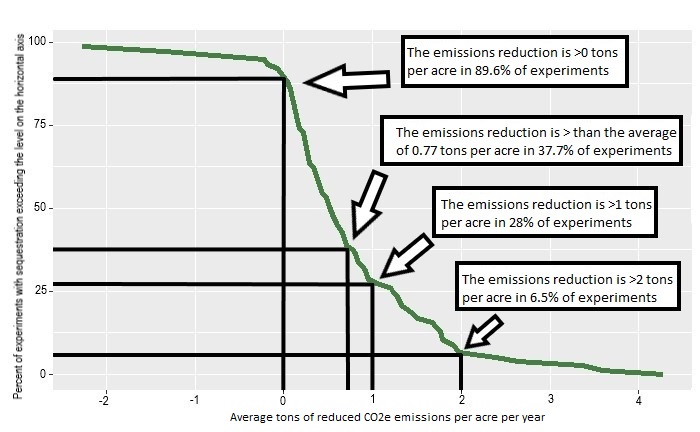
Figure 1: Frequency distribution of annual emissions reductions due to switching from standard tillage to no-till
FIGURE 2
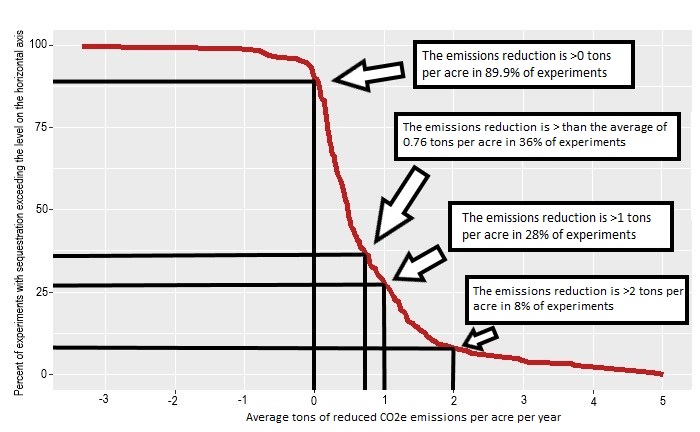
Figure 2: Frequency distribution of annual emissions reductions due to adding cover crops
FIGURE 3
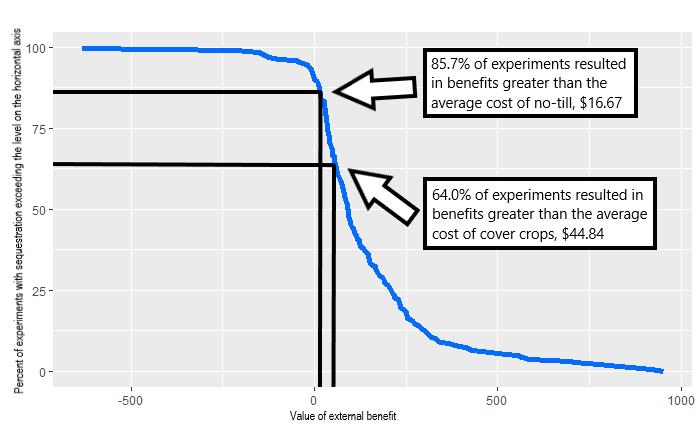
Figure 3: Frequency distribution of average per-acre social benefit from carbon sequestration by reducing tillage or by adopting cover crops
Figures at a glance