
Weed Management Practices as Influenced on Weed Dynamics of Kharif Okra [Abelmoschus esculentus (L.) Moench]
Received Date: April 10, 2025 Accepted Date: May 10, 2025 Published Date: May 13, 2025
doi:10.17303/jacs.2025.4.105
Citation: Sadhana kongala, Venkateswara reddy, Veena joshi, Madhavi molluru, Ram Prakash (2025) Weed Management Practices as Influenced on Weed Dynamics of Kharif Okra [Abelmoschus esculentus (L.) Moench]. J Adv Agron Crop Sci 4: 1-10
Abstract
A field experiment was conducted during 2019-20 at the PG Research Block, College of Horticulture, SKLTSHU, Rajendra nagar, Hyderabad, to identify the most effective weed management practices in okra. The field experiment was conducted using a randomized block design with twelve treatments, each replicated three times. The findings indicated that the application of black polythene sheet mulch resulted in the highest weed control efficiency (WCE), along with the lowest weed density and weed dry matter. This was statistically comparable to mechanical weeding (inter-row) and hand weeding (intra-row) at 30 and 60 days after sowing (DAS) in the weed-free check, as well as the application of pendimethalin at 675 g/ha (pre-emergence) combined with propaquizafop at 62.5 g/ha (post-emergence) followed by intercultivation at 45 DAS. Conversely, the unweeded control plot exhibited the highest weed density, increased weed dry matter, and the lowest weed control efficiency. The black polythene mulch treatment recorded the lowest weed index values, whereas the unweeded control plot had the highest.
Keywords: Okra; Black Polythene Mulch; Oxyfluorfen; Pendimethalin; Propaquizafop; Weed Management
Introduction
Okra (Abelmoschus esculentus (L.) Moench), a member of the Malvaceae family, is commonly known as lady’s finger and has a diploid chromosome number of 2n = 130. Originating from Africa, it is a widely cultivated vegetable in tropical, subtropical, and warm temperate regions across the globe. The fruit is rich in iodine, which aids in controlling goitre, while its leaves are traditionally used to treat inflammation and dysentery. Okra is highly nutritious, providing approximately 1.9 g of protein, 0.2 g of fat, 6.4 g of carbohydrates, 0.7 g of minerals, and 1.2 g of fiber per 100 g of edible portion [1]. Weed management is a critical challenge in okra cultivation, as the crop struggles to compete with weeds due to its slow initial growth and limited canopy coverage. Weeds compete for moisture, nutrients, and environmental resources, ultimately hindering crop development. Additionally, they serve as hosts for pests and disease-causing organisms and can exert allelopathic effects that negatively impact okra growth, resulting in lower yield and quality. Uncontrolled weed competition weakens the crop, making it unhealthy. Research has shown that yield losses in okra due to inadequate weed control range from 40% to 80% [2]. To maximize yield potential, timely and effective weed control measures are essential. Given the labor-intensive and costly nature of manual weeding, integrated weed management strategies should be explored to provide farmers with practical and efficient solutions. Therefore, this study was conducted to identify the most effective weed management practices for okra cultivation.
Materials and Methods
The present study was conducted during the Kharif season of 2019 at the PG Research Block, Department of Vegetable Science, College of Horticulture, Rajendranagar. The experiment was designed using a randomized block design (RBD) with twelve different weed control treatments, each replicated three times. The soil at the experimental site was sandy loam in texture, with 0.57% organic carbon, low levels of available nitrogen (192 kg/ha), phosphorus (5 kg/ha), and potassium (272 kg/ha). It exhibited a slightly acidic reaction (pH 7.51) and normal electrical conductivity (0.22 dS/m).
The twelve weed management treatments included:
- T1: Oxyfluorfen 0.2 kg/ha (pre-emergence) + propaquizafop 62.5 g/ha (post-emergence) + intercultivation at 45 DAS
- T2: Pendimethalin 675 g/ha (pre-emergence) + propaquizafop 62.5 g/ha (post-emergence) + intercultivation at 45 DAS
- T3: Oxadiargyl 90 g/ha (pre-emergence) + propaquizafop 62.5 g/ha (post-emergence) + intercultivation at 45 DAS
- T4: Oxyfluorfen 0.2 kg/ha (pre-emergence) + rice straw mulch at 7–10 DAS
- T5: Pendimethalin 675 g/ha + rice straw mulch at 7–10 DAS
- T6: Oxadiargyl 90 g/ha + rice straw mulch at 7–10 DAS
- T7: Rice straw mulch at 7–10 DAS
- T8: Black polythene mulch
- T9: Stale seedbed + intercropping with green leafy vegetable (palak)
- T10: Mechanical weeding at 15, 30, and 60 DAS
- T11: Mechanical weeding (inter-row) followed by hand weeding (intra-row) (weed-free check)
- T12: Unweeded control
The seeds of okra cv. Arka Anamika were sown at a spacing of 60 × 30 cm. Prior to sowing, the field was enriched with 25 t/ha of farmyard manure (FYM), which was incorporated into the soil during the final ploughing. Ridges and furrows were prepared at 60 cm spacing. The recommended basal dose of 40 kg/ha nitrogen, 60 kg/ha phosphorus, and 60 kg/ha potash was applied in the form of urea, single super phosphate, and muriate of potash, respectively, and thoroughly mixed into the soil. Immediately after fertilizer application, irrigation was provided.
For nutrient management, an additional 40 kg/ha of nitrogen was top-dressed 30 days after sowing (DAS), followed by the remaining 40 kg/ha at 60 DAS. The crop was sown on July 23, 2019, and all standard agronomic practices were followed, except for weed management. Herbicides were applied using a knapsack sprayer fitted with a flat fan nozzle, mixed at a rate of 500 L of water per hectare as per the respective treatments.
Observations were recorded on both weed and crop parameters. Weed density (number per m²), dry weight (g/m²), and weed control efficiency (%) were evaluated. Growth and yield attributes were assessed from five randomly selected plants per plot, while fruit yield was measured from net plots. Weed population and dry weight were recorded at 15, 30, 60, and 90 DAS using a randomly placed 25 × 25 cm quadrant in each plot, with values converted to a per square meter basis. Before statistical analysis, data on weed density and dry weight were transformed using the square root (x+0.5) method.
Calculation of Weed Control Efficiency (WCE)
Weed control efficiency was determined using the formula suggested by [3] and expressed as a percentage:
Where:
WCE (%) = Weed Control Efficiency
DMC = Dry Matter Weight of Weeds in the Control Plot
DMT = Dry Matter Weight of Weeds in the Treated Plot
Calculation of Weed Index (WI)
The weed index (WI), which represents the reduction in yield due to weed interference compared to a weed-free plot, was calculated based on the formula proposed by [16]:
Where:
X = Yield from the Weed-Free Plot
Y = Yield from the Treated Plot
WI (%) = Weed Index
Results and Discussion
Weed Flora
The predominant weeds identified in the experimental plots during the course of investigation were Cyperus rotundus L. which was the only sedge and among the grasses Cynodon dactylon (L.) and Dactyloctenium aegyptium (L.) Beauv. were predominant weeds in all the treatments. Among BLW’s, Parthenium hysterophorus, Digera arvensis Forsk, Euphorbia hirta L. Amarathus viridis L. and Commelina benghalensis L.were the major weeds.
Weed Density
Density of grasses, sedges, BLW’s and total weed density was present edintable among different treatments, application of oxyfluorfen 0.2 kg ha-1(PE) + propaquizafop 62.5 g ha-1(PoE) + intercultivation at 45 DAS gave least weed density at 15 DAS. All the grasses, sedges, BLW’s and total weed density was least with this treatment at 15 DAS. The reason might be that this herbicide kills the weed seedlings through contact action and membrane disruption. Application of oxyfluorfen @ 0.2kg ha-1showed phytotoxicity symptoms upto 30 DAS. Even after 30 days there was about 80% mortality of the crop. The reason for such huge rate of mortality was slightly higher dosage. The other main reason was severe rainfall immediately after herbicide application. The phytotoxicity symptoms observed were yellowing and necrosis. Application of oxyfluorfen at 0.2 kg ha-1resulted in the weed control of more than 90 percent of weeds, but the herbicide inhibited the crop growth. Thus, broad-leaved weeds were effectively controlled with the herbicide. Similar results were observed by [4-6]. Where as at 30 and 60 DAS mechanical weeding (inter row) followed by hand weeding (intra row) at 30 and 60 DAS (weed free check) recorded minimum weed density which was statistically on par with black polythene mulch. While at 90 DAS black polythene sheet mulching significantly reduced the weed population which was significantly on par with mechanical weeding (inter row) followed by hand weeding (intra row) at 30 and 60 DAS (weed free check). Best weed control under plastic mulch might have resulted from better soil coverage which prevented weed growth through prevention of photo induction needed for weed seed germination and actingas a mechanical hindrance. [7] also reported similar results. Unweeded control plot recorded the highest weed density.
Dry Weight of Weeds
Perusal of the data presented in Table 3 and Figure 1 indicate significant difference in dry weight of weeds during crop growth (15, 30, 60 and 90 DAS) due to the influence of different weed control practices. At 15 DAS, the least dry weight of weedswasrecordedinoxyfluorfen0.2kgha-1(PE) +propaquizafop62.5gha-1(PoE) + inter cultivation at 45 DAS further it was on par with mechanical weeding (inter row) followed by hand weeding (intra row) at 30 and 60 DAS (weed free check). At 30 and 60 DAS, the lowest dry weight of weeds recorded in mechanical weeding (inter row), followed by hand weeding (intra row) at 30 and 60 DAS (weed free check) which is statistically on par with black polythene sheet. At 90 DAS, lower dry weight of weeds recorded inblack polythene sheet mulch, which isstatistically on par with mechanical weeding (inter row) followed by hand weeding (intra row) at 30 and 60 DAS (weed free check). In all the stages of crop growth, maximum dry weight of weeds observed in unweeded plots which was statistically significant difference with all other weed management practices. This might be due to higher density of weeds. Similar results were reported by [4,5,7-10].
Weed Control Efficiency (%)
Weed control efficiency was calculated on the basis of dry weight of weeds recorded in different treatments at different stages of crop growth in comparison to unweeded control and thecalculated data is presented in Table3 and Figure 1. Maximum weed control efficiency was noted at the stage of15 DAS with oxyfluorfen 0.2 kg ha-1(PE) + propaquizafop 62.5 g ha-1(PoE) + intercultivation at 45 DASand it was on par with mechanical weeding at 15, 30 and 60 DAS. At 30 and 60 DAS, weed free check recorded the maximum WCE and it was closely followed by black polythene mulch. At 90 DAS, the maximum weed control efficiency was significantly recorded in black polythene mulch and it was closely followed by mechanical weeding (inter row) followed by hand weeding (intra row) at 30 and 60 DAS (weed free check). However, mulching with black polythene sheet gave consistent weed control efficiency till 90 DAS. This might be due to lower dry weight of weeds where the lowest WCE was observed under unweeded control because of increase in density, growth and dry matter of weeds. Similar results were reported by [7,9,10].
Weed Index (%)
Weed index was calculated on the basis of yield in different treatments in comparison to weeded treatment and the data calculated is presented in Table 3 and Figure 2. Regarding weed index minimum value recorded in mechanical weeding (inter row) followed by hand weeding (intra row) at 30 and 60 DAS (weed free check). However maximum weed index recorded in unweeded control plot. The lower dry weight and lesser weed density resulted in better weed index with the treatments of black polythene mulch. This might be due to better control of weeds under black polythene mulch which might had provided comparitively stress free environment to crop. These findings are to be close proximity of that reported by [7,9,10].
Total pod Yield (t ha-1)
Different weed management practices influenced the yield of okra presented in Table 3 and Figure 2. Total Pod yield was highest in black polythene sheet mulch treatment which was on par with mechanical weeding (inter row) followed by hand weeding (intra row) at 30 and 60 DAS (weed free check). The least total pod yieldwas recorded in unweeded control. Higher yield of okra attributed to improved soil nutrients, structure, moisture content and reduced weed pressure and recorded maximum values for plant growth characters. [11] also have reported positiveeffectof black polythene sheet mulchingonyieldof okra. Reducedfruit yield in case of unweeded control might be due to reduced plant growth, reduced fruit size andnumber andduetosevere crop weed competitionfor nutrients,moisture,lightand space during the crop growth period. Similar results were reported by [8,12-15].
Conclusion
The findings of this study indicate that various weed management strategies had a significant impact on weed growth and crop yield. Among the different methods evaluated, black polythene sheet mulching proved to be the most effective in reducing weed density and dry weight, enhancing weed control efficiency, minimizing the weed index, and improving the yield of okra compared to other treatments. The second most effective approach was mechanical weeding between rows, followed by hand weeding within rows at 30 and 60 DAS (weed-free control). This was then followed by the application of pendimethalin at 675 g ha⁻¹ (pre-emergence) combined with propaquizafop at 62.5 g ha⁻¹ (post-emergence) along with inter cultivation at 45 DAS.
Acknowledgments
The authors extend their gratitude to the authorities of the Department of Horticulture, Agronomy, and Soil Science at S.K.L.T.S.H.U and P.J.T.S.A.U, Rajendranagar, Hyderabad, for their support and assistance.
- Gopalan C, Rama Sastri BV, Balassubramanian SC (1989) Nutritive value of Indian foods. National Institute of Nutrition. ICMR, Hyderabad, India.
- Sah D, Heisnam P, Pandey AK (2018) Weed management in okra under foot hill conditions of North Eastern Himalayas. Journal of Crop and Weed. 14: 201-4.
- Patil VC, Patil SV (1993) Studies on weed control in bamboo. Indian Journal of Weed Science. 75: 83-6.
- Sathya PR, Chinnusamy C, Perumal M, Murali AP (2017) Evaluation ofnew formulation of oxyfluorfen (23.5% EC) for weed control efficacy and bulb yield in onion. American Journal of Plant Science, 4: 890-5.
- Mathukia RK, Sagarka BK, Mathukia PR, Gohil BS, Panara DM (2018) Bioefficacy assessment of herbicides mixtures for weed management in kharif okra [Abelmoschus esculentus (L.) Moench]. International Journal of Agricultural Sciences. 10: 5329-31.
- Sankar V, Thangasamy A, Lawande KE (2019) Weed management studies in onion (Allium cepa L.) Cv N 2-4-1 during rabi season. International Journal of Tropical Agriculture. 33: 627-31.
- Shamla K, Sindhu PV, Meera M (2017) Effect of weed management practices on growth and yield of okra [Abelmoschus esculentus (L.) Moench.]. Journal of Tropical Agriculture. 55: 57-62.
- Jalendhar G, Chandra SRK, Srinivas A, Manohar Rao A (2016) Effect of integrated weed management practices on growth, yield and it’s attributes in okra [Abelmoschus esculentus (L.) Moench] Cv. Arka Anamika. International Journal of Science and Nature. 7: 165-7.
- Manju B, Yadav KS, Satish K, Narayan L, Govind S (2017) Effect of integrated weed management inokra. International Journalof Chemical Studies. 5: 1103-6.
- Sujeeta S, Binod G (2018) Effect of mulching practice on crop improvement and soil properties. A review. Basic Research Journal of Agricultural Science and Review. 6: 79-86.
- Mahadeen AY (2014) Effect of polyethylene black plastic mulch on growth andyield of two summer vegetable crops under rainfed conditions under semi-arid region conditions. American Journal of Agricultural Biological Science. 9: 202-7.
- Gordon GG, Foshee WG, Reed ST, Brown JE, Vinson EL (2010) The effects of colored plastic mulches and row covers on the growth and yield of okra. Horticultural Technology. 20: 224-33.
- Bhutia TL, Singh SH, Reddy KCS (2017) Effect of mulching and nitrogen on growth, yield and economics of okra [Abelmoschus esculentus (L.) Moench]. Ecology, Environment & Conservation. 23: 826-32.
- Ritesh KJ, Ram BN, Abishkar K, Shailesh P, Bhishma RD (2018) Effect of different spacing and mulching on growth and yield of okra [Abelmoschus esculentus (L.) Moench] in Chitwan, Nepal. Journal of Agriculture and Natural Resources. 1: 168-78.
- Nagegowda et al. (2019) stated thatin okra themaximumplant height (115.52 cm), number of branches (3.10), stem girth (4.76 cm), leaf area index (2.76), number of dry pods per plant (14.33), weight of dry fruit(10.33g) and seed yield(15.30qha-1) was recorded with T4-150:75:150 N: P2O5: K2O kgha-1 applied through fertigation (WSF) with mulch over unmulched treatment.
- Gill GS, Vijay K (1969) ‘Weed Index’- A new method for reporting weed control trials. Indian Journal of Agronomy. 14: 96-8.
FIGURE 1
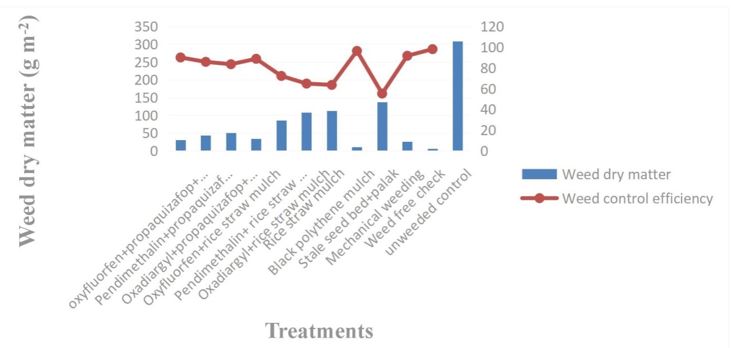
Figure 1: Influence of different weed management practices on weed dry matter (g m-2) and weed control efficiency (%) at 30 DAS
FIGURE 2
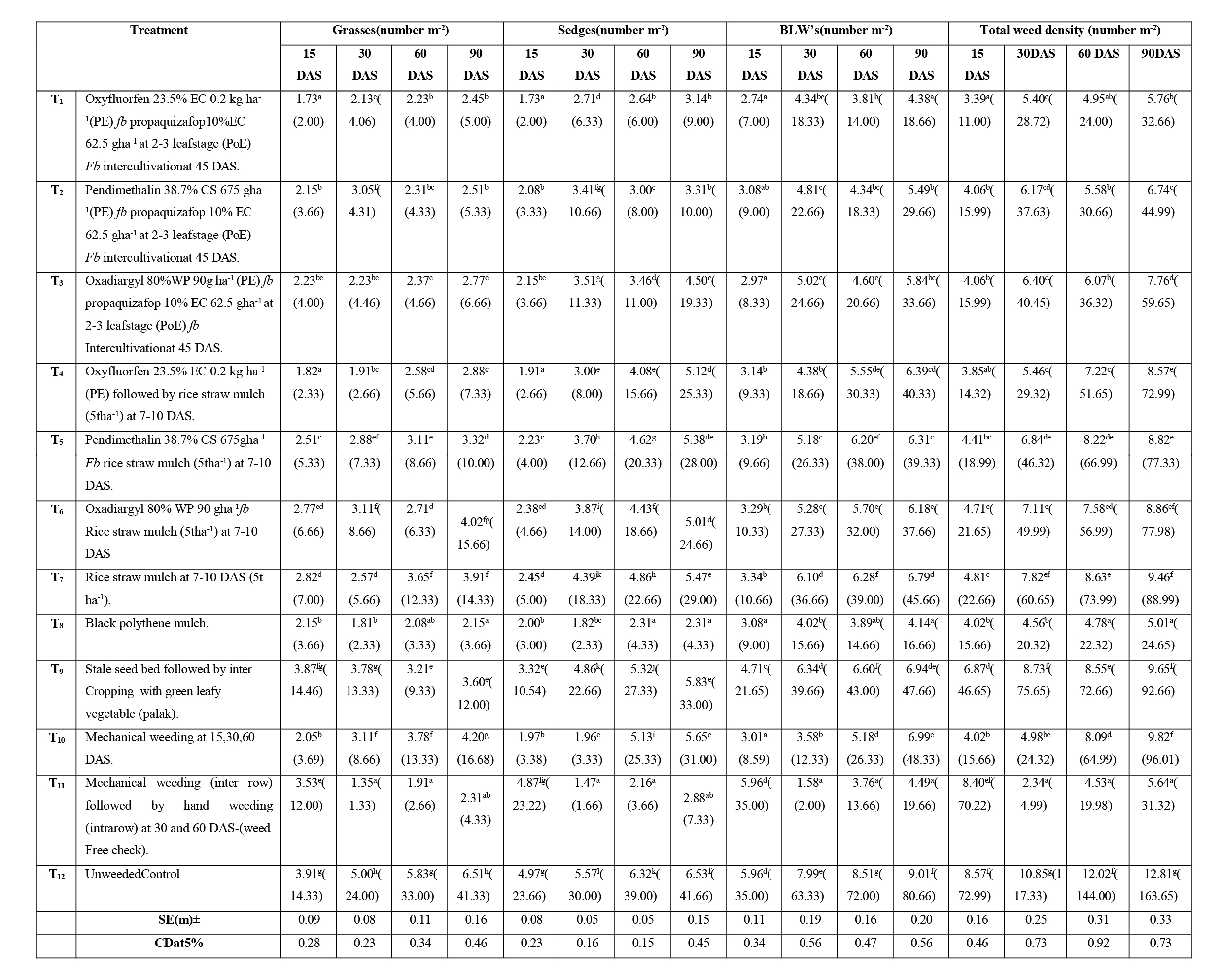
Table 2: Density of grasses, sedges, BLW’s and total weed density (number m-2) as influenced by weed management practices in okra
FIGURE 3
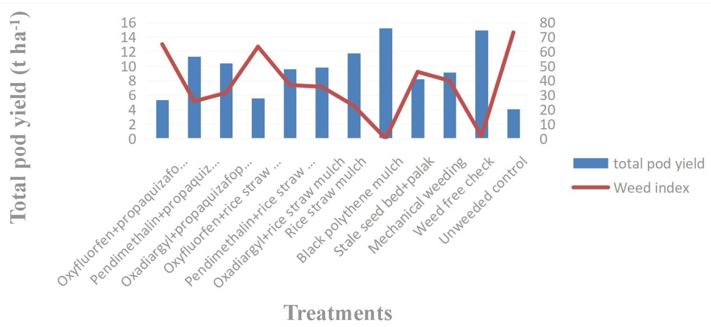
Figure 2: Influence of different weed management practices on total pod yield (t ha-1) and weed index (%)
FIGURE 4
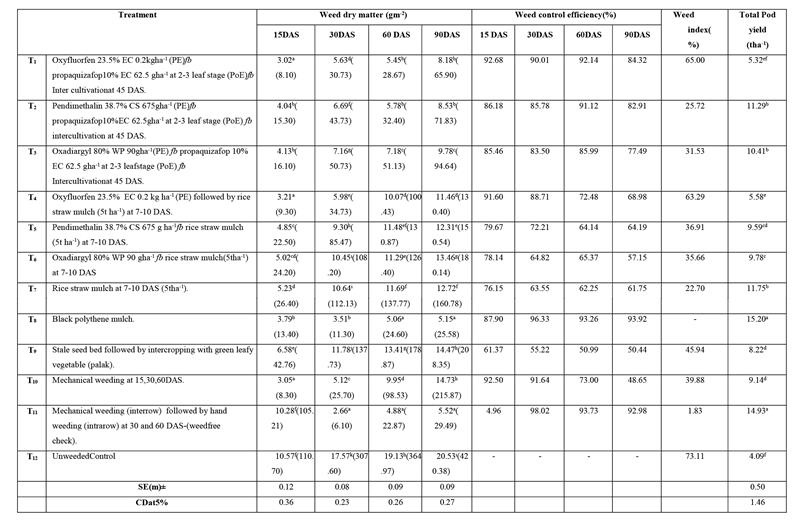
Table 3: Weed dry matter(gm-2), weed control efficiency (%), weed index (%) and total pod yield(tha-1) as influenced by weed management practices in okra
Tables at a glance
Figures at a glance