
Growth and Yield Performance of Oyster Mushrooms (Pleurotus Ostreatus) Using Polyethylene Plastic Waste as Substrate
Received Date: July 10, 2025 Accepted Date: July 30, 2025 Published Date: August 02, 2025
doi:10.17303/jacs.2025.4.203
Citation: Sheryl N. Galvan (2025) Growth and Yield Performance of Oyster Mushrooms (Pleurotus Ostreatus) Using Polyethylene Plastic Waste as Substrate. J Adv Agron Crop Sci 4: 1-9
Abstract
Mushroom cultivation is an economically viable technology process that utilizes and degrades various waste products. The study was conducted at the Iloilo State University of Fisheries Science and Technology, Dingle, Iloilo, to assess the potential of using polyethylene plastic (PE) to enhance the growth and yield of oyster mushrooms (Pleurotus ostreatus). Five substrates (100% sawdust, 25% PE Plastic + 75% sawdust, 50% PE plastic + 50% sawdust, 75% plastic + 25% sawdust, 100% PE plastic) were tested. Spawn of oyster mushrooms was obtained from the Department of Agriculture Mycology laboratory. The spawn was inoculated in each of the assigned five (5) Treatments with three (3) replications and undertaken under aseptic conditions. The growth and development of the mushroom were monitored daily for Forty-five (45) days. Results of the study revealed that oyster mushrooms can grow on PE plastic in combination with organic materials or even at a 100% utilization rate. The highest yield, number of fruiting bodies, and pileus diameter were obtained from 100% sawdust, followed by 25% PE plastic, but with comparable results with all other treatments. The utilization of 25%, 50%, 75% and 100% PE plastic can be used as an alternative substrate for the cultivation of oyster mushrooms.
Keywords: Growth, LDPE Plastic; Pleurotus Ostreatus; Substrate; Waste Product; Yield
Introduction
Plastic pollution is now a menace to society and the environment that has to be dealt with immediate action before it completely overwhelms us. It is estimated that the world has over 150 million tons of plastic in the oceans, and by 2050, there could be more plastic than fish. Plastic is infamous for its endurance and resistance to regular decomposition. [1]. its cheapness, durability, and versatility have made our lives very easy and are used on a large scale worldwide. However, the biggest challenge is the fact that plastic degradation is a pressing is-sue, as plastic never really goes away; it just breaks into microscopic pieces of plastic lying in a non-biodegradable state [2].
Polyethylene (PE) is one of the most common synthetic polymers, and PE waste pollution has been an environmental and health concern for decades [3]. Polyethylene is a polymer made of long-chain monomers of ethylene. Due to the high per capita consumption, the accumulation of plastic waste in the environment is a primary source of pollution. Approximately 0.3–0.4 billion tons of plastics are produced annually worldwide, including an estimated 1.6 million tons per day due to COVID-19 [4], yet less than 10% are recycled. Approximately 50% of all plastic waste ends up in landfills, the most common method of disposal (Organization for Economic Co-operation and Development, 2022). The most often used synthetic polymers are high-density (HDPE) and LDPE or low-density polyethylene [5]. Plastics are disposed of, in many nations, through open, uncontrolled burning and landfilling [6]. Open burning emits toxins into the atmosphere, which can lead to a variety of health issues. Furthermore, burning plastics produces persistent organic pollutants, which have been linked to a number of negative impacts in humans. They discharge hazardous compounds into the environment, contaminating food [7] . A significant source of air pollution, the open burning of mixed wastes produces a variety of adverse environmental and human health effects. Plastics are a particularly problematic waste stream when it comes to open burning [8].
Since incineration of solid waste is not allowed under Republic Act 9003 for the safety of human health and protection of the environment, land filling and the 3 Rs integrated waste management method (Reduce, Reuse, and Recycle) are the main types of SWM in the country [9] However, sadly, the practice of burning plastic waste continues. This calls for newer and more effective scientific ways to tackle the situation rather than burning them.
Biological approaches based on industrial and environmental biotechnology are for the remediation of waste. One such biological method is mycoremediation, which is based on the use of fungi and mushrooms for the removal of waste from the environment. The mushrooms and other fungi possess enzymatic machinery for the degradation of waste/pollutants and therefore, can be applied for a wide variety of pollutants [10, 11].
The oyster mushroom (Pleurotus species) belongs to the family of Tricholomataceae, the second most widely cultivated mushroom worldwide, and is the third largest commercially produced mushroom in the world market (Obodai et al.). Pleurotus species are popular and widely cultivated, mostly in Asia. Like other mushroom species, oyster mushrooms can be grown on various agricultural wastes and they grow at a wide range of temperatures. In the Philippines, the main substrate for the production is sawdust. It is a mixture of shavings from the woods of many trees. Numerous mushroom species contain a wide range of metabolites with anti-tumor, antigenotoxic, antioxidant, antihypertensive, antiplatelet-aggregating, anti-hyperglycemic, antimicrobial, and antiviral activities. The study assessed the potential of utilizing polyethylene plastic on the growth and yield of oyster mushrooms (Pleurotus ostreatus). Considering the volume of PE plastics and the pressing need to re-use and reduce plastic waste, this study proposes and promotes the cultivation of oyster mushroom as an effective method of generating income and a step towards decreasing the plastic load and trash thrown for disposal.
Methodology
Experimental Design
This study utilized sawdust and polyethylene plastics on the growth and yield of oyster mushrooms (Pleurotus ostreatus) as a growing medium. Polyethylene plastics gathered from the solid wastes accumulated from the Municipal garbage collection of the Municipality of Dingle, Iloilo, were shredded into small pieces of 2-4cm. The experiment was arranged in a completely randomized design (CRD) with five treatments replicated three times as follows: A - 100% sawdust (control), B- 25% PE plastics + 75% sawdust, C- 50% PE plastics + 50% sawdust, D- 75% PE plastics + 25% sawdust and E- 100% PE plastics. The study was conducted at the Iloilo State University of Fisheries Science and Technology College of Agriculture, Dingle Campus from March to July 2022.
The polyethylene plastic – roughly about 75kg of PE plastic was cleaned and shredded/grounded into 0.5-1.5 cm length together with sawdust and was soaked separately in water over 24 hours to moisten them thoroughly. After which, substrate materials were stalled on a steep cemented floor to allow the draining of excess moisture from the substrate to obtain a 65% moisture level. After draining excess water from those materials, the various substrates were supplemented with 9% rice bran and 1% sugar.
Thoroughly mixed PE plastics and sawdust were bagged in a 5x12 polypropylene plastic at one kilogram per bag, and proportions were based on the assigned treatment. A PVC pipe of 2.0cm thick and 2.5cm long was inserted in the neck of each bag to serve as a bottle neck and held in place with a rubber band. A piece of cotton wool was plugged into the neck of each bag and was sterilized to avoid contamination. There were twenty-five (25) bags used per treatment, and were distributed on the prepared rock per treatment and replication based on the experimental layout. Bagged substrates were sterilized in an improvised sterilizer at 100 °C for 5 hours and were allowed to cool down.
Inoculation and Incubation
Bagged substrates and spawn bottles were disinfected with 70% alcohol. Likewise, the researcher’s hand was sanitized with alcohol before inoculation of the spawn. Three grams of spawn were inoculated per bag. Inoculated substrates were kept at a room temperature of 26 °C to 28oC under dark conditions. Substrate openings were misted with water every other day to maintain moisture and hasten the sprouting of mycelia. Opening of the bag for fruiting is done upon thickening of the mycelia. Misting of water was done every other day at each of the treatments to ensure proper moisture in each fruiting bag.
Harvesting of Fruiting Bodies
Harvesting was done when the in-rolled margins of the mushroom were completely flattened and was done by cutting the mature mushroom from the base of the stipe per treatment per replication.
Data Collection and Statistical Analysis
Number of days for visible mycelial growth. Data were taken by counting the number of days from inoculation until visible mycelial growth appeared.
Number of days for pin-head formation. Data were taken by counting the number of days from inoculation until the maturity of the fruiting body.
Number of fruiting bodies. The total number of completely formed fruiting bodies was counted per fruiting bag per treatment per replication.
Diameter of pileus (mm). the diameter of the pileus was measured using a digital caliper, measuring from one end of the pileus to the other through the center of the pileus.
Thickness of pileus (cm). the thickest portion of the pileus was measured.
Length of the stipe (cm). stipe length was measured from the point of attachment to the substrate to the point where the gills of the pileus start.
Diameter of stipe (cm). the stipe diameter was measured by measuring the main diameter within the stipe area.
Average yield (g). Mature fruiting bodies were obtained by cutting the mature mushroom from the base of the stipe.
Statistical Analysis
All data collected were subjected to the One-way analysis of variance for a Completely Randomized Design (CRD). Significant results were subjected to the least significant difference (LSD) to compare significant differences among treatment means.
Results and Discussion
Time Elapsed For Mycelial Running and Pin-Head Formation, and Maturity of the Fruiting Body
Results on the total number of days required for mycelial running, pin-head formation, and maturity of fruiting bodies are illustrated in Figure 1. Mycelial running is an extension and colonization of fungal hyphae throughout the substrate. The mycelial growth was faster on sawdust (11 days) than in all other treatments with PE plastic combinations. The 25% PE plastic combination exhibited the second fastest mycelial running (14 days), followed by the 50% and 75% (15 days), and 100% (18 days) PE plastic combinations, respectively.[12] reported the completion of the spawn running on paddy straw waste to be 15 days.
The period of pin-head formation was quicker in substrates with pure sawdust (26 days after inoculation). Treatments with LDPE plastic combinations formed pin-heads at 31 (25% PE plastic) and 33 days after inoculations (50% and 75% LDPE plastics), while it took relatively longer time in growing substrates at 100% PE plastics. [13] Reported that the pinhead formation of oyster mushroom cultivated in different substrates takes 20 to 23 days.
The time required for the maturity of fruiting bodies varied from 35 days (100% sawdust) to 44 days (100% PE plastics). The earliest time to harvest the oyster mushroom was 35 days with 100% sawdust as substrate. The different PE plastic percentage, although takes a little longer to harvest but do not vary that far in terms of maturity or time of harvesting that ranging from 39, 42, 43, and 44 days from date of spawn inoculation for 25%, 50%, 75%, and 100% PE plastic substrates, respectively.
Yield
Average fresh weight of fruiting bodies of oyster mushrooms as affected by low-density polyethylene plastics as growing substrates is shown in Table 1.
The result revealed that oyster mushrooms inoculated in 100% sawdust (Treatment A) obtained the highest fresh weight of fruiting bodies with a mean of 322.38 grams followed by Treatment C (287.59grams), Treatment B (287.57grams), Treatment D (283.16grams) and Treatment E (282.17grams), respectively.
Analysis of variance revealed that oyster mushrooms inoculated in 100% sawdust significantly obtained the highest yield compared to all other treatments inoculated with different PE plastic combinations. However, results from PE plastic combinations exhibited comparable results with each other.
*Significant (<.05)
Treatment means in the same row having a common letter superscript are not significantly different at 5% level.
Number of fruiting bodies
Result revealed that oyster mushroom inoculated in 100% sawdust obtained the most number of fruiting bodies with a mean of 9.20, followed by 25% PE plastic – 8.68, 50% PE plastic – 8.00, 75% PE plastic – 7.85, and 100% PE plastic - 6.89, respectively.
Analysis of variance showed that Treatment A (100% sawdust) was significantly different among treatments, which obtained the highest number of fruiting bodies, but was comparable to 25% PE plastic. The lowest number of fruiting bodies was obtained in 100% PE plastic, but was comparable to 75%PE plastic.
Pileus Diameter
The highest diameter of pileus was measured in oyster mushrooms inoculated in 100% sawdust, followed by mushrooms inoculated in 25% PE plastic (95.92mm), 50% PE plastic (90.41mm), 75% PE plastic (76.17mm), and 100% PE plastic (71.94mm), respectively.
Analysis of variance revealed that the result of 100% sawdust as a substrate for oyster mushroom was significantly higher in diameter compared to all other treatments. All other Treatments containing different PE plastic percentages obtained diameters that are comparable with each other.
Pileus Thickness, Diameter, and Length of the Stipe
Results on the thickness of pileus, diameter, and length of stipe showed no significant differences among treatment means.
Effect of Substrate Combinations on Economic Return from Each Treatment
Table 2 presents the cost and return analysis of producing Oyster mushrooms grown in different substrates. The 100% sawdust, 25% PE plastic, 50% PE plastic, 75% PE plastic, and 100% PE plastic have utilized common materials except for Treatment A and Treatment E, which have used pure sawdust and pure PE plastic, respectively. The total cost incurred in each Treatment was sixty-three pesos and seventy centavos (63.70). Net profit for Treatment A was 63.70 pesos, Treatment B- 36.95, Treatment C - 36.96, Treatment D- 35.41, and Treatment E - 35.06 pesos, respectively.
Generally, the study confirmed that oyster mushrooms (Pleurotus ostreatus) can grow on low-density polyethylene plastic (PE) at different rates combined with organic substrates and even in 100% utilization. Although growth was observed even at 100% PE plastic, the overall growth performance in terms of yield, number of fruiting bodies, and pileus diameter was lower than that observed in sawdust treatments. This indicates that while PE plastic can serve as an alternative growing medium, it is not superior to organic substrates like sawdust. It also proved that the 100% utilization of PE plastic as substrates shows potential in supporting mushroom growth, yet it should not be regarded as the preferred substrate when considering total yield and quality. Therefore, PE plastic substrates may be considered under conditions where organic materials are limited or unavailable.
However, it must be emphasized that this present study did not assess or con-firm the biodegradation of polyethylene plastic by Pleurotus ostreatus. The scope of the experiment was limited to evaluating the growth performance and yield characteristics of oyster mushrooms when cultivated on PE plastic-based substrates. Although growth was observed, this should not be interpreted as direct evidence of plastic degradation. Further scientific investigations are recommended to verify whether P. ostreatus actively degrades PE plastic, and if so, to what extent.
In terms of substrate composition, the utilization of 25%, 50%, and 75% PE plastic can be used as alternative substrates, given that the growth performance and yield of oyster mushrooms in these treatments were still acceptable, next to 100% sawdust. This could also serve as a sustainable solution for the utilization of the huge plastic waste available. These results align with the findings of Subramanian et al. (2013), who reported that the mycelium of Pleurotus florida can utilize polyethylene sheets as a carbon source for growth and may play a role in the biodegradation of low-density polyethylene. However, the implications for food safety must be taken seriously.
In terms of product consumption, further studies should be conducted to determine the nutritional composition and analyze potential chemical or heavy metal contaminants that may be absorbed during the growing stage of mushrooms cultivated on plastic-based substrates. The possibility of harmful substance absorption from plastic materials poses health risks and therefore, should be clarified through future investigations. Likewise, further studies need to be conducted on the potential of other industrial wastes on oyster mushroom cultivation, their economic feasibility, and other related issues to fully realize the multiple socio-economic and environmental significance of the mushroom industry, especially in areas where semi-biodegradable and non-biodegradable waste products are abundant.
In conclusion, the study confirms that sawdust remains an effective substrate for improving the yield and quality of oyster mushrooms, and that mushrooms can also grow on LDPE plastic. However, a cautionary note must be considered: the potential absorption of harmful substances such as chemical residues or heavy metals from plastic substrates may pose food safety concerns. Thus, future studies should include chemical analysis of mushrooms grown on plastic to ensure consumer safety before recommending its widespread use.
Acknowledgments
The assistance provided by my student assistant in the College of Agriculture, Crop Science Department Ms. Angel Mae Otero, is gratefully acknowledged.
- Gupta C. and Prakash D. (2019). Mushrooms as Plastic Eaters, Acta Scientifica Pharmaceutical Sciences. 3.
- Sandeep K, Bansal H., Hundal B, Arora B, Kaur N, et al. (2021) Cultivation of Oyster Mushroom (Pleurotus ostreatus) from Agro-waste and Dry Leaf Litter in used Plastic Bottles: Community Waste Management Model Targeting.
- Elsamahy T, Jianzhong S, Sobhy EE, Sameh SA (2023). Biodegradation of low-density polyethylene plastic waste by a constructed tri-culture yeast consortium from wood-feeding termite: Degradation mechanism and pathway J Hazard Mater.
- N.U. Benson, D.E. Bassey, T. Palanisami (2021). COVID pollution: impact of COVID-19 pandemic on global plastic waste footprint Heliyon, 7, Article e06343.
- Teleky BE, Vodnar D.C (2021). Recent advances in biotechnological itaconic acid production, and application for a sustainable approach. Polymers.13: 3574.
- Siddiqua A., Hahladakis J.N., Al-Attiya W.A.K.A (2022). An overview of the environmental pollution and health effects associated with waste landfilling and open dumping. Environ. Sci. Pollut. Res. 29: 58514–36.
- Thakali A., MacRae J.D (2021). A review of chemical and microbial contamination in food: What are the threats to a circular food system? Environ. Res. 194: 110635.
- Pathak G, Nichter M, Hardan A (2023). Plastic pollution and the open burning of plastic wastes.
- Hibikino, W., Kitakyushu F (2013). Status of Solid Waste Management in the Philippines. Environmental Resources System, Graduate School of Environmental Engineering, the University of Kitakyushu, 1-1, 808-0135.
- Purnomo AS, Mori T, Putra SR, Kondo R (2013): Biotransformation of heptachlor and heptachlor epoxide by white-rot fungus Pleurotus ostreatus. Int Biodeterior Biodegrad 82: 40–4.
- Kulshreshtha S, Mathur N, Bhatnagar P, Kulshreshtha S (2013) : Cultivation of Pleurotus citrinopileatus on handmade paper and cardboard industrial wastes. Ind Crop Prod, 41: 340–46.
- Onuoha CI, Oyibo G, Judith E (2009) Cultivation of straw mushroom (Volvariella volvacea) using some agro-waste material. J Am Sci 5: 135–38.
- Fan L, PA, Mohan R, Soccol CR (2000). Use of various coffee industry residues for the cultivation of Pleurotus ostreatus in solid-state fermentation. Acta Biotechnology 20: 41-52.
- Hoa TH.Wang CL, Wang CH. (2015). The Effects of Different Substrates on the Growth, Yield, and Nutritional Composition of Two Oyster Mushrooms (Pleurotus ostreatus and Pleurotus cystidiosus).
- Kayla Vasarhelyi (2021). Plastic-Eating Mushrooms. Environmental Center Division of Student Affairs. University of Colorado Builder.
- Organization for Economic Co-operation and Development Global Plastics Outlook OECD (2022).
- Subramanian K., Shanmugasundaram K (2013). Assessment of Low-Density Polyethylene (LDPE) biodegradation potential of an edible mushroom, Pleurotus florida.
- Usha, R., Sangeetha, T., Palaniswamy, M. (2011). Screening of polyethylene-degrading microorganisms from garbage soil. Libyan Agri Res Cent J Int 2: 200-4.
- Yutaka T., Calabia B.P., Ugwu C.U., Aiba S (2004). Biodegradability of plastics. Int. J. Mol. Sci. 10:3722–24.
FIGURE 1
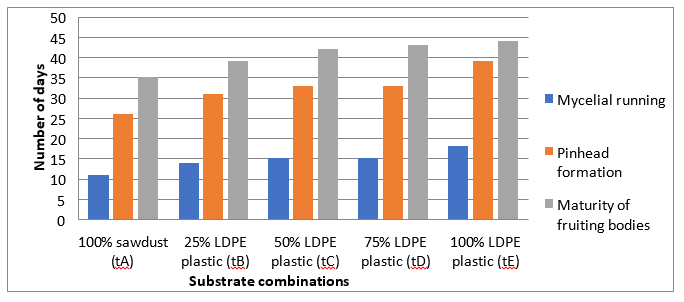
Figure 1: Time elapsed for mycelial running, pin-head formation, and maturity of fruiting bodies.
Tables at a glance
Figures at a glance