
Responsible Data Science in Medical Contexts: Ensuring Ethical and Secure Data Handling
Received Date: November 10, 2024 Accepted Date: December 10, 2024 Published Date: December 13, 2024
doi: 10.17303/jaist.2024.1.203
Citation: Lakshmi Namratha Vempaty (2024) Responsible Data Science in Medical Contexts: Ensuring Ethical and Secure Data Handlin Artiflntel Soft Com Tech l: 1-6
Abstract
As the role of data science expands in the medical field, ethical considerations become paramount to ensure responsible and secure handling of sensitive medical data- This paper explores the importance of responsible data science practices in medi- contexts, highlighting the potential benefits and risks. By discussing key principles, data anonymization techniques, regu- latory compliance, and privacy-preserving methodologies, this paper aims to guide healthcare professionals, researchers, and data scientists toward ethical and secure data utilization in medical research and applications. Keywords: Responsible Data medical data, ethics, data privacy, data anonymization, regulatory compliance, privacy-preserving techniques.
Keywords: Responsible Data Science; Medical Data Ethics; Secure Data Handling; Data Privacy; Informed Consent; Anonymization
Introduction
In the ever-evolving landscape of modern technology, Artificial Intelligence (A1) has emerged as a driving force, shaping industries and reshaping possibilities. Its transformative capabilities have touched numerous aspects of our lives, promising solutions to complex challenges and unprecedented opportunities Ill. However, with the promise of A1's potential comes a critical realization that knowledge and power are intertwined with a profound responsibility Nowhere is this responsibility more evident than in the realm of data-particularly when it pertains to personal health information within the medical field [3],
In this age of AI-driven advancements, it's tempting to believe that AI holds the key to solving a multitude of problems. Indeed, AI has demonstrated remarkable success across various domains, from automating tasks to diagnosing diseases. [4] Yet, beneath this veneer of technological marvel lies the recognition that harnessing AI for the greater good necessitates vigilance, prudence, and ethical mindfulness [5].
Data, particularly in the context of healthcare, holds immense potential to revolutionize diagnosis, treatment, and patient care [6]. Personal health information, intricately linked to the most intimate aspects of an individual's life, is a trove of insights that can drive medical breakthroughs and enhance healthcare delivery. However, the delicate nature of health-related data requires us to tread with utmost care, respecting privacy, ensuring security, and preserving the dignity of every individual.
This paper delves into the pivotal intersection of AI, data, and healthcare, shedding light on the essential responsibility that accompanies the use of AI in managing personal health information. As we explore the challenges and opportunities inherent in this convergence, we underscore the indispensable need for ethical and responsible data handling. In an era where AI's capabilities seem boundless, we advocate for a balanced perspective—one that champions innovation while safeguarding the fundamental principles of privacy, security, and human dignity in the context of healthcare data.
As we navigate this transformative journey, we recognize that AI has the potential to illuminate the path toward better healthcare outcomes. But let us also remember that the brilliance of AI is most resonant when it is harnessed for the well-being of individuals and societies, guided by a steadfast commitment to responsible and ethical data science [7].
The Importance of Responsible A1/Data Science in Medical Contexts
While A1 demonstrates remarkable potential, its application in sensitive domains, especially healthcare, demands a judicious and ethical approach. The power of medical data and information is deeply personal, encompassing details that individuals entrust to healthcare systems. This data possesses immense potential to improve patient outcomes, diagnosis, and treatment. Hence Responsible data science underscores the ethical imperative of preserving patient privacy, maintaining data security, and adhering to ethical guidelines while utilizing medical data.
Guidelines which I think are necessary to follow are
Data privacy and security: Given the sensitive nature of medical information, safeguarding patient privacy and data security is paramount to establish trust and prevent breaches that could lead to dire consequences.
Transparency and accountability: Responsible data science entails transparency in AI algorithms and models, enabling healthcare professionals and patients to understand and trust the decision-making processes.
Avoiding bias and discrimination: As AI systems learn from existing data, the risk of perpetuating bias or discrimination must be mitigated to ensure equitable healthcare outcomes.
Informed consent: In utilizing medical data for AI applications, obtaining informed consent from patients is not only ethical but also legally essential to ensure data usage aligns with individual preferences. Lot of times people don’t ask for consent and say if you don’t opt-out you are opted-in , it should be the other way round.
Regulatory compliance: Adhering to regulatory frameworks such as HIPAA ensures that patient data is handled responsibly and in accordance with legal requirements.
Collaborative approach: The responsibility Of data science extends to fostering collaboration among researchers, clinicians, data scientists, and patients to ensure a holistic understanding of data usage.
Anonymization and De-identification: Implement robust methods to deidentify and anonymize patient data, ensuring that individual identities cannot be traced back to the information.
Data Governance: Establish clear policies and procedures for data access, sharing, and usage, and designate responsible individuals or teams to oversee compliance.
Education and Training: Provide ongoing education and training to data scientists, healthcare professionals, and all the parties involved about the ethical considerations surrounding medical data usage and AI.
Data Ownership and Control: Clarify patients' rights over their medical data, allowing them to control how their information is used and shared within the bounds of ethical and legal considerations.
Data Encryption: Implement encryption techniques to secure data both during storage and transmission, reducing the risk of unauthorized access.
Limit Third-Party Sharing: Minimize sharing medical data with third parties unless explicitly necessary and with proper consent from patients.
Research Ethics: When using medical data for research, obtain necessary ethical approvals, respect the principle of minimal harm, and prioritize the greater good.
Crisis Preparedness: Develop strategies for addressing potential data breaches, cyberattacks, or unexpected events that could impact data security.
International Data Standards: Adhere to international data protection standards and regulations, especially when dealing with cross.border data flows.
Ethical AI Review: Establish internal review boards or committees to assess the ethical implications of AI applications and data usage.
What happens if we don’t follow guidelines?Not being a responsible data scientist in a medical context can have serious ethical, legal, and societal consequences. Here are some potential negative outcomes:
Privacy Violations: Inadequate data anonymization and protection can lead to the exposure of sensitive patient information. This can result in identity theft, discrimination. or other harms to individuals [8].
Bias and Discrimination: Improper handling of data can lead to biased models that disproportionately impact certain groups, potentially resulting in unequal access to healthcare and biased treatment recommendations [9].
Inaccurate Diagnoses and Treatment: Inaccurate or poorly validated models can lead to incorrect medical diagnoses and treatment recommendations, potentially putting patients' lives at risk [10].
Lack of Informed Consent: Using patient data without proper informed consent violates patients' autonomy and can erode trust in medical research and healthcare systems [11].
Regulatory Violations: Non-compliance with data protection regulations, such as GDPR in the European Union or HIPAA in the United States, can result in legal penalties [12].
Loss of Public Trust: Irresponsible actions can lead to loss of public trust in medical research, data science, and healthcare institutions, undermining the potential benefits of data-driven solutions [13].
Unintended Consequences: Deploying algorithms without understanding their potential impact on patient care can lead to unexpected and harmful outcomes [14].
Conclusion
In the realm where data meets medical care, the ethical imperative of resBmsible data handling cannot be overstated. The union Of A1 and healthcare data is a beacon of promise, with the potential to revolutionize diagnostics, treatments, and patient experiences. Yet, this promise must be responsibly. The principles outlined in this paper provide a blueprint for the ethical and se. cure application of data science in medical contexts. From safeguarding patient privacy and mitigating bias to fostering transparency and collaboration, these guidelines unders- core the gravity of handling sensitive medical data with utmost care.
In this pivotal juncture, responsible data science emerges not just as a regulatory mandate but as a moral obligation. The convergence ofadvanced technologies and medical insights holds the key to a brighter healthcare future, but it must be unlocked with the key to ethical considerations. By adhering to these principles, we ensure that Al driven advancements in healthcare align with human vaL ues, preserving trust, privacy, and the welfare of individuals. As we embrace the potential of A1 to reshape medical landscapes, let us remember that the true measure of success lies not just in innovation, but in the ethical compass that guides our journey.
- Russell SJ, Norvig P (2016) Artificial Intelligence: A Modern Approach. Pearson.
- Floridi L Cowls J (2019) A unified framework Of five principles for A1 in society. Harvard Data Science Review 1
- Smith JR, Clancey WJ (2019) Ethical challenges of AI and data science: Scratching the surface. AI & Society 34: 457-62.
- LeCun Y, Bengio Y, Hinton G (2015) Deep learning. Nature 521: 436-44.
- Jobin A, lenca M, Vayena E (2019) Ihe global landscape of A1 ethics guidelines. Nature Machine Intelligence 1: 389-99.
- Choi S, Kim SW (2020) The role of data science for the COVID-19 pandemic: A comprehensive review. IEEE Transactions on Industrial Informatics 17: 2038-50.
- Verghese A, Shah NH, Harrington RA (2018) What this computer needs are a physician: Humanism and artificial intelligence. JAMA 319: 19-20.
- El Emam K, Jonker E, Arbuckle L, Malin B (2011) A Systematic Review of Re-identification Attacks on Health Data. ONE 6: 08071.
- Obermeyer Z, Powers B, Vogeli C, Mullainathan S (2019) Dissecting racial bias in an algorithm used to manage the health of populations. 366:447-53.
- Beam AL, Kohane IS (2018) Big Data and Machine Learning in Health Care JAMA 319: 1317-8.
- Mittelstadt BD. Fairweather NB. Shaw MLCG, McBride N, Green DP (2016) The ethics of algorithms: Mapping the debate. Big Data & 3: 2053951716679679.
- European Union (2016) General Data Protection Regulation (GDPR). Regulation (EU) 2016/679.
- Wachter S, Mittelstadt B, Russell C (2019) Counterfactual Explanations without Opening the Black Box: Automated Decisions and the GDPR. Harv. JL & Tech 33: 841.
- Rajkomar A, Dean J, Kohane I (2019) Machine Learning in Medicine. New England Journal of Medicine 380: 1347-58.Bottom of Form
FIGURE 1
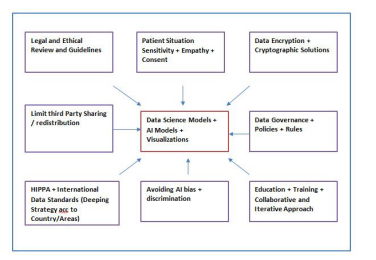
Figure 1: Framework
Figures at a glance