
Optimizing Energy Efficiency in 5G Small Cells with Machine Learning
Received Date: April 11, 2025 Accepted Date: May 11, 2025 Published Date: May 14, 2025
doi:10.17303/jaist.2025.2.104
Citation: Premdas Pawar, Pravin Ingale, Snehal Raien, Mrunmai Vaze, Tejas Vast (2025) Optimizing Energy Efficiency in 5G Small Cells with Machine Learning. J Artif Intel Sost Comp Tech 2: 1-9
Abstract
The advent of 5G networks has revolutionized mobile communication, promising unprecedented data rates and connectivity. However, this rapid expansion poses significant challenges, particularly concerning energy consumption, as small cell base stations (SBSs) become increasingly prevalent to meet the growing demand for mobile data. This report delves into the core contributions of the paper, which introduces a sophisticated framework that integrates machine learning algorithms to optimize the operational states of SBSs. The proposed mechanism employs advanced sleep mode functionalities, allowing SBSs to dynamically transition between active and sleep states based on real-time user activity and traffic patterns. By classifying small cells into distinct categories—such as SLEEP MODE, ACTIVE, and FULL LOAD—based on various metrics including user count, traffic load, and energy consumption, the model facilitates intelligent decision-making processes that significantly reduce energy waste during periods of low demand. The analysis presented in the paper is grounded in extensive simulations that evaluate the performance of the proposed ML model against traditional energy management strategies. Results indicate that the implementation of this mechanism can lead to energy savings of up to 70%, while simultaneously ensuring that the quality of service (QoS) remains intact for users.
Keywords: 5G Networks; Machine Learning; Energy Efficiency; Small Cells; Sleep Mode; Classification; Decision-Making Algorithm; Network Optimization
Introduction
5G is a revolutionary step forward in wireless communication, offering unprecedented improvements in connectivity, speed, and efficiency [1]. Representing the successor to 4G LTE, it will meet the ever-growing needs of modern digital ecosystems in which applications range from autonomous vehicles, IoT, AR, to smart cities. This puts 5G well in the revolutionizing of industrial and individual and device ways to connect to and interact with technology. The advantages of this network are: very high data speed, it is up to 10 Gbps, which is ten times the speed of 4G. Thus, video streaming, quick downloads, and real-time communications for such applications as remote surgery or virtual reality would be enabled. Another point: 5G has ultra-low latency with delay of just 1 millisecond.
With 5G, network capacity has increased by an enormous number of devices per square kilometer. This is very important for IoT applications where in all probability billions of devices would run in parallel. With this, the energy efficiency and spectrum utilization increase with better performance at reduced power consumption under ideal conditions.
Though 5G will have the potential to transform the world, it will have many inherent challenges and limitations. One of the major drawbacks associated with 5G is it is quite cost-intensive in the context of its infrastructure cost. The deployment of 5G networks requires installation of small cells, antennas, and base stations that achieve this high coverage as well as required capacity. These become a very big challenge, especially in areas that are characterized as rural and remote, where ROI might not quite suffice for actual deployment [3]. The signals of 5G have a very low range, particularly millimetre waves in higher frequency bands, so can easily be blocked by any type of physical barrier such as buildings and trees. This makes it extreme spacing out with an ultra-dense small cell network, requiring for coverage. While power consumption in a 5G network is way greater, another very significant problem related to environment sustainability, such an environment dependent carbon-emitting planet as us hopes for reductions even more upon issues like such.
Existing Methods
The techniques adopted by the present-day energy efficiency optimization of 5G networks fall under the categories: hardware optimization, network planning, and intelligent resource management[6]. They reduce power consumption with quality of service. Some of the most important techniques which are widely adopted are mentioned below:
Dynamic Resource Allocation
This technique is designed for dynamic allocation of resources, including power and bandwidth. They are dependent on dynamic traffic demand and user requirement [4]. The approach avoids energy wastage during unfruitful times of low network usage quite effectively. A few techniques for the optimization of resource allocation are power control, load balancing, and carrier aggregation. For example, power control balances the base stations' and user equipment's transmission power for optimum energy efficiency along with coverage requirements. Load balancing is used to ensure that network traffic is distributed evenly across cells so that no specific base station gets overloaded and therefore wastage of energy is minimized.
The energy efficiency of the system can be mathematically represented as:
where:
η= Energy Efficiency (bit per joule)
R=Data Rate (bit per second)
Ptotal=Total Power consumption (watt)
Sleep Mode Techniques
Sleep mode techniques reduce energy consumption by making small cells enter low-power states for periods of minimal demand of traffic. This results in dynamic management of active and sleep transitions such that the idle power consumption is avoided, but the user experience is not compromised. In off-peak hours or rural regions, the small cells could be asleep with the connectivity still maintained through the macro cell, while advanced scheduling mechanisms enable fast wake-up responses in case traffic demand increases [10].
The power consumed for active and sleep states can be represented as:
where:
Pstatic= Baseline power consumption.
PDynamic= Power consumption proportional to traffic load.
PSleep=Reduce power consumption during sleep mode.
Massive MIMO Optimization
Massive MIMO systems allow for spectral efficiency since it can serve more than a few users at the same time with more antennas. Therefore, to further optimize massive MIMO systems to be energy-efficient, advanced beamforming algorithms should be accompanied with improved power allocation mechanisms. Beamforming orients a considerable amount of transmitted power towards the intended receivers, thereby reducing interference and minimizing energy wastes. Additionally, the number of active antennas and user scheduling should be dynamically varied with changing traffic demands to accommodate energy savings as well as performance demands.
The total power consumption in a massive MIMO system is as follows:
where:
PBS=Power consumption by base station.
PUE=Power consumption by user equipment.
K=Number of active users.
Heterogeneity-Aware Energy Saving
Heterogeneity-aware approaches, which consider diverse types and configurations of cells that are present in the 5G network, do reduce the average power consumption throughout the network since energy-intensive macro cells are selected during high demand and energy-efficient small cells at low demand time. Machine learning models are thus used to perform the analysis and predict the network traffic and suitable configurations for a heterogeneous network.
Energy Harvesting-Based Activity Scheduling in Small Cells
Activity scheduling techniques ensure the optimal utilization of energy harvesting small cells such that active time is aligned with energy availability as well as demand for traffic [5]. Advanced scheduling algorithms, based on an energy harvesting model and real-time traffic prediction model, make sure that energy harvesting small cells are operated with quality-of-service guarantee.
Clustering-based Energy Saving
Small cells cluster together and dynamically adapt the power levels and active configurations of cells based on traffic demands. Important energy savings are realized through traffic consolidation into fewer clusters during low-demand conditions without any degradation in quality of service.
Comparative Study
Activity Scheduling for Energy Harvesting Small Cells in 5G Wireless Communication Networks optimizes the activity of energy harvesting small cells with forecasted user demand [9]. The authors proposed a new approach that incorporates mixed-integer optimization to schedule small cell activities and optimize time slot duration according to demand forecasts. This approach has been able to balance the consumption of energy and user demand with significant savings in energy by optimizing scheduling. The results show that the proposed scheduling algorithm can adapt to varying traffic loads, ensure efficient use of energy, and satisfy user requirements.
A Clustering-Based Energy Saving Scheme for Dense Small Cell Networks presents a three-phase approach toward minimizing total power consumption in dense small cell networks while ensuring Quality of Service (QoS) for all users. The use of clustering for base stations contributes to reducing the complexity of the problem while solving ON/OFF control, which is known to be NP-hard. Authors here have saved approximately 35% of power in simulations with the network through integration of intra-cluster and inter-cluster control mechanisms. This work shows some capabilities of clustering in managing energy consumption for high-quality service in densely populated areas.A Sleeping Mechanism for Cache-Enabled Small Cell Networks with Energy Harvesting Function: This paper proposes a sleeping mechanism that integrates energy harvesting and cooperative caching to reduce energy consumption from the power grid [3]. The authors formulated the minimization problem on energy consumption with decomposition into two subproblems-the decision on SBS status and optimization of content caching. The proposed algorithm efficiently reduces energy consumption with a high cache hit ratio, thus showing the benefits of combining energy harvesting techniques with strategies in caching. This paper emphasizes the role of intelligent resource management to enhance energy efficiency for small cell networks.
Dynamic Clustering Algorithm for Power Effective Small Cell Deployment in HetNet 5G Networks challenges the issues of small cell deployment in heterogeneous networks by offering a proposed dynamic clustering algorithm [4]. This algorithm optimizes load balancing and interference management so that small cells can be adapted to the user distribution. Results show that dynamic clustering improves the energy efficiency as well as minimizes interference to enhance the network performance in general. While building small cells, it is well recommended that these factors, among others, do reflect the real-time user behaviors and traffic in deployment.In this paper titled "Optimization of Energy with Multi-Level Sleeping Control in 5G HetNets: A Reinforcement Learning Approach" will delve into discussing how reinforcement learning may be put forth for the small cells' use in multi-level sleeping modes in managing [7]. Distributed Q-learning with an algorithm will adapt the small cell activity from users' demand levels and interference; it allows adjustments to the operation states of the small cells real-time, improving energy consumption in terms of accepting QoS requirements. The results show that the reinforcement learning framework can properly balance energy saving with service quality, which would demonstrate the intelligent algorithm's promise in energy management.
The Heterogeneity-Aware Energy Saving and Energy Efficiency Optimization in Dense Small Cell Networks focuses on the heterogeneity of small cells in dense networks. The authors explore a joint optimization strategy for energy saving and energy efficiency through subchannel allocation, subframe configuration, and power allocation. The authors defined an energy efficiency preference function to quantify the impact of heterogeneous information of small cells on energy optimization. The proposed algorithm adaptively follows the energy efficiency preference variation of small cells and attains significant energy efficiency while fairly sharing the resources of the network between users. Thus, this paper brings to attention the consideration of various characteristics in energy optimization methods for small cells.
The methodologies applied in these papers are considerably different, which reflects the different approaches towards optimization in energy for 5G networks. The second publication, which is activity scheduling, highlights demand forecasting and mixed integer optimization as a means of improving energy efficiency. Indeed, thirdly, clustering approach is used to reduce complexity in the ON/OFF control problem as one shows how local decisions are effective in energy management.In the fourth, an energy-harvesting-integrated design by developing a sleeping mechanism that harnesses the novel interaction between energy-efficient and cache strategy is deployed in order to make the proposed work less power-grids. A fifth demonstrates an application based on reinforcement learning techniques for dynamic handling of operational modes within small cell entities, as real-time adaptation may eventually become possible at runtime according to demands from active users and degrees of interference within networks. Such would be part of more insightful and data-guided energy handling.
Conclusion
Transiting to 5G networks is a great technological leap promising a future of unprecedented speed, connectivity, and efficiency. However, this transformative technology brings in its wake some inherent challenges, especially in the domain of energy efficiency. In general, small cell networks are considered the cornerstones of 5G infrastructure, critical for delivering high capacity and low latency, but they pose unique challenges in energy consumption because of their dense deployment and operational requirements. All these demands a more holistic approach in terms of hardware advances, intelligent resource management, and innovative optimization techniques.
The review of existing methodologies highlights the intensity of the research work directed towards improving energy efficiency in 5G small cell networks. Some of the conventional techniques, which form the starting point of reducing power wastage and achieving higher spectral efficiency, include dynamic resource allocation, sleep mode transition, and optimization of massive MIMO. This trade-off between network performance and power consumption demonstrates that even the basic approach can result in significant energy savings without trading off service quality.
More advanced techniques include clustering-based energy saving, heterogeneity-aware optimization, and energy harvesting-based activity scheduling in order to accommodate the special demands of dense and heterogeneous 5G networks. Such solutions include renewable energy sources in dynamic power variations and traffic aggregation to ensure greater energy efficiency of the networks. For example, simplification of control decisions for the ON/OFF control can be achieved by clustering techniques, hence reducing the computation complexity but boosting the network performance. In addition, energy-harvesting mechanisms allow using renewable sources and demonstrate how, with small cells, environmental sustainability could be approached.
The amplification potential of 5G network energy optimization is supported further by machine learning and artificial intelligence [2,7]. This involves reinforcement learning and predictive models in adapting in real time to conditions of networks, user behaviour, and demands in traffic. Such data-driven approaches give intelligent decisions to the networks; for example, the dynamic change in the operational mode or scheduling the activity based on anticipated traffic and availability of energy. Machine learning therefore integrates well into the systems to the effect that, other than achieving energy efficiency, the networks will continue being responsive and resilient.
Comparing the methodologies, no single technique is optimal for all, but a mixture of techniques would depend on the network configuration and the requirements. The same example here is activity scheduling algorithms optimizing the consumption based on traffic variability, while in dense urban deployments, a good candidate may be clustering and heterogeneity-aware approaches. Another level of adaptability that comes with reinforcement learning and other intelligent algorithms is the dynamic balancing of energy efficiency with quality of service.
Optimization of energy consumption in 5G small cell networks is both a technical necessity and an environmental need. Climate change is imposing its effects on the world; hence, the carbon footprint of 5G infrastructure is essential to reduce. Methodologies discussed here show the feasibility of achieving energy-efficient 5G networks without compromising performance and latency, which are the demands of modern applications. It will pave a way for a sustainable future, allowing the industry to continue to innovate and integrate the most cutting-edge technologies to bring about the realization of the benefits of 5G without damaging the well-being of the planet.
Work Done
Future Work
The proposed machine learning-based mechanism for improving energy efficiency in 5G small cell networks has laid a strong foundation; however, several enhancements can be made in future research [4]. A critical direction is the integration of more advanced machine learning models, such as Convolutional Neural Networks (CNNs) and Reinforcement Learning (RL). These models can process larger datasets and learn complex dependencies between variables, leading to better classification of small cells and more accurate decision-making. For instance, RL can dynamically optimize the switching of small cells by interacting with real-time network data, allowing it to adapt to traffic variations and interference conditions effectively.
Future work should also expand the feature set used in the classification and decision-making processes. Additional parameters like environmental factors, user mobility patterns, and real-time energy costs can refine the predictions. Incorporating this data can improve the model's ability to balance energy savings and Quality of Service (QoS) across different network conditions. In tandem, the system could benefit from real-time feedback loops, enabling dynamic updates to model predictions and improving adaptability to sudden changes in traffic or energy demand.
In the current work, two decision-making algorithms were highlighted: the Greedy Algorithm and the Neighbor Awareness Algorithm. The Greedy Algorithm aggressively turns off cells classified as "Sleep Mode," saving substantial energy but risking reduced QoS as some users may remain unserved. On the other hand, the Neighbor Awareness Algorithm considers the states of neighboring cells, redistributing users from cells classified as "Sleep Mode" to neighboring "Active" cells, thereby preserving QoS while achieving moderate energy savings. Future research can enhance these algorithms by integrating hybrid approaches that dynamically switch between the two based on real-time traffic density and user distribution. Advanced scheduling algorithms could also be explored to determine optimal transitions between these states.
Moreover, integrating renewable energy sources like solar and wind into the power supply of small cells can further reduce reliance on traditional grids[10]. Future studies could develop algorithms to manage these hybrid energy sources effectively, aligning energy harvesting schedules with traffic demand and storage capacity. Cross-layer optimization, addressing the physical, network, and application layers simultaneously, could also be a fruitful direction, enabling more holistic performance improvements.
Testing and validating these mechanisms in diverse deployment scenarios will be essential [8]. Simulations in urban, rural, and indoor environments with varying user densities and mobility patterns can provide insights into the scalability and robustness of the proposed models. In addition, regulatory and policy considerations must be factored into these solutions to ensure compliance with energy standards and deployment guidelines. By incorporating advanced machine learning techniques, richer datasets, hybrid energy solutions, and refined algorithms, future work can push the boundaries of energy efficiency in 5G small cell networks. Such innovations will be pivotal in meeting the dual demands of sustainable energy consumption and the high performance required in modern digital ecosystems.
- Zhang Y, Wang Y (2020) "Energy-Efficient Resource Allocation in 5G Small Cell Networks." IEEE Transactions on Wireless Communications, 19: 1234-45.
- Liu H, Zhang L (2021) "Machine Learning for Energy Management in 5G Networks: A Survey." Journal of Network and Computer Applications, 175: 102-15.
- Chen X, Zhao Y (2019) "Cooperative Caching Strategies for 5G Small Cell Networks." IEEE Access, 7: 45678-89.
- Kumar P, Singh R (2022) "Dynamic Energy Management in 5G Small Cells Using Machine Learning." International Journal of Communication Systems, 35: e5000.
- Alshahrani M, Alhussein M (2020) "Energy Harvesting Techniques for Sustainable 5G Networks." Sustainable Cities and Society, 54: 102-10.
- Bhatia S, Gupta, R (2021) "A Review of Energy-Efficient Techniques in 5G Networks." Wireless Networks, 27: 2345-60.
- Wang J, Li K (2020) "Optimizing Energy Consumption in 5G Networks: A Machine Learning Approach." IEEE Transactions on Green Communications and Networking, 4: 456-67.
- Zhang H, Liu J (2022) "Performance Evaluation of Energy-Efficient Caching in 5G Networks." Journal of Communications and Networks, 24: 1-12.
- Yang Y, Chen Y (2021) "Adaptive Energy Management for 5G Small Cell Networks." IEEE Transactions on Mobile Computing, 20: 2345-58.
- Miao Y, Zhang Q (2020) "A Survey on Energy-Efficient Techniques in 5G Networks." Future Generation Computer Systems, 108: 123-35.
FIGURE 1
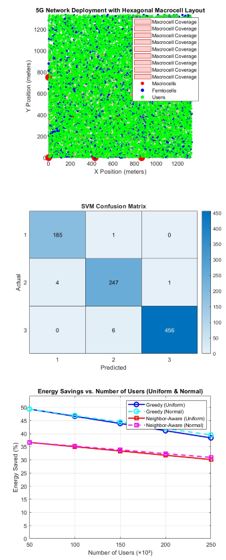
Figure1
Figures at a glance