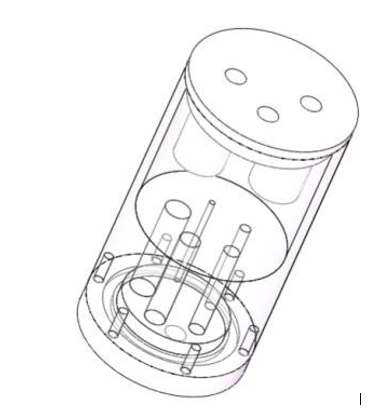
Figure 1: The schematic diagram of the NEMA image quality phantom
Figure 1: The schematic diagram of the NEMA image quality phantom
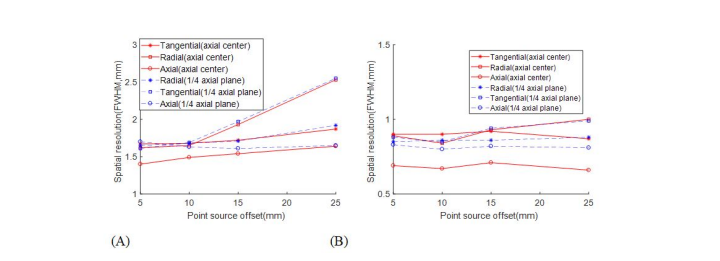
Figure 2: Spatial resolution results for: (A) FBP, (B) OSEM+PSF
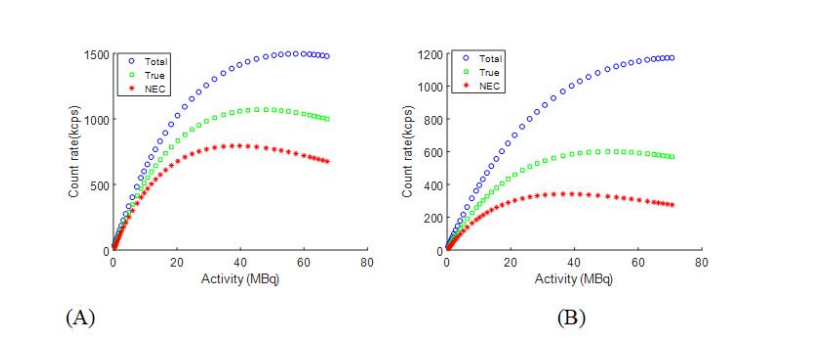
Figure 3: Results of Noise Equivalent Count Rate experiments for: (A) mouse-like phantom, (B) rat-like phantom
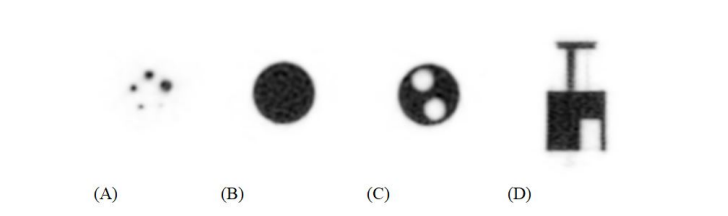
Figure 4: Reconstructed image of the NEMA image quality phantom: (A) a transverse slice of the 1, 2, 3, 4, 5 mm hot-rod regions; (B) a transverse slice of the uniform region; (C) a transverse slice ofthe cold region containing water and air; (D) a coronal slice of the phantom
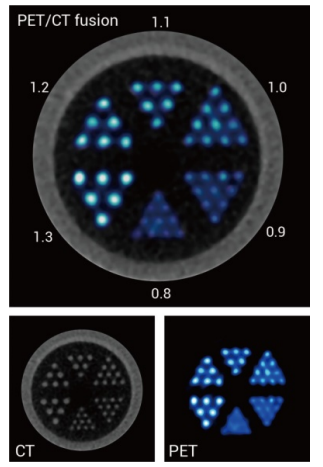
Figure 5: Images of the Micro Derenzo phantom. Top: PET/CT fused images; bottom-left: CT image; bottom-right: PET image
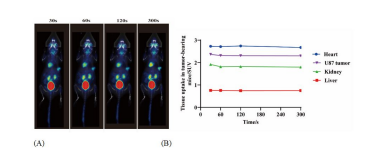
Figure 6: Micro PET/CT images of U87 tumor-bearing mouse with various acquisition durations 1 h after 18F-FDG (68 μCi) intravenous injection: (A) Coronal sectional images of tumor site with scan time of 0 - 30 s, 31 - 60 s, 61 - 120 s, and 121 - 300 s, respectively; (B) Time activity (SUV-mean value) curves of the heart, liver, kidney and tumor of the U87 tumor-bearing mouse
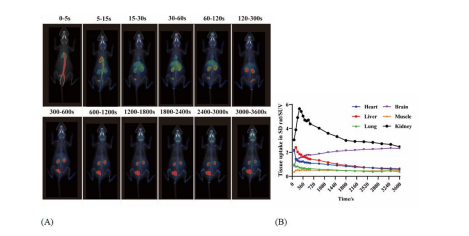
Figure 7: Dynamic PET/CT images of a SD rat after administrated with 40 μCi 18F-FDG:(A) Maximum intensity projection (MIP) fused PET/CT images with frames of 0 – 5 s, 5 - 15 s, 15 - 30 s, 60 - 120 s, 300 - 600 s, 600 - 1200 s, 1200 - 1800 s, 1800 - 2400 s, 2400 - 3000 s, 3000 - 3600 s; (B) Time activity curves of the heart, brain, liver, muscle, lung and kidney, derived from the reconstructed dynamic images of various acquisition times
Tables at a glance
Figures at a glance