
The Definition of Unlimited, Pentagonal Shape Penrose Tile that is Defect-Free
Received Date: June 02, 2024 Accepted Date: July 02, 2024 Published Date: July 05, 2024
doi:10.17303/jcec.2024.3.102
Citation: Chung Yuan Kung (2024) The Definition of Unlimited, Pentagonal Shape Penrose Tile that is Defect-Free. J Chem Eng Catal 3: 1-9
Abstract
Penrose tilings do not repeat, making them a good example of an aperiodic pattern. This indicates that they lack translational symmetry. This article provides a clearer and more rigorous definition of traditional Penrose tiles and proposes a coupling construction process for infinitely scalable, defect-free Penrose tiles.
Keywords: Decagon; Penrose Tiling; Defect; Pentagon Shape
Introduction
Penrose tilings do not repeat, making them a good example of an aperiodic pattern. This indicates that they lack translational symmetry. Recently the very original Penrose tile was modified into a pentagonal shape simply by adding some tiles out ward and this pentagonal shape composed of three types of decagons: type-a , type-b and type-c [1]. Further, pentagonal Penrose tiles can be infinitely enlarged without any defects and may not always be mirror or fivefold symmetrical because they can be made up of any combination of the six different forms of decagons [2].
The purpose of the study is to adopt these pentagonal shapes (symmetrical and asymmetrical) as a standard paradigm for extending Penrose tiles and to demonstrate that various types of Penrose tiles (either symmetry or asymmetry) can be extended infinitely by using coupling technique without generating defects.
It should be noted that when making the Penrose tiles to infinity, a strict new rule must be adhered to “No bricks can be missing from any decagon of the pentagonal Penrose tiles” and there is “no brick that does not belong to the six one of the decagons. Other-wise, the tiles are considered as defective tiles.
Results and Discussion
As described, the ternary pentagonal Penrose tiles fit well with the original Penrose tiles, as shown in Figure 2. The ternary tile in Figure 2 can be simply converted into a binary pentagonal tile, as shown in Figure 3a, by replacing all c-type decagons (located at the edge of the tile) with b-type decagons. The diagram in Figure 3a illustrates a unique five-fold symmetry of a standard pentagonal Penrose tile with 5 decagons on each side. It shows that all decagons are Type a and Type b and behave the same internally when rotated by 72 degrees. Figure 3 (b,c,d,e) illustrates the creation of four additional asymmetric binary decagonal pentagons based on Figure 3a. It should be noted that all five of the pentagonal-shaped Penrose tiles in Figure 3 have the identical array of decagons on their edge-sides. The graph in Figure 3a shows how a symmetric Pentagonal can be extended to an infinite binary pentagonal-shaped tile without any defect (five-fold and mirror symmetry). Whereas, the graphs in Figure 3 (b,c,d,e) show how the asymmetric tiles are made (not necessarily a five-fold, nor mirror symmetry) without any defect. For simplicity, some extra-graphs will be shown here, but they do not represent the results of a symmetry graph.
Here is an illustration of how the coupling process creates a defect-free Penrose tile using the diagram in Figure 3a, and shows how easily the defects created by the coupling process (Ref. 3) can be reversed. As shown in Figure 4a, we can perform appropriate mirror coupling on the edge along the center of the upper rightmost red star. Thereafter, appropriate cropping from the Figure 4a can be performed to obtain a piece of a mirror-symmetry triangle as shown in Figure 4b, which can be employed as one of the side triangle of the next larger pentagon. Defective decagons marked in dark grey can be replaced with type b or type c decagons, making the tiles defect-free. In this case, it is suggested to use type-b in order to maintain the binary pentagonal tile shape. This cutting triangle is mirrored and serves as the first base of the next larger round of pre-coupled Penrose tiles.
Figure 5a shows the results of tessellation (splicing) based on the graph (mirror symmetric triangle) in Figure 4b. Combination of degree splices include: first 72-degree rotation, second 144-degree, third 216 degree and finally 288 degree rotation. Following the fifth round of splicing (that is, after the first round of coupling), a larger pentagon Penrose tile with ten decagons on each side is constructed. The defects created during the tessellation process in the seam regions are shown in Figure 5, where all defective decagons are clearly reversed to the type-b decagons. Using the same procedure applied to the graph in Figure (5), after further extended coupling, error-free binary Penrose tiles with 20 decagons on each side can be obtained, as shown in Figure 6.
Absolutely, these coupling defects (unwanted decagons) created in the seam area can all be transformed into a proper decagon (in this case in, Figure 5b, defect decagons are all replaced by type-b decagon), resulting in binary Penrose tiles. Using the same procedure, a defect-free binary Penrose tiles (conventionally defined five-fold round the origin center) of infinite size can be obtained.
Furthermore, a very different result obtained from the same technique applied to the asymmetric tiles in Figure 3 (b,c,d,e) indicates that it is possible to create asymmetrical Penrose tiles free of defects. Thus, this may lead to the creation of various forms of decagons. The process is described as follows: First, use three different asymmetry Penrose tiles coupling in x-direction to create the graph that is shown in Figure 6a. This results in a triangle with identical shape as the graph in Figure 4c with the ten decagons on one side (for construct next larger pentagonal Penrose tiles), as shown in Figure 6b. To create a larger pentagonal Penrose tile with a highly complex situation in the center region (as shown in Figure 6c), rotationally splice this triangle four (five) times.
Different types of decagons can be chosen to match-fit the center region. The results are shown in Figure 7(d), with the binary five-fold Penrose tiles with defects marked in pink color. After much effort to eliminate all the defects in Figure 7(d), the author discovered that there was a single unavoidable defective tile (as shown in Figure 7e). At this point, the Penrose tile is asymmetrical and has type-c and type-e decagons, as well as an unavoidable defect marked in grey color. Nevertheless, Figure 7 (d) and (e) are both Penrose tile graphs.
On the other hand, apply the previously described procedure to the Figure 7(e). As shown in Figure 8, the asymmetry tile can be extended to a larger pentagonal-shaped (five-fold symmetric) Penrose tiles that are defect free. The author intended to leave two unfinished pentagonal Penrose tiles as shown in Figure 8a and 8b to demonstrate how difficult (or easy) and how systematical it is to extend a Penrose tile to infinity without any defect. Figure 8a shows a symmetry Penrose tile with a complicated defect in the center region, while Figure 8b shows an asymmetric tile containing all six types of decagons.
Summary
In this study, a pentagonal Penrose tile is used as example to demonstrate the simplest and easiest-to-understand coupling scheme. Here, a defect concept for coupling different types of pentagonal Penrose tiles with a strict condition is introduced. Finally, the defect free Penrose tile of infinite size is conceivable. Since the pentagonal Penrose tiles should consist of at least of two types of decagons (any combination of six types of decagons), they may not always be five–fold or mirror symmetry (ref). Therefore, it can be proven that when they are coupled together to form infinite Penrose tiles with invisible boundaries, no potential defects are created (but may create other types of decagons).
- Penrose R (1974) The role of aesthetics in pure and applied mathematical research. Bulletin of the Institute of Mathematics and Its Applications, 10: 266-71.
FIGURE 1
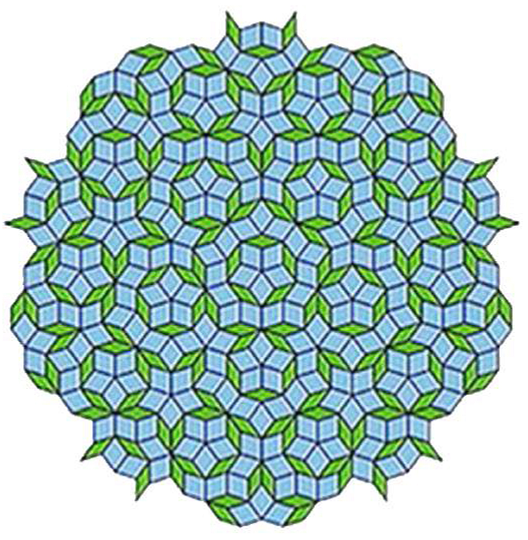
Figure 1: Original Penrose tile
FIGURE 2
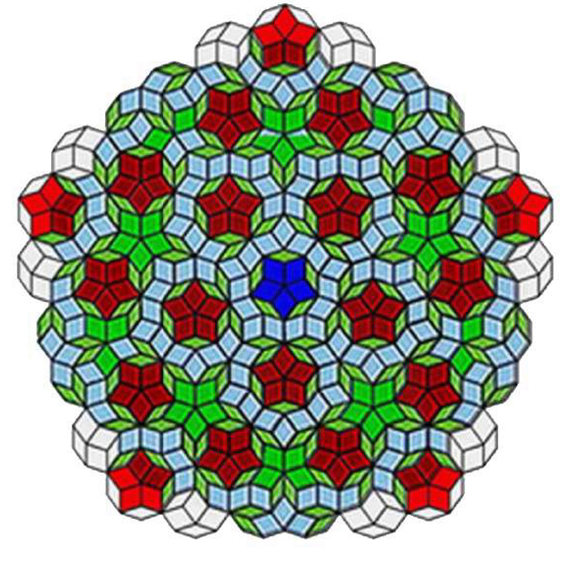
Figure 2: Superposition coincidence of the original Penrose tile and a pentagonal shape trinary Penrose tile
FIGURE 3
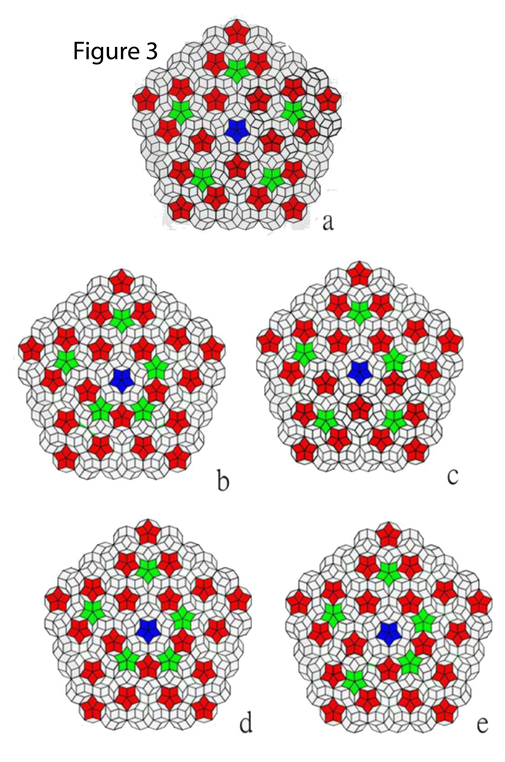
Figure 3: Convert of trinary Penrose pentagonal tile in to binary Penrose pentagonal tile (a) symmetry, (b,c,d,e) asymmetry
FIGURE 4
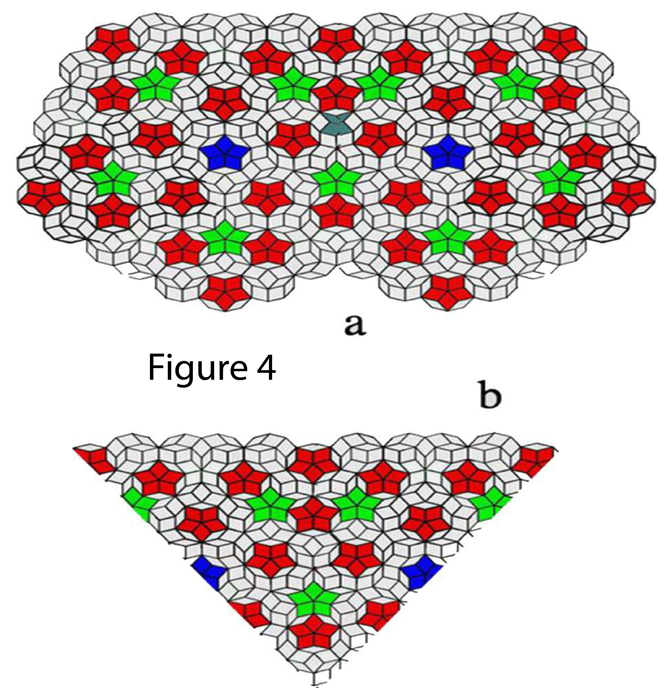
Figure 4: (a) The pentagonal shape Penrose tile with proper coupling on center of top right most (the far ) end right, (b) a symmetric triangle by appropriated cutting through the blue dark star in figure 4 (a), with ten decagons on one side.With a defective decade marked as dark grey
FIGURE 5
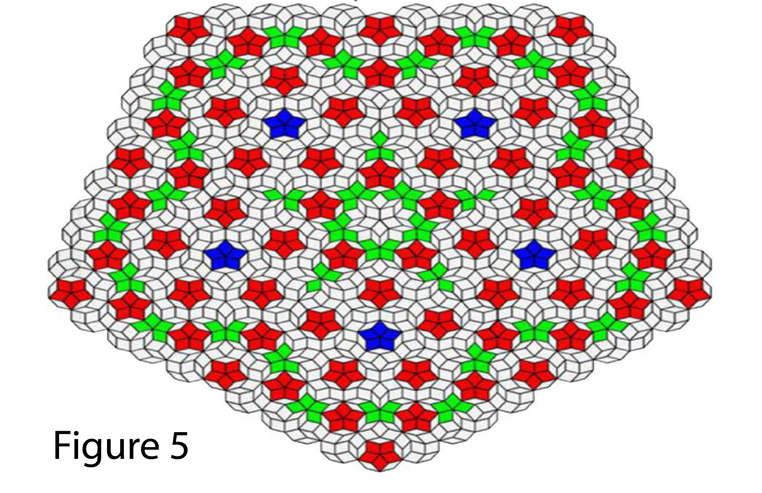
Figure 5: Further splice coupling of figure 4 (b) resulting a pentagonal shape Penrose tile with ten decagons per side
FIGURE 6
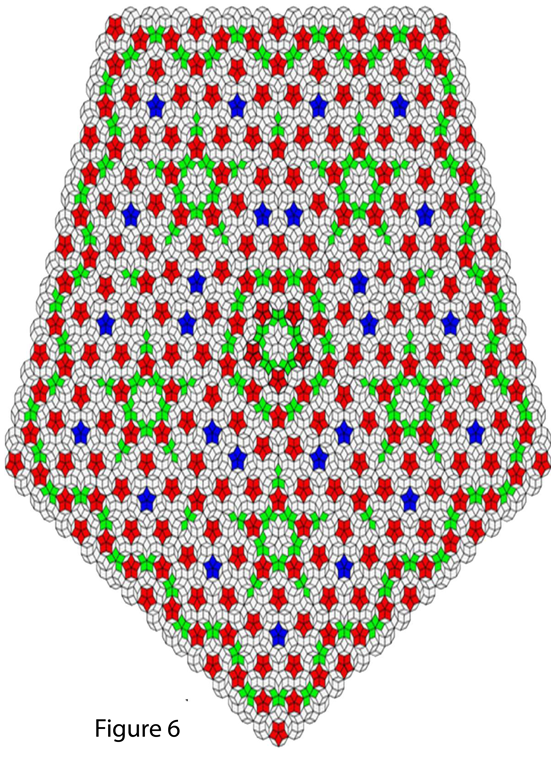
Figure 6: Further coupling resulting in pentagonal shape five-fold symmetry Penrose tile with twenty decagons per side
FIGURE 7
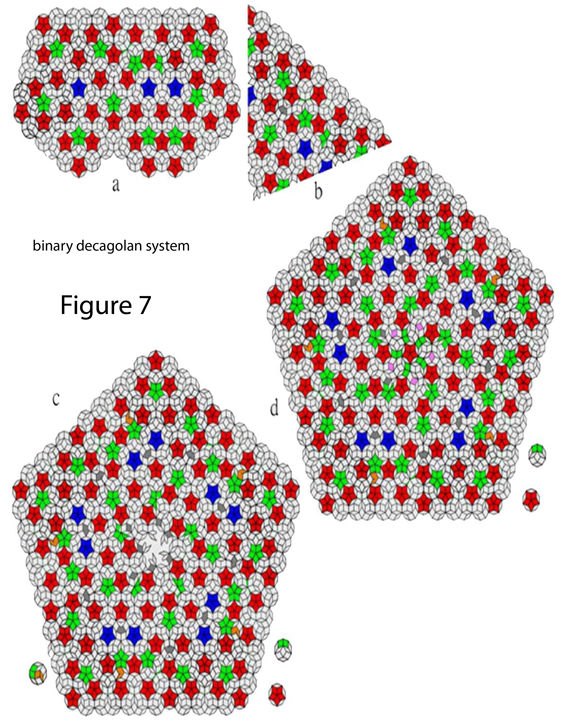
FIGURE 8
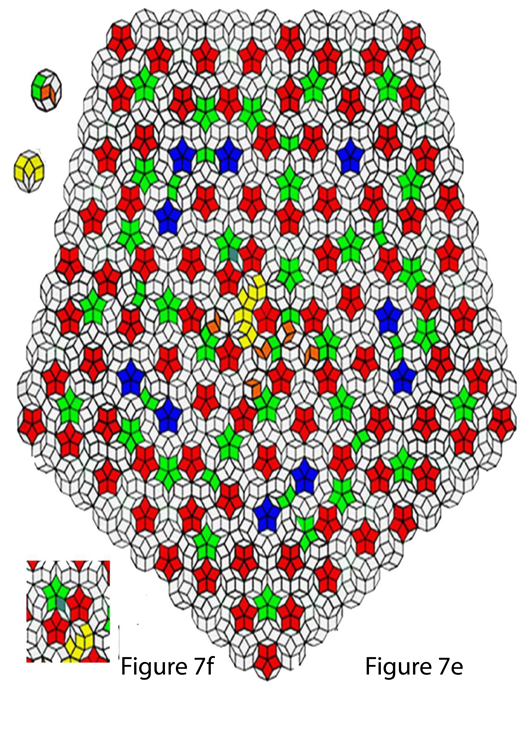
Figure 7: (a) Appropriate coupling of three asymmetric Penrose tiles in x-direction. (b) Cutting through the center of blue star in figure 7a to form an asymmetric triangle. (c) Five splice of rotation asymmetric graph is figure 7(b) to form a symmetric Penrose tile with a complicated center region. (d) Center region of figure 7(c) is repaired to form a convention binary Penrose tile, but with five defective decagons marked as grey color. (e) Asymmetry Penrose tile formed by splice of figure 7(a), containing other types of decagons type-d and type-e as well as a seemly unavoidable defect marked as grey color
FIGURE 9
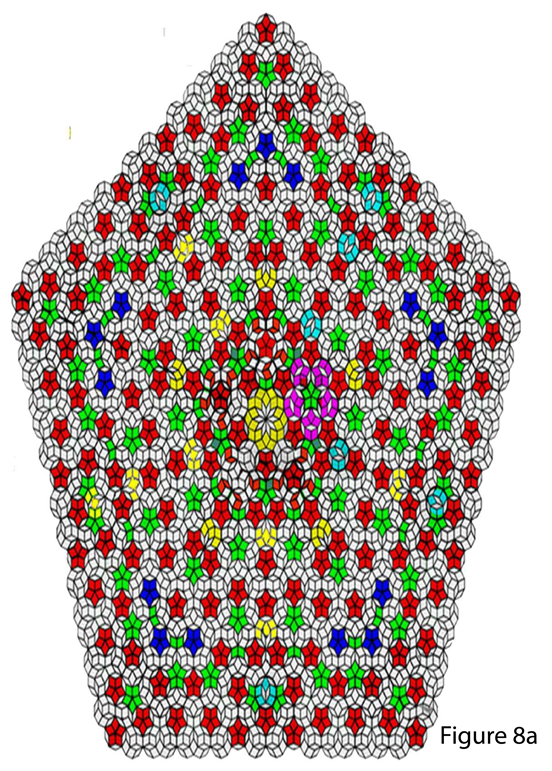
FIGURE 10
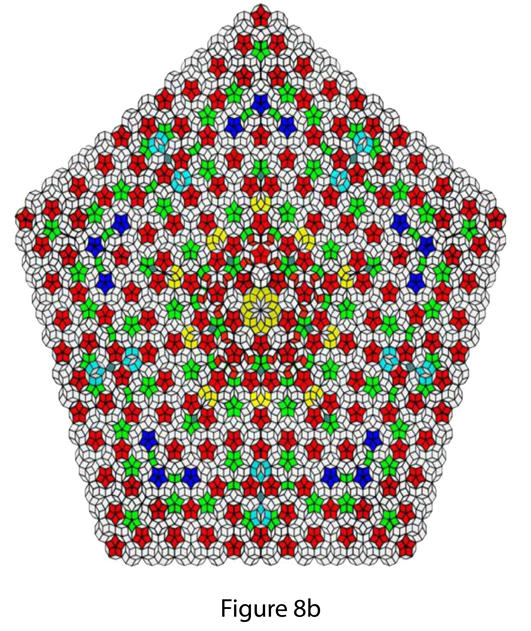
Figure 8
Figures at a glance