
Intellectual Property Blockchain “IPTECH”
Received Date: December 31, 2024 Accepted Date: January 31, 2025 Published Date: February 03, 2025
doi:10.17303/jcssd.2025.4.101
Citation: Saeed Ali Faris Alketbi, Massudi bin Mahmuddin (2025) Intellectual Property Blockchain “IPTECH”. J Comput Sci Software Dev 4: 1-10
Abstract
Intellectual Property (IP) management is of paramount importance in the contemporary business landscape, serving as a safeguard for the creative endeavors of inventors, artists, and entrepreneurs. Recognizing the intrinsic vulnerabilities within the realm of IP, governments worldwide are increasingly exploring the transformative potential of blockchain technology. This exploration is rooted in the pursuit of rendering IP management more efficient, transparent, and secure. Moreover, it extends to leveraging blockchain for the governance, protection, and enforcement of intellectual property rights. The research outlined herein underscores the global commitment to enhancing IP protection, with a particular focus on Blockchain Intellectual Property initiatives led by government bodies. This study offers an in-depth exploration of Blockchain Intellectual Property, shedding light on its efficacy in protecting virtual assets, fostering innovation and growth, while also acknowledging its inherent limitations and implementation challenges. Additionally, it delves into the stance of the World Intellectual Property Organization (WIPO) and the United Arab Emirates' (UAE) support for blockchain, presenting practical applications and insights gleaned from the WIPO white paper.
Keywords: Blockchain; IP; IPTech; Fintech Government; Blockchain Technology
Introduction
In the era of digitalization, the imperative of safeguarding virtual data has never been more pronounced. Consider a scenario where countless hours of creative effort and innovation culminate only to witness another entity claiming undue credit. In response to this evolving landscape, the government of Dubai has displayed a profound interest in harnessing the capabilities of blockchain technology, particularly concerning intellectual property [1].
Since the inception of the internet, the paradigm of accessing services and information has undergone a profound transformation, offering real-time access with the assurance of data immutability. However, significant challenges persist in specific domains of online security, notably data protection and identity verification. Smart contracts, which are activated on blockchain networks upon meeting predefined conditions, have emerged as a groundbreaking solution within the digital realm [2]. The post-Covid-19 era has witnessed a notable upswing in innovation, with Artificial Intelligence (AI) and the Internet of Things (IoT) poised to redefine the structures of governance systems [3].
The significance of open data in fostering transparency, citizen participation, and initiatives such as open government has garnered widespread recognition. A recent study conducted by Ahmed, Mahmuddin, and Mahat underscored the importance of assessing variables related to citizen satisfaction in the context of open government data in Malaysia [4]. Intellectual property, encompassing the protection of unique creations such as designs and artworks, necessitates safeguarding mechanisms like patents and copyrights to harmonize innovation with rightful ownership [5]. The pursuit of bolstered data security through blockchain technology emerges as a pivotal inquiry. Blockchain has the potential to deliver substantial value to intellectual property management by supporting the entire lifecycle of applications [6]. The forthcoming years anticipate a convergence of revolutionary technologies, including blockchain and the Internet of Things [7]. Notably, a white paper published by WIPO highlights the transformative potential of blockchain technology in elevating the core facets of intellectual property management [8].
The Government Involvement and the Initiative in “BCIP”
The UAE government is actively pursuing the establishment of a robust digital economy, leveraging the myriad benefits of cutting-edge technologies [9]. Recognized as a technological forerunner, the UAE is pivoting towards Blockchain for digital transactions, associating each user with a unique identifier linked to their Blockchain-secured data [10]. This technology ensures data security and facilitates efficient processing, which in turn aids the nation in achieving its long-term objectives. My research, stemming from various discussions and interviews, has culminated in a system that leverages blockchain technology for intellectual property rights management [11]. This system is projected to bolster intellectual property rights protection internationally, facilitating collaboration between global entities and governmental bodies. Notably, Dubai Customs recently secured intellectual property certification for this innovative approach from the Ministry of Economy, following an earlier acknowledgment from the World Intellectual Property Organization (WIPO) [12].
Blockchain Services to the Users
Since its inception, the intrigue around blockchain technology has surged, giving rise to various blockchain-powered services [13]. Consider the commonplace act of online money transfer: traditional methods involve intermediaries, adding layers of time and cost to the process. Blockchain circumvents these complications, streamlining transaction processes and offering both time and cost efficiencies [14].
Real-World Examples of Intellectual Property Technology (IPTECH)
Blockchain in intellectual property (IP) offers several realworld applications:
- Blockchain can facilitate patent registries by providing a transparent and tamper-proof record of ownership and transfers.
- It can secure digital content management, safeguarding digital assets like music, videos, and images.
- Furthermore, a blockchain-driven platform for trademark management can mitigate unauthorized trademark usage and infringement [15].
These examples underscore the profound impact of Blockchain on enhancing IP protection by introducing heightened levels of transparency and security.
Intangible Assets
Blockchain technology, by its very design, provides a more efficient and reliable means to verify transactions than conventional centralized systems [16]. This technological evolution has sparked a slew of ideas centered around trust, data traceability, and security. Consequently, some IP industry experts advocate for Blockchain as an alternative to conventional IP protection mechanisms [17]. As intangible assets like knowledge, domain names, and patents become pivotal economic drivers, technologies like Blockchain, AI, and IoT are forecasted to engender novel intellectual property management models.
How Blockchain Will Work in Intellectual Property
Blockchain's inherent qualities make it a potent tool for managing and safeguarding intellectual property rights. Its decentralized structure ensures robust tracking of digital assets and their transactions, which can mitigate IP infringements and streamline IP management [18]. Notably, Blockchain's immutability is its key strength, ensuring that once data is recorded, it remains permanently, thereby establishing an incontrovertible proof of creation or ownership.
Challenges and Problems of Implementing BCIP
Despite its promises, the integration of blockchain into intellectual property (IP) protection presents significant challenges:
Technical Challenges
- Scalability and Sustainability: Blockchain needs to be scalable and sustainable to accommodate extensive transaction volumes, especially of large IP portfolios.
- Interoperability: Ensuring seamless operation and compatibility across different blockchain systems and versions is vital.
- Data Storage: High data volumes need to be efficiently stored, posing challenges to the existing infrastructures.
- Device Upgrades: Stakeholders will need to upgrade their devices to handle blockchain's demands [19].
- Legal Challenges: Inter-Country Regulation: The legal framework around blockchain varies between countries, creating inconsistencies.
- Legal Status and Ownership: Ambiguities continue around the legal status of blockchain-based assets and smart contracts, with clear ownership and rights still evolving.
- GDPR and Confidentiality: Blockchain must navigate GDPR and other data protection requirements to ensure user privacy.
- Governance and Regulatory Interoperability: Challenges such as different legal frameworks, lack of standards, data protection issues, digital identity, etc., hinder blockchain adoption [20].
- Awareness and Product Maturity: Many stakeholders in the IP community lack awareness about blockchain's potential, and the immaturity of certain blockchain products makes them less attractive than traditional solutions.
The digital landscape has revolutionized content creation and distribution, accentuating the need for robust IP protection mechanisms. With its promises of increased transparency and security, blockchain is primed to play a transformative role in this arena.
World Intellectual Property Rights (WIPO)
WIPO, as a neutral body, has the potential to spearhead the exploration of blockchain solutions in the IP space. Established under the Paris and Berne Conventions, WIPO has played a crucial role in shaping global IP norms and standards. With its multifaceted responsibilities, from patent application handling to framing IP policies, WIPO is pivotal in promoting innovation and safeguarding intellectual property rights on a global scale [21].
The Main Idea
The main idea of this project is to explore the potential use of Blockchain for Intellectual Property rights while spotlighting the dedication of the Dubai government to this cause. Through this project, we aim to create a decentralized system that simplifies the process of registering and managing IP rights using blockchain. This new system will harness the capabilities of smart contracts to automate various tasks, ultimately saving time, reducing manual errors, and increasing efficiency.
Method/Plan
For the prototyping phase, a local host blockchain was employed. We used the solidity programming language to craft smart contracts for our BCIP platform. Tools such as Remix, Ganache, Truffle, and Metamask were integral in the development process. Comprehensive testing and auditing ensured that the platform met security and reliability standards.
The New Idea
A shift towards blockchain can revolutionize the current Intellectual Property landscape. With the Dubai government's backing, a more efficient, transparent, and secure ecosystem for IP rights is envisioned. Blockchain could address key challenges, including disputes over invention timelines and the complexities of managing IP in a global market.
Coding/ Algorithms Used
For this project, we primarily used Solidity, an objectoriented programming language for writing smart contracts on the Ethereum blockchain. To ensure maximum security and efficiency, we applied several algorithms and followed best coding practices.
Explanation: This segment of code defines the primary contract called "Blockchain." Within this contract, we define structures for trademarks, copyrights, and patents. Each structure contains details like name, description, date, market value, and the owner. The mappings then associate unique identifiers to these structures, ensuring easy and secure storage and retrieval.
Explanation: This code section demonstrates how users can register trademarks and copyrights. Each registration function generates a unique hash for the given details and ensures that the IP isn't already registered. The getTM function allows for the retrieval of trademark details using the unique hash.
Functionality Explanation
The provided code encompasses three essential functions dedicated to the registration and retrieval of trademarks and copyrights within the blockchain-based Intellectual Property (IP) management system. Each function serves a distinct purpose in the efficient management of intellectual property rights. The following section elaborates on the functionality of these functions:
registerTM Function
The registerTM function is responsible for the registration of new trademarks within the blockchain system. It accepts four essential parameters: name, description, date, and marketValue. The operational steps of this function are delineated as follows:
Unique Hash Generation: Initially, the function employs the keccak256 hashing algorithm to create a unique tmHash. This hash is derived from the amalgamation of the input parameters, namely name, description, date, and marketValue.
Verification of Existence: To ensure the uniqueness of trademarks, a require statement is instituted. This statement ascertains whether a trademark with the generated tmHash already exists within the system. The verification hinges on the evaluation of the owner field of the trademark, which should be an empty address (address(0)). If a trademark with an identical hash is already registered, the function aborts execution, and an error message "TradeMark already registered" is conveyed.
Trademark Registration: In the absence of a preexisting trademark associated with the tmHash, the function proceeds to instantiate a new TradeMark struct. This newly created struct is then associated with the generated tmHash, serving as its unique identifier within the tradeMarks mapping.
Return Value: Subsequently, the function returns the tmHash of the freshly registered trademark. This tmHash serves as an exclusive reference to the trademark, facilitating subsequent management within the blockchain.
getTM Function
The getTM function is purpose-built for the retrieval of comprehensive information pertaining to a specific trademark based on its unique tmHash. The elucidation of its functionality is presented below:
Trademark Retrieval: Upon invocation, the function initiates the retrieval process by accessing the tradeMarks mapping using the provided tmHash. This action retrieves the complete set of information associated with the target trademark.
Existence Verification: To ensure the existence of the specified trademark, the function employs a require statement. This statement scrutinizes the owner field of the trademark to confirm that it is not an empty address (address(0)). In the event of an absent trademark, the function aborts, and an error message "TradeMark does not exist" is returned.
Information Extraction: In the presence of the trademark, the function proceeds to extract and return its particulars. These include the trademark's name, description, date, marketValue, and owner. Such comprehensive information empowers users to access and validate the specific attributes of a registered trademark seamlessly.
registerCR Function
The registerCR function mirrors the functionality of the registerTM function but caters to the registration of copyrights within the blockchain system. It accepts identical parameters: name, description, date, and marketValue. The following stages elucidate its operation:
Unique Hash Generation: Analogous to the registerTM function, the registerCR function initializes by generating a unique crHash. This hash is produced through the keccak256 hashing mechanism, encompassing the input parameters: name, description, date, and marketValue.
Existence Verification: A require statement is employed to validate whether a copyright associated with the generated crHash already exists within the system. This verification relies on the evaluation of the owner field of the copyright, which should remain unassigned (address(0)) for non-existent copyrights. Should a copyright with an identical hash be detected, the function ceases execution, and an error message "CopyRight already registered" is emitted.
Copyright Registration: In the absence of an extant copyright linked to the crHash, the function proceeds to instantiate a new CopyRight struct. This newly created struct is then associated with the generated crHash, serving as its unique identifier within the copyRights mapping.
Return Value: Finally, the function returns the crHash of the recently registered copyright. This crHash offers a distinctive reference to the copyright, facilitating subsequent management and verification within the blockchain ecosystem.
In summary, these meticulously designed functions collectively enable the streamlined registration and retrieval of trademarks and copyrights within the blockchain-based Intellectual Property management framework. Notably, while this code segment predominantly focuses on trademarks and copyrights, a parallel approach can be employed to manage patents effectively by crafting analogous functions grounded in the structure of the registerTM and getTM functions.
Conclusion
BCIP significantly impacts how individuals protect and manage Intellectual property. Intellectual property is vulnerable and needs protection such as patents, trademarks and Copyright. To make the system more efficient and reliable, a Blockchainbased platform is required. Blockchain Intellectual Property can provide transparency and reliability in Intellectual Property management. The Blockchain-based platform is powerful as it provides security and ensures fast services. It saves time through the fast transfer of information and verification. The system allows users to manage their intellectual property rights through blockchain technology. With all the system's advantages, it also has challenges and limitations to its performance. Technical complexities and legal barriers are some of the downsides faced by the system. Despite these limitations and challenges, the blockchain Intellectual Property System highlights and presents the efforts made toward improved performance in the security and management of Intellectual Property.
- Dubai Government (2022) "Blockchain Applications in Governance,"
- Gondhek (2023) "Smart Contracts and Blockchain," Journal of Digital Innovations.
- Himanshi (2022) "AI and IoT in Modern Governance," Tech Review.
- MS Ahmed, M Mahmuddin, NI Mahat (2017) "Open Data and Citizen Satisfaction in Malaysia," Journal of Engineering and Applied Sciences, 12: 3843-6.
- World Intellectual Property Organization (2022) "Protection Mechanisms for IP,"
- WIPO (2023) "Blockchain in IP Management,"
- Shawwal (2023) "Future of Technologies and Business Innovations," Business Journal.
- World Intellectual Property Organization (2023) "Blockchain in IP," White Paper.
- Mohammed Shihab Ahmed, Massudi Mahmuddin, Nor Idayu Mahat (2017) The International Journal of Business & Management, 12: 3843-6.
- WIPO "Blockchain technologies and IP ecosystems: A WIPO white paper."–
- Gondhek C. Blockchain and Intellectual Property Rights Protection Technology. Originstamp.
- Shawwal (2023) A Dubai Customs employee creates a smart intellectual property management system. Dubai.
- WIPO. Blockchain and intellectual property. WIPO.
- Himanshi (2022) Proof of Authority (PoA) in Blockchain.
- Denter NM, Seeger F, Moehrle GM (2023) How can Blockchain technology support patent management? A systematic literature review, Int J Inf Manage, 68.
- Peer to peer resource discovery mechanisms in grid computing: a critical review. Mowafaq SalemAlzboon, Suki Arif, M Mahmuddin, Omar Dakkak (2015) The 4th International Conference on Internet Applications, Protocols and Services (NETAPPS2015), 48-54.
- WIPO (2020) WIPO Technology Trends 2019: Artificial Intelligence, Journal of Science Communication, 163: 51-9.
- World Intellectual Property Organization (WIPO) (2022) Global Innovation Index 2022. What is the future of innovation-driven growth?. WIPO.
- European Union Intellectual Property Office (2020) 2020 Status Report on IPR Infringement.
- UNCTAD (2021) Harnessing blockchain for sustainable development: prospects and challenges. June 25.
- World Intellectual Property Organization (WIPO) (2022) Global Innovation Index 2022. What is the future of innovation-driven growth?. WIPO.
- Himanshi (2022) Blockchain in Intellectual Property: Benefits, Challenges, and the Future.–
- Ethereum Foundation (2021) Solidity Documentation.
- Ganache (2020) Quickstart Guide.
- Truffle Suite (2020) Truffle Framework Documentation.
FIGURE 1
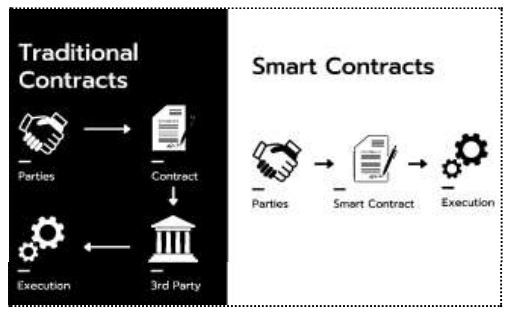
Figure 1: Various diagrams showcasing the Blockchain and Intellectual Property Rights Protection Technology, and the final objective for IP Management
FIGURE 2
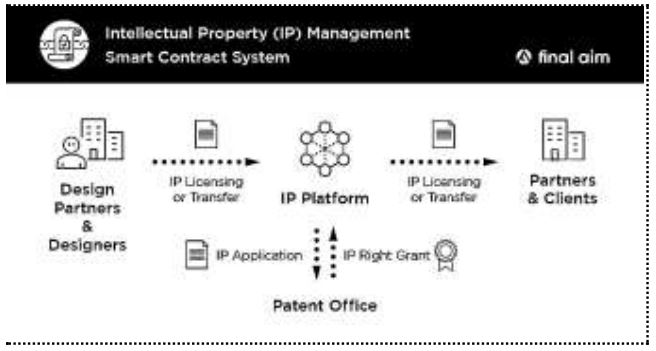
Figure 2: Final aim filed Patent for Intellectual Property Management System
FIGURE 3
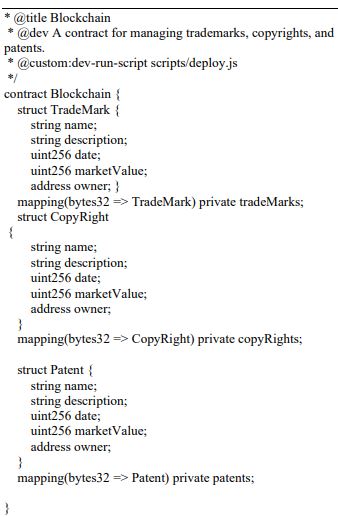
Blockchain IP Code (Part 1)
FIGURE 4
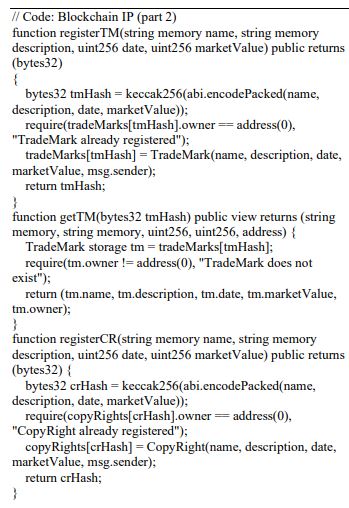
Blockchain IP Code (Part 2)
Figures at a glance