
Oral Hygiene Status of Children with Autism Spectrum Disorders: Cross Section Study
Received Date: February 15, 2023 Accepted Date: March 15, 2023 Published Date: March 18, 2023
doi: 10.17303/jdoh.2023.10.102
Citation: Abdalmawla Alhussin Ali, Karima Ali Belgasem (2023) Oral Hygiene Status of Children with Autism Spectrum Disorders: Cross Section Study. J Dent Oral Health 10: 1-5
Abstract
Aim: The aim of the current study was to evaluate the oral hygiene status on children with autism in Sirte-Libya
Patients and Methods: A descriptive cross-sectional study was carried out with a total of 24 participants, examination of the status of oral hygiene by using simplified oral hygiene index with dental mirror, dental explorer and portable light source.
Results: moderate level of dental plaque, calculus and the OHI-S scoring of autistic patients was 1.08.
Conclusion The main finding of the study was observed the oral health of children participants in this study have fair oral hygiene, therefor, attention is required to plan a comprehensive dental health care program for these group of patients
Keywords: Autism Spectrum Disorder; Oral Hygiene; Sirte –Libya
Introduction
The third place after mental retardation and cerebral palsy among the most common developmental disorders is the autism. Autism spectrum disorders (ASD), a set of developmental, psychological, and neurological disorders that occur in early childhood, and was first described by Leo Kanner in 1943 [1]. It has a prevalence of 1 case for every 150 children, it is more predominant among males than females, with a 4:1 rate [2,3]. The exact etiology of ASD is still unclear but had been reported as post encephalitic infection, autoimmune factors in many cases associated with a genetic base. The main characteristics of autistic children are associated to socialization problems, communication deficit, and cognitive inflexibility [1].
The autistic children have several oral features due to their behavior such as eating habits, limit the communication, self-injurious behavior like lip biting, resistance to oral care, and hyposensitivity to pain are the common oral problems associated with autistic children [4,5]. In addition, anterior open bite, dental crowding, class II molar relationship and tongue thrusting are the orthodontic disorders in autistic children [6].
Previous studies aimed to assessment the oral health of autistic children. Some studies [3,7] reported that autistic children had less caries experiences and better gingival health despite poor oral hygiene conditions. In India, previous study [8] reported that children with ASD had higher incidence of caries and gingivitis and concluded that the association between functional limitations and poor oral health is significantly higher in patients with ASD. Jaber [9], reported that autistic patients have more caries, poorer oral hygiene and does not receive adequate oral health-care.
The services for dental treatment for patients with ASD was reported to be limited due to financial resources in addition to restricted knowledge and experience of dentists in how to manage these cases [10]. Few statistics are available in Sirte-Libya regarding the oral health condition of autistic children, for this reason, this study aimed to determine the oral health status of a group of children with autism in Sirte – Libya.
Patients and Methods
A cross sectional descriptive survey was carried out with a total of 24 children diagnosed with autism, and their ages ranged from 3 to 14 years. The permission to conduct the study was gained from the director of the rehabilitation center. Clinical data was collected and assessment of the oral hygiene of children was done by two dentists under one main researcher, the medical records of each patient were checked, taking note of the habits and their following any physician recommended diet, examination was carried out using mouth mirror, dental explorer, disposable gloves, and gauze., and used a lightweight portable examination light evaluating for the presence of plaque, and calculus according to the Silness and Loe plaque index (11).
The OHI-S index (simplified oral hygiene index) is composed of the combined Debris Index DI-S and Calculus index CI-S, The OHI-S index for each patient was calculated by dividing the total sum with the number of groups.Oral hygiene status of children were classified according to OHI-S index rating as following good (score= 0-1.2), fair (score= 1.3- 3) and poor (score= 3.1- 6). Data were tabulated and analyzed using SPSS software package version 20.0 and Chi square test were used for data analysis.
Results
Demographic data of the study participants, males represented 58.3% (14 child) and 41.6%(10 child) were females. Autistic children in the study were in the age range 3–14 years with mean. In terms of the periodontal health, this study determined that 12.5% (3 patients) of participants did not have any clinical signs of periodontal disease, and we observed that 87.5% of the sample that was diagnosed with gingivitis, and 50.0% that patients who suffered from calculus. The Simplified Oral Hygiene Index was 1.08. The OHI-S scoring of participates in this study have fair oral hygiene.
Discussion
As the prevalence of autistic children has increased in recent years, and their behavioral disorders generally make oral hygiene and dental care more complex in these patients, children with mental, physical or medical disabilities often require special oral health care [12,13]. It is important for dental professionals to further understand the experiences and challenges encountered by these children [14].
As little information is available on the oral health conditions of children with ASD in Sirte, and the need for obtaining a solid data regarding the dental health of autistic children is becoming essential. This study was conducted to provide such valuable information and a base data for further oral health care improvement for children with ASD in Sirte - Libya.
The current study demonstrated that moderate amount of plaque accumulation found
in children with an ASD and autistic children have a fair oral hygiene with mean of 1.0. same results were founded in comparison with autistic children in Chile that showed an average OHI-S index score of 1.03 as demonstrated by Orellana et al., 2012 [15]. This finding corresponds to results from many studies (6, 16,17) who reported that the plaque index value and periodontal disease of autistics were frequently found to be statistically higher compared to healthy children.
This result is lower than those obtained by Mariana, 2017 [18] who after evaluated 96 autistic patients concluded that 83.3% that was diagnosed with gingivitis, 59.41% of the total sample suffered from calculus and the Simplified Oral Hygiene Index was 3.4. Autistic children participate in this study had lower OHI-S average value than Indians children of 2.19 average score as demonstrated by Subramaniam and Gupta, 2011 [8]. Also, Mohamed et al., 2021 [19], who detected that the OHI-S scoring showed that 100% of autistic patients of the current study have poor oral hygiene.
Conclusions
In conclusion, from the results of our study results that can be concluded Autistic children participates have fair hygiene. The findings suggest that preventive educational interventions with emphasis on healthy diet and teaching proper tooth brushing technique may be desirable to improve oral health and self-care of children with ASD.
- Kanner L (1943) Autistic disturbances of affective contact. Nervous Child 2: 217-50.
- Varela-González DM, Ruiz-García M, Vela-Amieva M, Munive-Baez L, Hernández-Antunez BG (2011) Conceptos Actuales sobre la etiología del Autismo. Acta Pediatr Mex 32: 213-22.
- Namal N, Vehit HE, Koksal S (2007) Do autistic children have higher levels of caries? A cross-sectional study in Turkish children. J Indian Soc Pedod Prev Dent 25: 97-102.
- DeMattei R, Cuvo A, Maurizio S (2007) Oral assessment of children with an autism spectrum disorder. J Dent Hyg 81: 65.
- Medina AC, Sogbe R, Gomez-Rey Am, Mata M (2003) Factitial oral lesions in an autistic paediatric patient. International Journal of Paediatric Dentistry 13: 130-7.
- Luppanapomplarp S, Leelataweewud P, Putongkam P, Ketanont S (2010) Periodontal status and orthodontic treatment need of autistic children.World J Orthod11: 256-61.
- Loo CY, Graham RM, Hughes CV (2008) ‘The caries experience and behavior of dental patients with autism spectrum disorder’, The Journal of the American Dental Association 139: 1518-24
- Subramaniam P, Gupta M (2011) ‘Oral health status of autistic chil-dren in India’, Journal of Clinical Pediatric Dentistry 36: 43-8.
- Jaber MA (2011) ‘Dental caries experience, oral health status and treat-ment needs of dental patients with autism’, Journal of Applied Oral Sci-ence 19: 212-7.
- Purohit BM, Acharya S, Bhat M (2010) Oral health status and treatment needs of children attending special schools in South India: a comparative study. Spec Care Dentist 30: 235-41.
- Sillness J (1964) ‘Periodontal disease in pregnancy. II. Correlation between oral hygiene and periodontal condition’, Acta Odontol. Scand 24: 747-59.
- Regn JM, Mauriello SM, Kulinski RF (1999) ‘Management of the au-tistic patient by the dental hygienist’, J Pract Hyg 8: 19-23.
- Waly AS (2020) Dental Management of Children with Special Health Care Need. EC 14.Dental Science 19: 01-08.
- Weil TN, Inglehart MR (2012) ‘Three-to 21-year-old patients with autism spectrum disorders: Parents' perceptions of severity of symp-toms, oral health, and oral health-related behavior’, Pediatric Dentistry 34: 473-79.
- Orellana LM, Silvestre FJ, Sanchis SM, Mihi VM (2012) Oral manifestations in group of adults with autism spectrum disorder. Med Oral Patol Oral Cir Bucal 17: 415-9.
- Vajawat M, Deepika PC.Comparative evaluation of oral hygiene practices and oral health status in autistic and normal individuals. J Int Prev Community Dent 2: 58-63.
- B Kuter, N Guler (2019) Caries experience, oral disorders, oral hygiene practices and sociodemographic characteristicsof autistic children. European Journal of Paediatric Dentistry 20: 3
- Mariana C (2019) Oral Health Assessment of a Group of Children with Autism Disorder. The Journal of Clinical Pediatric Dentistry 41: 2.
- Mohamed A Ahmed, Nagwa M, Khattab Ahmad A, Elheeny (2021) Oral hygiene status among group of Egyptian autistics children: A cross sectional survey 32: 82-5.
FIGURE 1
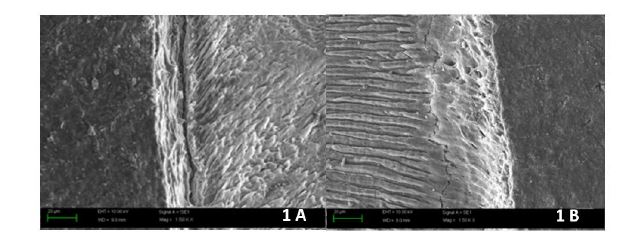
Figure 1: SEM photomicrograph of resin- dentin interface of Group 1 (No Pretreatment): Immediate (1A), Delayed (1B); interfacial gap is evident at nine months.
FIGURE 2
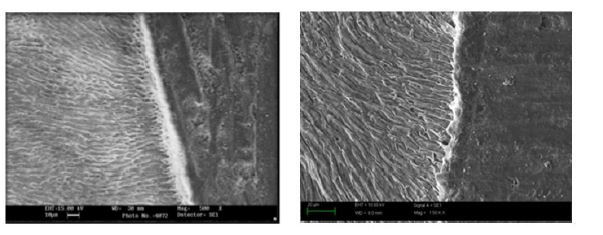
Figure 2: SEM photomicrograph of resin- dentin interface of Group 2 (Baicalein): Immediate (2A), Delayed (2B); good interfacial adaptation can be observed at both time periods.
FIGURE 3
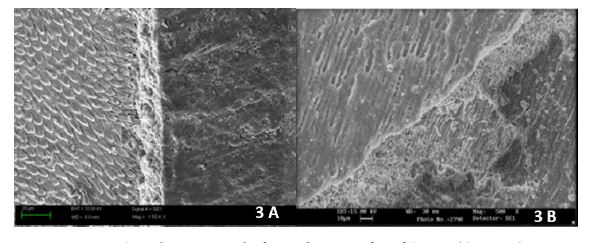
Figure 3: SEM photomicrograph of resin- dentin interface of Group 3 (Curcumin): Immediate (3A), Delayed (3B); good interfacial seal is evident.
FIGURE 4
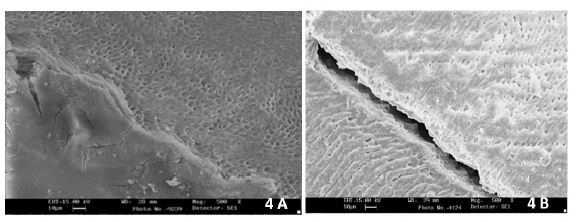
Figure 4: SEM photomicrograph of resin- dentin interface of Group 4 (Berberine): Immediate (4A), Delayed (4B); interfacial gap is observed at nine months.
FIGURE 5
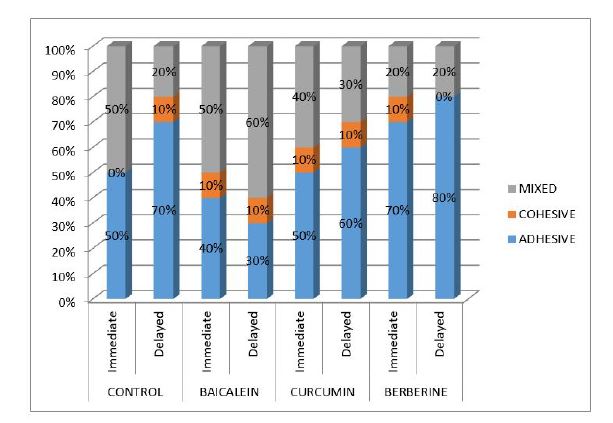
Figure 5: Failure mode analysis
Tables at a glance