
Formulation of Gluten-Freee Baked Cookies with Fiber Prepared Using a Range of Trapa Natans (Water Chestnut) Flour Fortified with Prunus Dulcis (Almond) Flour.
Received Date: April 11, 2023 Accepted Date: May 11, 2023 Published Date: May 13, 2023
doi: 10.17303/jfn.2023.9.201
Citation: VMadhura Padmakar Desai, Hanmant B Bodhankar (2023) Formulation of Gluten-Freee Baked Cookies with Fiber Prepared Using a Range of Trapa Natans (Water Chestnut) Flour Fortified with Prunus Dulcis (Almond) Flour. J Food Nutr 9: 1-10
Abstract
Study of cookies was carried out at the department of Food and Technology Parul Institute of Applied Sciences, Parul University, Vadodara, Gujarat. The Nutritional, sensory, proximate, and microbial analysis of cookies made from Water chestnut and Almond Flour using varying ranges of their blends was performed. Three formulations with different variations of cookies were prepared (a) Control (100% WF), (b) C1 (100% WCF), (c) C2 (80% WCF and 20% AF), (d) C3 (70% WCF and 30% AF). The purpose of conducting the study is to produce water chestnut cookies that will add gluten-free cookies along with fibre content for gluten-sensitive consumers as well as for other consumers. Water chestnut cookies were manufactured using the following processing steps – Mixing different dry and wet ingredients into a homogenous mixture. Shaping the dough by using a cookie cutter. Baking the cookies at 180 degrees Celsius for 15 minutes followed by cooling. Cookies were subjected to physio-chemical analysis to evaluate their Moisture Content, Ash Content, Protein, Carbohydrate, Fat, and Dietary Fibre. The Sensory Evaluation of the cookies samples was carried out for consumer acceptance and preference of three different ranges of formulation using 3 untrained professors of Parul University department of food technology based on appearance, colour, texture, taste, and overall acceptability. The findings confirmed that cookies prepared from (70% WCF and 30% AF) i.e.C3 sample show good response than other formulations.
Keywords: Water chestnut flour; Almond flour; Fibre; Gluten free cookies
Introduction
Ready-to-eat processed foods are highly demanded worldwide as they have a better shelf life, high nutritional quality, satisfying taste, and easy palatability, and due to the growing urbanization and increased employment of women in the industrial and public sectors. Bakery products are the most important items that can satisfy these requirements. (Chavan, J. K, Kadam, S.S. et.al 1993) Cookies are one of the best-known quick bakery snack products (Farheena et al. 2015; Olaoye et al. 2007) described cookies as nutritive snacks produced from unpalatable dough that is transformed into appetizing products through the application of heat in an oven. (Peter Ikechukwu et.al. 2017)
Celiac disease is an autoimmune-mediated disease also called gluten-sensitive disease triggered by the consumption of gluten protein by genetically predisposed individuals (Anu Bala et.al. 2015, Marsh et.al. 1992). Wheat, a staple food for most populations in the world, and other cereals such as rye and barley are the major source of Gluten in it (Anu Bala et.al. 2015, Mir et.al. 2014a). Since is one of the common lifelong disorders. A strict lifelong gluten-free diet is the only treatment for this disease. Almost all ages of people can suffer from celiac disease, commonly in early childhood (E Arendt et.al. 2011). The basic ingredient in bakery products is wheat flour. The quality of the wheat flour is diminished nutritionally after milling even further in the refining of flour. Water, yeast, salt, egg, sugar, shortening fat, dough conditioners, improvers, and baking powder are the common ingredients mixed with refined flour. These ingredients do not add proteins to bakery products. Hence, most bakery products are low in quality proteins as well as poor in minerals and vitamins. Enriching the products with high-quality non wheat proteins. Recently, attempts have been made to incorporate non wheat sources of vegetable proteins and fibre to enrich bakery products. (Chavan, J. K, Kadam, S.S. et.al 1993)
Trapa natans are commonly known as singhara nut or water chestnut (English), singhara or simkhata (Hindi). The fruit is used as a substitute for cereal in Indian subcontinent during fasting days during Navatras and other fasting and sacred days. Flour is prepared using dried fruit that is easily digestible and has less or no fat content. (Pusteet.al. 2004). The good replacement of Wheat flour is Water Chestnut flour with respect to Celiac disease caused by indigestion of gluten (wheat protein) (GD Singh et.al. 2011). The water chestnut kernels are a good source of minerals such as calcium, phosphorus, iron, copper, manganese, magnesium, and potassium. The kernels also contain some vitamins like thiamine, riboflavin, nicotinic acid, Vitamin C, and Vitamin A. (Krishnaiya, et.al. 2015).
Almond is an underutilized crop which belongs to a group of nuts with hard shelled seeds enclosing a single edible kernel (Othmer et. al. 1976). The almond tree also called Tropical almond, is primary a coastal tree belonging to the family combretaceae (Adesina et.al. 2013).
In the study, the raw material used is Water Chestnut flour and Almond flour were blended in various proportions to make gluten-free cookies to replace Wheat flour. The present study was as such carried out to prepare cookies from Water chestnut flour by supplementation with different proportions and study their functional and organoleptic properties.
Materials and Methods
The present study entitled “Formulation of Gluten-Free Cookies with Fibre using Water Chestnut and Almond Flour” was carried out in the Department of Food Technology, Parul Institute of Applied Sciences, Parul University, Vadodara. This section enlists the material used and elaborates on the processing techniques, organoleptic evaluation, and analytical procedure following during the research.
Materials
Raw materials used in studiesThe ingredients used in preparation of Gluten free cookies are Water Chestnut flour, Almond flour, Bakery shortening(dalda), sodium chloride salt, sugar powder, sodium bicarbonate, Milk powder were all procured from the local market at Vadodara, Gujarat.
Processing EquipmentEquipment required for the preparation of Water Chestnut cookies are Weighing Balance, Bowl, Whisker, measuring cups, molds, Baking Oven, Mixer, Freezer, and other utensils were obtained from the Food Processing Lab, Department of Dairy Technology, Parul Institute of Technology, Parul University, Vadodara.
Methods
Physio-chemical AnalysisWater Chestnut flour, Almond flour, Bakery shortening(dalda), sodium chloride salt, sugar powder, sodium bicarbonate, and Milk powder were used to prepare Gluten Free Water Chestnut cookies were analysed for proximate composition including moisture, ash, protein, fat, carbohydrate, fibre, and calories content as per the standard procedure.
Moisture ContentMoisture Content was estimated by finely ground sample (10g) was weighed accurately in a coved dish previously dried at 105°C in a hot air oven cooled in a desiccator and weighed soon after reaching room temperature. Later the dish was again placed in the hot-air oven at for 135°C, transferred to a desiccator, and weighed soon, after reaching room temperature. The resultant loss in weight was calculated as a percentage of moisture content on a dry basis.
Moisture % = [(W1 – W2) ×100] ÷ WW = Weight of sample
W1 (Initial weight) = weight of sample + weight of petri dish.
W2 (Final weight) = Weight of dried sample + weight of petri dish.
Ash ContentAsh content was estimated by finely ground sample (5g) sample was weighed into a pre-weighed porcelain crucible and it was heated in a hot air oven at and cooled in a desiccator. The sample along with the crucible covered with dish transferred to the muffle furnace maintained at 700°C and incinerated until light grey ash was obtained (nearly for 5 hours). On dry weight basis the crucible was placed in desiccator for cooling and weighed to report the result.
Ash% = [(W1 – W2) ×100] ÷ WW = Weight of sample
W1 = weight of sample + weight of crucible.
W2 = Weight of ash + weight of petri dish (after ashing)
Determination of Protein Carbohydrates and Fats: The results are Fiber was 3.94% Protein 24.94%, Carbohydrate was 81.71%, and Fat was 49.62%
EnergyEnergy content was calculated for cookies by using following formula:
Energy (kcal) = 4.0 × protein (g) + 4.0 × carbohydrate (g) + 9.0 × fat (g) Microbial ParameterIn food quality analysis, microbial examination is the perfect quality assessment protocol performed. The microbial quality of prepared cookies was determined. In the present study different microbial parameters such as Total Plate Count, Yeast and Mould were examined also the samples were examined during the storage at ambient temperature.
Determination of total plate count Preparation of nutrient agar medium:25g of nutrient agar was added in 250ml of distilled water and it was heated till it dissolved properly. Its mouth was plugged with cotton and it was sterilized in an autoclave for 20min at 1210 C and 15lbs pressure.
Preparation of sample solutionWeigh out pre-grounded 1gm of sample into the largest test tube and to it add 10ml of sterile saline. Shake the tube thoroughly and allow it to stand until the heavier particle settle down. Transfer 1ml of the supernatant to a second tube containing 9ml of sterile saline (10-2 dilution). Mix the contents well using a pipette and similarly prepare the further dilution aseptically up to 10-4 dilution.
Preparation of pour platePetri plates and pipettes were sterilized by hot air oven (dry heat treatment) or by autoclave (moist heat treatment). Sterilized Petri dishes were taken to the laminar airflow cabinet and ultraviolet light was switched on for 30min. After 30min the UV light was switched off and then the blower was switched on, and the working surface was cleaned with 70% alcohol. Plates were properly marked then 1ml of samples were poured into the plates. 15-20ml of molten media was poured into each plate. This was done near a flame to prevent contamination of the plate by microbes. The plates were firmly swirled and kept for solidification. The plates were then placed into the incubator for 48hrs at 370 C and then observed for the colonies on the plates.
Determination of Yeast and Mold count Preparation of potato dextrose agar mediumPreparation of potato dextrose agar medium 11g of Potato dextrose agar medium was added in 250ml of distilled water and it was heated to dissolve properly. Using cotton plug the mouth was plugged and it was sterilized in an autoclave at 1210-C for 20min with 15lbs pressure.
Preparation of sample solutionWeigh out pre-grounded 1gm of sample into the largest test tube and to it add 10ml of sterile saline. Shake the tube thoroughly and allow it to stand until the heavier particle settles down. Transfer 1ml of the supernatant to a second tube containing 9ml of sterile saline (10-2 dilution). Mix the contents well using a pipette and similarly prepare the further dilution aseptically up to 10-4 dilution.
Preparation of platesPetri plates and pipettes were sterilized in hot air oven (dry heat treatment) or by autoclave (moist heat treatment). Sterilized petri dishes were taken to laminar air flow cabinet and ultraviolet light was switched on for 30min. After 30min UV light was switched off and then blower was switched on, and the working surface was cleaned by 70% alcohol. Plates were properly marked and then 1ml of samples were poured into the plates. 15- 20ml of molten media was poured into each plate. This was done near a flame to prevent the contamination of the plate by microbes. The plates were firmly swirled and kept for solidification. Then the plates were kept into the incubator for 48hrs at 370 C and the colonies were observed on the plates. The former colonies were counted on the plate.
Formulation and Preparation of Gluten-free Cookie MixingMixing is a process designed to blend different ingredients into a uniform and homogenous mixture. The major ingredients are water chestnut flour, Almond flour, vegetable oil, sugar, and sodium bicarbonate. The cookie dough was prepared according to the formulation given in fig. Primarily, first, the ground sugar and shortening are mixed until a creamy texture is formed as shown in fig. All the measured dry and wet ingredients are sieved twice and put together for dough formation as shown in table 1. Thereafter, the water containing milk powder, sodium bicarbonate, and salt was added to it.
Shaping / Forming and bakingThe dough formed was thinly rolled on the sheeting board to a uniform thickness (3.4mm) and cut out the shape using a cookie cutter. Dough pieces are placed on the baking tray along with parchment paper and baked in the baking oven at 180°C for 15mins. Baked cookies are allowed to cool in a desiccator at room temperature to avoid condensation of steam and shrinkage of packing material and stored in air tight container till further analysis.
The various ingredients used for the standardization of recipe for the preparation of Water chestnut cookies consist of 100g. Cookies were prepared in three formulations. The amount (in grams) of C1 Formulation was 100g of water chestnut flour, 40g Sugar, 30g Vegetable Oil. 10g Corn Starch, 5g of Milk Powder and 3g of baking powder C2 Formulation was 80g of water chestnut flour, 20g of Almond Flour, 40g Sugar, 30g Vegetable Oil. 10g Corn Starch, 5g of Milk Powder and 3g of baking powder C3 Formulation was 70g of water chestnut flour, 30g of Almond Flour, 40g Sugar, 30g Vegetable Oil. 10g Corn Starch, 5g of Milk Powder and 3g of baking powder. The dough was mix and spread in sheet and cut into circular shape and baked in 180°C for 15 Min. It was further Cooled down for 10 mins. The prepared cookies were kept in Low Density Polyethylene (LDPE) Zip bags. Cookies can be stored at normal temperature for shelf-life.
The result obtained during the analysis of “Gluten free Water Chestnut flour cookies fortified with Almond flour” is discussed here. Final product analysed for nutritional, sensory evaluation, microbial, and physio-chemical and can be stored in normal room temperature.
Microbial analysis of CookiesTotal plate count (TPC) of Cookies: The mean values for TPC of Cookies samples is 2.2x10² Log10 cfu/g.
Total yeast and mould count of Cookies: The mean values for mould count of Cookies sample are 3.1x10² Log10 cfu/g.
The quality of cookies was greatly influenced by their flavour, texture, and taste. There were significant changes in texture and taste of cookies due to different concentration Water chestnut flour and Almond Flour. The cookies with F1 formulation got 7 hedonic score appearance, 6 hedonic score on Color, 8 hedonic score on Texture, 6 hedonic score on taste and its overall acceptability was 6.75. The cookies with F1 formulation got 6.75 for overall acceptability which indicates that the cookies is Liked slightly according to 9-point hedonic scale. It can be because of dull taste, poor texture and appearance and taste. F2 formulation got 8 hedonic score appearance, 8 hedonic score on Color, 8 hedonic score on Texture, 8 hedonic score on taste and its overall acceptability was 8. The cookies with F2 formulation got 8 for overall acceptability which indicates Like very much. The F3 formulation got 8 hedonic score appearance, 8 hedonic score on Color, 9 hedonic score on Texture, 9 hedonic score on taste and its overall acceptability was 8.5. The cookies with F3 formulation got 7 for overall acceptability which indicates the cookiesto be like very much and like extremely. Therefore, cookies with F3 formulation were selected as the best Cookies.
Packaging and StorageThe cookies were packed in Low-Density Poly-Ethylene (LDPE) Zip bags. Per cookies were packed in a single zip bag and stored at room temperature for 5 to 6 months.
Conclusion
It can be concluded from above research that from all the formulation containing different concentrations of Water chestnut flour and Almond flour, F3 was found to be the best among all the different treatments. Cookies with F3 formulation contains 12.39% moisture. 1.119% Ash, 10.97% Protein, 61.91% Carbohydrate, 49.62% Fat 3.94% Dietary fiber and 738 Kcal of Energy. The prepared cookies can provide enough energy, Fiber, and protein to the body. Cookies can be consumed by all age groups. Cookies is called as snacks and can have anytime while consuming meal. The ingredients for cookies were chosen with the intention to utilize the waste product and develop a healthy snack. cookies can be stored in Low Density Poly-Ethylene (LDPE) and can be kept in the room temperature for 5 to 6 months. The cost of the product is 50 rupees for 70 grams per packet.
- Farheena I, Avanish K, Uzma A (2015) Development and Quality Evaluation of Cookies Fortified with Date Paste (Phoenix dactylifera L). International Journal of Science and Technology 3.
- JK Chavan a, SS Kadam b, N Ramka Reddy (2015) Nutritional enrichment of bakery products by supplementation with nonwheat flours J. K. Chavan a, S. S. Kadam b & Dr. N. Ramka Reddy Department of Biochemistry , Mahatma Phule Agricultural University , Rahuri, 413: 722
- Puste AM (2004) Agronomic management of wetland crops. Kalyani Publishers.
- Ramya Krishnaiya, Crassina Kasar, Sheetal Gupta (2015) Influence of water chestnut (Trapa natans) on chemical,rheological, sensory and nutritional characteristics of muffins
- Othmer M (1976) Vegetable oils. New Encylopedia of Chemical Technology 19: 348-59.
- Adesina AJ (2013) Effects of roasting on the lipid quality of raw Terminalia catappa (Tropical almond) kernels. Open Journal of Analytical Chemistry Research 1: 26-36.
- Anu Bala, Khalid Gul, Charanjit Singh Riar (2015) Functional and sensory properties of cookies prepared from wheat flour supplemented with cassava and water chestnut flours.
- Elke Arendt, Fabio Dal Bello (2008) Gluten-Free Cereal Products and Beverages.
- Gagan Deep Singh, Charanjit Singh Riar a, Cozy Saini a, Amrinder S Bawa b, Dalbir Singh Sogi c, (2011) Indian water chestnut flour- method optimization for preparation, its physicochemical, morphological, pasting properties and its potential in cookies preparation.
- Marsh MN (1992) Gluten, major histocompatibility complex, and the small intestine. A molecular and immunobiological approach to the spectrum of gluten sensitivity, Gastroenterology
- Mir NA, Gul K, Riar CS (2014) Physicochemical, pasting and thermal properties of water chestnut flours: Acomparative analysis of two geographic sources. Journal of Food Processing & Preservation.
- Makinde, Folasade Maria, Adeyemi Anuoluwapo Taibat QUALITY CHARACTERISTICS OF BISCUITS PRODUCED FROM COMPOSITE FLOURS OF WHEAT, CORN, ALMONDAND COCONUT Department of Food Science and Technology, Bowen University, Iwo, Osun state, Nigeria.
- Makinde, Folasade Maria, Adeyemi Anuoluwapo Taibat QUALITY CHARACTERISTICS OF BISCUITS PRODUCED FROM COMPOSITE FLOURS OF WHEAT, CORN, ALMONDAND COCONUT Department of Food Science and Technology, Bowen University, Iwo, Osun state, Nigeria.
- Peter Ikechukwu A, Okafor DC, Kabuo NO, Ibeabuchi JC, Odimegwu EN (2017) Production and evaluation of cookies from whole wheat and date palm fruit pulp as sugar substitute.
FIGURE 1
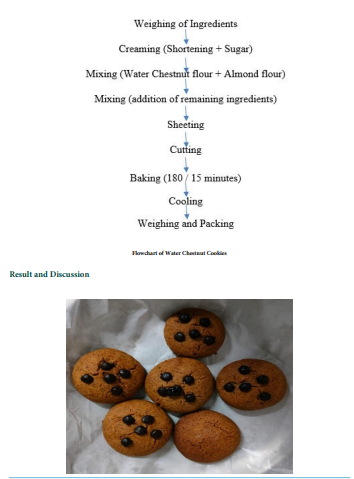
Figure 1: Developed Cookies
FIGURE 2
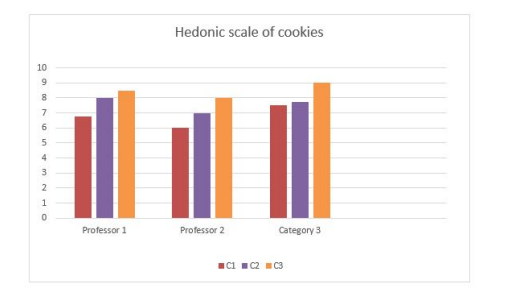
Figure 2: Hedonic Scale
Tables at a glance
Figures at a glance