
A Review on Morphological and Morphometrical Study of External Human Ear for Identification
Received Date: August 24, 2025 Accepted Date: September 24, 2025 Published Date: September 27, 2025
doi: 10.17303/jfrc.2025.10.104
Citation: Nisha Upreti, Sneha Yadav, Priyanka Chabbra (2025) A Review on Morphological and Morphometrical Study of External Human Ear for Identification. J Forensic Res Crime Stud 10: 1-17
Abstract
The external human ear is a morphologically unique structure with wide range of variations in its features amongst individ- ual. Recent advances in forensic science have established the use of morphological traits of diverse parts of the human body in establishing the identity of an individual. For any characteristic to be used for identification, it is important that its unique. ness is verified among individuals. Due to this, the uniqueness and variations of the ear pattern are used for establishing the identity of an individual. This review explains the morphological features like the overall shape of ear; size and shape of tragus; presence, thickness and attachment of earlobe; shape of helix and metric features like height and width of ear; height and width of lobule; auricular and lobular index of the ear use in identification of individual.
Keywords: Niorphological, Morphometrical, Ear Pattern, Identification
Introduction
For personal identification, the use of various human features is older than many can realize, and this includes ear also II External human ear is identified to be an extremely var. ied structure presenting distinct morphological and individual. iStic features among various individuals and population groups, Also the ear is one of the most stable anatomical structures whose growth is predictable [3], Several morphological and metric features of the human body other than ear like finger. prints, footprints, facial characteristics, iris, gait pattern, teeth, bitemarks, lip prints, voice characteristics, and DNA fingerprinting have been used widely for personal identification in forensic examination [4]
Alphonse Bertillon was considered the first to discover the use of ear as tool for human identification. [5]. This was one of the II anthropometric measurements for the establishment of identity of individual [6]. Anthropometric Measurement is a technique that indicates quantitatively the measurements that is the length, breadth, depth and size of human body which shows variation according to age, sexy and population groups. [7], And thus anthropometry of external feature ofear can also be used to establish identity [8].
Ear print analysis or forensic otoscopy is the use of ear prints in forensic investigation [9]. Fritz Hirsch was the first to use the ear print in investigation in the year in Switzer- land [101. It was a burglary case. Thereafter it is extensively and widely used till date. Ear prints can be crucial evidence, found in cases where a person standing by placing his/ her ear over a surface specifically doors, window and patterns are formed on the surface due to exchange of wax and oil on ear, according to Locardk principle of exchange [11]. The prints formed can then be snapped or advanced and observed for identification purpose. The impressions formed are two dimensional, marked by elevated portions of the structure of helix, antihelix, tragus, antitragus [12], From the heights of these prints stature of the criminal can be estimated [13]. Like fingerprint pattern, human external ear features are exclusive to an individual [14]. The uniqueness of the human ear is due to its particular and unshared morphological structure. [15]. The human ear is the most crucial feature of the face. Numerous studies have been performed for specific identi- fication from morphologic feature of ears [16]. Countless studies have been directed to reveal disparities in human ears morpho. logically and morphometrically. Nearly recent studies are (Rubioet ale 2017 Cameriere et ale 2011; Purkait 2016) have exposed that every part of the exterior ear is morphologically inimitable. Even though the Distinctiveness of Ear, and hence its application for identification of individuals has been hypothesized, organized study to produce that ear in fact are different and discrete, and that such eccentricity can be substantiated through ment is yet to be established. The case of Mark Dallagher would always be tantamount with "ear print evidence' in Great Britain upon his persuasion of murder in 1998. While professionals orated on the basis of evaluation of the print obtained from the crime scene and the sampling taken from the suspect Dallagher that the prints were ofone and the same creature. However, DNA profiling done afterward verified irrefutably that the print is not of Dallagher and he was set free after suffering in confinement for seven long years. Even though some studies on the ear have been made [17-31]. The delinquent of identification of individu- als from ear still remains questionable.
There are many benefits Of using ear pattern for the purpose Of human identification because Of the location Of the characteristic traits or parts, their angle, lcxation, and relation within the ear which are unique and therefore are a mode of identification [32]. Ihe ear pose Other benefits as well, as it is more coplanar, is less affected by ageing, and remains unaffected by facial makeup like spectacles etc., [33]. The biostatistics Of ear is a very exciting matter as during crime scene search, ear marks and measurements are every so Often used for identification in the absenteeism Of effective fingerprints. Ear biometrics can cer- tainly categorize an individual using proportional scrutiny of the human ear and its morphology. The dimensions Of the pinna have found to diverge amongst unlike ethnic groups 1341. Countless studies have been steered concerning morphological variations of human ears but the statistics for disparities between inter- ethnic groups was deficient, which is indispensable for the personal identification in forensic sciences (35,361. Imhofer cor- respondingly stressed the prospect of by means of ear charac- teristics for evaluating ancestral associations, as the morphology Of ears have a tendency to be transmissible 137]. The outline Of the free lobule was anticipated by Altmann to be a overriding trait with the attached lobule representing the recessive trait 1381. Oepen premeditated the external ear from an anthropological point of view and congregated data from the ears of 500 male and 500 female subjects [39]. Alfred V. Iannarelli in 1989 operated on human ear outlines and institute that they all were differ- ent [40]. The distinctiveness of Verrappan body, a famous san- dal wood smuggler from Indian subcontinent was confirmed by his ear morphology and biometrics measurements in [41]. Jung and Jung directed an inspection and inveterate the age, gender and ethnic variations of ears among Koreans 1421. According to Hammer, the prospect for the accidental manifestation of four concordant features of ear was estimated to be one in 7800 [43]. An ear institutes a valued identification feature used in creating a signalment portrait, various methods of appearance renewal, identification of persons which is grounded on photographs and identification of cadavers. Another important characteristic is identification of ear impressions on various exteriors found at the scene of crime. [44]. The ear lobe is essentially a part of the disaster identification system [45].
Structure of EarThe ear comprises of a solitary portion of fibrocartilage with an intricate relief on the anterior, concave side and impar- tially smooth configuration on the posterior, convex side. Fetal growth of ear starts soon after conception and by 38th day some of the features becomes decipherable. The ear interchanges to its conclusive spot on 56th day and the shape of the ear can be doc. umented on 70th day, The important aspect of the shape of ear is that it remains fixed from then on and do not transform after it [46]
Human ear is separated into external, middle and internal parts. The auricle or auricula and external acoustic meatus form the external ear which is of excessive implication in forensic sciences for the determination of individual identification and certification. Auricle is also one amongst the five key features of the human face and is tremendously persuasive in deciding its appearance [47]. The lateral surface of the auricle is irregularly concave, faces temperately forward and demonstrate a lot of discrepancy and depressions, due to which it contacts with various surfaces and yield a print like that of a rubber stamp. The cartilaginous part of auricle forms an outer curvature called as helix. A second innermost curvature runs parallel with helix called antihelix. In the intermediate of the auricle is a muffled depression, called concha. It continues into the skull as the external acoustic meatus. Proximately anterior to the of the external acoustic meatus is an elevation of cartilaginous tissue known as tragus. Opposite to the tragus is the antitragus.
Inferior crus of AntihelixThe lower cartilaginous ridge which ascends at the branching of the antihelix that ends underneath the fold of the ascending helix, and divorces the concha from the triangular fossa. The inferior anti helical crus run in an anterior and to some extent superior direction, is usually sharply defined, and appears less varied than its additional complement. A synonym is anteri- or crus of the antihelix.
Superior crus of AntihelixThe upper cartilaginous ridge ascending at the diver- gence of the antihelix that splits the scapha from triangular fossa. The superior crus run in a higher and to some extent frontal direction and is usually less sharply pleated than the lower portion and inferior crus.
AntiragusIhe anterosuperior cartilaginous protrusion lying between the incisura and the origin of the antihelix. The antero. superior margin of the anti ragus forms the posterior wall of the incisura.
ConchaThe fossa bounded by the tragus, incisura, anti ragus, antihelix, inferior crus of the antihelix, and the origin of the spiral, into which opens the external auditory canal. It is usually crossed by the cru’s helix into the cymba authoritatively and cavum inferiorly.
HelixThe outer rim of the ear that ranges from the superior insertion of the ear on the scalp to the finish of the cartilage at the earlobe. The helix can be divided into three estimated parts: the rising helix, which encompasses steeply from the root the superior helix, which begins at the uppermost of the ascending portion; the descending helix. Which commences inferior to the Darwin tubercle.
Crus of HelixThe prolongation of the anteroinferior ascending helix, which extends in a posteroinferior course into the void of the concha above the external auditory meatus. The middling crus helix ranges about one half to two thirds the distance across the concha,
LobeIhe soft, fleshy, inferior part of the pinna. It is circumscribed on its posterosuperior border by the end of the descending helix, on the anterosuperior border by the inferior border of the anti ragus and superiorly by the incisura the earlobe is highly capricious in size and in the degree of attachment of the anteroinferior portion to the face.
ScaphaThe groove between the helix and the antihelix.
TragusA posterior, slightly inferior, protrusion of skin shielded cartilage, anterior to the auditory meatus. Ihe inferoposterior margin of the tragus forms the anterior wall of the incisura.
Triangular fossaThe incurvature bounded by the larger and the lower crura of the antihelix and the ascending portion of the helix.
Ear for Forensic Identification [49].Even though ears are an external part of the head, and and are frequently perceptible they do not fascinate human con. sideration and a terminology to describe them is typically deficient, As for the latent prints, the mutual ones to be found in crime scenes are of fingertips, palms, and feet, Even though earprints may also be initiate in crime scenes fingerprints are much more ample and recurrent. The circumstance that the forensic use of ears and some of the other biometric traits was ceased and become less prominent by the initiation of fingerprints is somewhat due to this real-world advantage. Dutch courts have acknowledged abundant cases of earprint related evidence (Van der Lugt C 2001). Earprints have also been used as a means of personal identification in other countries, such as the United States, UK, Germany and Switzerland- In Germany both ear. prints and ear images have been used for identification (Champod et al. 2001). In Switzerland, latent earprints have been used to assist in the premature stages of investigation in burglary cases (R. v. Mark Dallagher 2002). While in a number of complex profile cases the trustworthiness of earprint evidence has been tested, been refused permission or triggered erroneous convictions. The evidence regarding earprints is mainly queried due to three main factors: (1 ) pressure deformation; and (2) the lack of generally acknowledged methodologies for assessment and (3) the lack of large-scale testing. A study of potential identification capabilities ofears was performed by Alfred Iannarelli who scru- tinized over ear samples over 38 years (Iannarelli 1989) and industrialized the Iannarelli System of Ear Identification. His system principally consists of taking a number of measure- ments from a set of landmark points on the ear. He concluded: "Through 38 years of research and application in earology, the author has found that in literally thousands of ears that were examined by visual means, photographs, ear prints, and latent ear print impressions, no two ears were found to be identical" Despite his all-embracing experience with different forms of ear representation in forensics, in 1985 the Florida trial court of State v. Polite 1985 did not diagnose him as an expert on earprint iden- tification on the grounds that his ear identification method was not generally recognized in the scientific community. The court also raised concerns over the effects of pressure deformation on the appearance of earprints and also over the lack of studies con. cerning the comparison of earprints and snubbed to accept the earprint identification evidence all in all. The later development of ears as a biometric was to count on the ground breaking work of Iannarelli.
Ear contact: applied force during listeningA potentially important source of intra -individual variation in earprints appeared to be variation in the force that is applied by the ear to the surface during listening (Hammer and Neubert, 1989; Neubert, 1985; Saddler, 1996). During preliminary studies into applied force while listening we noted that in. tra-individual variation in applied force was comparatively small as compared with the inter-individual variation (Meijerman et al., 2004c, 2005b). This was confirmed by Kieckhoefer et al. (2005). We hypothesized that applied force may possibly reflect a balance between the aim to create a seal with the ear on the surface to optimize hearing, and the inclination to minimize discomfort to the ear or cheek. The individual anatomy Of ona ear would then play a key part in determining both the amount of force needed to create a reasonable seal, and the amount of force that would cause discomfort to the listener. Force applied by the ear to the surface during multiple attempts of listening would thus fall within certain individual limits. We would therefore advise that, if possible, reference prints Of suspects are taken after actual efforts Of listening.
Ear contact: applied force during listening A potentially import. ant source of intra-individual variation in earprints appeared to be variation in the force that is applied by the ear to the sur. face during listening (Hammer and Neubert, 1989; Neubert, 1985; Saddler, 1996). During preliminary studies into applied force while listening we noted that intra.individual variation in applied force was comparatively small as compared with the inter-individual variation (Meijerman et 2M)4c, This was confirmed by Kieckhoefer et ale (2005), We hypothesized that applied force may possibly reflect a balance between the aim to create a seal with the ear on the surface to optimize hearing, and the inclination to minimize discomfort to the ear or cheek 'Ihe individual anatomy of one's ear would then play a key part in determining both the amount of force needed to create a reason. able seal, and the amount of force that would cause discomfort to the listener. Force applied by the ear to the surface during multi- ple attempts of listening would thus fall within certain individual limits. We would therefore advise that, if possible, reference prints of suspects are taken after actual efforts of listening. Ear contact: applied force during listening. A potentially important source of intra-individual variation in earprints appeared to be variation in the force that is applied by the ear to the surface during listening (Hammer and Neubert, 1989; Neubert, 1985; Saddler, 1996). During preliminary studies into applied force while lis- tening we noted that intra-individual variation in applied force was comparatively small as compared with the interindividual variation (Meijerman et al., 2004c, 2005b). This was confirmed by Kieckhoefer et al. We hypothesized that applied force may possibly reflect a balance between the aim to create a seal with the ear on the surface to optimize hearing, and the inclina- tion to minimize discomfort to the ear or cheek. The individual anatomy of onek ear would then play a key part in determining both the amount of force needed to create a reasonable seal, and the amount of force that would cause discomfort to the listener. Force applied by the ear to the surface during multiple attempts of listening would thus fall within certain individual limits. We would therefore advise that, if possible, reference prints of sus. pects are taken after actual efforts of listening. Ear contact: ap. plied force during listening A potentially important source of intra-individual variation in earprints appeared to be variation in the force that is applied by the ear to the surface during lis- tening (Hammer and Neubert, 1989; Neubert, 1985; Saddler, 1996). During preliminary studies into applied force while listening we noted that intra-individual variation in applied force was comparatively small as compared with the inter-individual variation (Meijerman et al., 2004c, 2005b). this was confirmed
by Kieckhoefer et al. (2005). We hypothesized that applied force may possibly reflect a balance between the aim to create a seal with the ear on the surface to optimize hearing, and the inclina- tion to minimize discomfort to the ear or cheek. The individual anatomy of one's ear would then play a key part in determining both the amount of force needed to create a reasonable seal, and the amount of force that would cause discomfort to the listener. Force applied by the ear to the surface during multiple attempts of listening would thus fall within certain individual limits. We would therefore advise that, if possible, reference prints of sus. pects are taken after actual efforts of listening. Ear contact: ap. plied force during listening A potentially important source of intra-individual variation in earprints appeared to be variation in the force that is applied by the ear to the surface during lis- tening (Hammer and Neubert, 1989; Neubert, 1985; Saddler, 1996). During preliminary studies into applied force while lis- tening we noted that intra-individual variation in applied force was comparatively small as compared with the inter.individual variation (Meijerman et al., 2005b). This was confirmed by Kieckhoefer et al. (2005). We hypothesized that applied force may possibly reflect a balance between the aim to create a seal with the ear on the surface to optimize hearing, and the inclination to minimize discomfort to the ear or cheek. The individual anatomy of one's ear would then play a key part in determining both the amount of force needed to create a reasonable seal, and the amount of force that would cause discomfort to the listener. Force applied by the ear to the surface during multiple attempts of listening would thus fall within certain individual limits. We would therefore advise that, if possible, reference prints of sus. pects are taken after actual efforts of listen 3.1
Ear contact [50].It is a theoretically imperative basis of intra-individual disparity in earprints seemed to be disparity in the vigor that is applied by the ear to the superficial surface during listening (Hammer and Neubert, 1989; Neubert, 1985; Saddler, During preliminary studies into applied force while listening it was renowned that the intra-individual variation in the applied force that was reasonably insignificant as equated With the inter-individual variation (Meijerman et al., 2004c, 2005b). This was long-estab- lished by Kieckhoefer et al. It was theorized that applied force may perchance replicate a balance between the objective to generate a seal with the ear on the surface to augment hearing, and the proclivity to diminish uneasiness to the ear or cheek. The individuaB anatomy of one's ear would then plays a very significant part in shaping both the amount of force desired to generate a reasonable seal, and the amount of force that would cause distress to the audiophile. The force applied by the ear to the surface during manifold attempts of listening would thus tumble within certain individual limits. It would therefore recommend that, if possible, reference prints of suspects are to be taken after actual efforts of listening.
Ear contact: duration of listeningHow long a donor listens at a surface affects the appearance of the retrieved earprint.
The duration of listening is exaggerated by the magni• tude and the strength of the embossed area to gage a print-mass. It was found that print-mass meaningfully enlarged with mea- surement of heeding (Meijerman et al.2004a), Kieckhoefer et al. (2005) and showed that the twiddling of the ear during lis- tening improved the quantity of engraved surface, Alternative consequence of amplified attending time may be a sophisticat- ed chance of smearing due to a descending of the ear across the surface, During a preliminary study into the effect of listening time on earprints it was pragmatic that some muddling of fea- tures commonly befallen after 20 to 25 seconds of listening, even though it was usually not so noticeable as to misrepresent minu- tiae to the amount that it was anticipated to affect individualiza- tion (De Conti et ale, Distorting in earprints may, however occur, It may, however be easily recognized- If smirching is too unadorned, one might contemplate terminating the print.
The quality of the surface from which prints are recovered may distress the level of detail to be repossessed in a print. Hence it may disturb the evidential value of a improved mark Saddler (1996) observed that, for example, brushstrokes on the paint momentously condensed skin detail in a mark that was pick up from a painted wooden door. Smooth, non-porous surfaces such as glasses and metal seemed to the extreme potential for the recovery of prints that are rich in detail. Buffed wood may also provide prints, predominantly when the paint is not longstanding and permeable. Prints recovered from artifi- Cial materials give the impression of minor eminence (Cor van der Lugt, Francesca De Conti, personal communications)
Secretion depositionThis may be envisaged the ear as a rubber stamp, the earprint being a two-dimensional imitation of the portions that affected a superficial layer, Oils and waxes that are unsurprising. ly existing on the ear may be abstracted to serve as ink on the stamp. quantity of these exudations existing on the ear may diverge contingent on outside temperature and whether the ear was freshly eviscerated or not. More or less secretions existing for printing could in theory impact the dimensions and/or the con- centration of the imprinted area. In turn, this might distress the area in which characteristics can be found or the perceptibility of such details. Therefore sustained examinations into intra-indi• vidual disimilarity by comparing the print-mass regained from prints collected before and after an ear was dressed but found no evidence for a significant decrease in the mass of prints created by cleaned ears (Meijerman et al., 2005a). This however, provides no assurance that the minutiae are of equal eminence and investigations into the steadiness of characteristic features (i.e., appreciated for individualization) in prints of newly cleaned ears are enduring.
In-situ changesIn the cases of burglary, even day time, a search for evidence will typically not flinch until the following day. In between deposition and securing, weathering or less likely emptying may affect the latent print. It may additionally be probable that scondary imprints Of ears, cheeks, palms or fingers are place over or are superimposed on the principal print. These events might disturb the extent to which particulars may be recovered.
The lifting processInconsistencies between diverse prints of a single may also happen as a consequence of discrepancy in the worth Of the material that was used to lift and protect the latent prints. The FearlD research team initiate that Black Gel Lifters were predominantly virtuous for conserving details. These prints presented more evidences for individualization than prints tenable using adhesive and acetate sheets (De Conti et al., The Inkless Impression Kit (11K), creating use of chemically treated paper that counters with a coater that has to be applied to the ear in development, was also tested. 11K initially promised to of. fer a cheap and hasty technique to generate reference prints of defendants as 11K prints presented a virtuous repossession of the details. 11K was, however, canned when it was found that, typically due to variation in the distribution of the applied coater, obtained prints occasionally swerved significantly from natural 'functional' earprints (Van der Lugt. personal communication Meijerman. 2002).
Uniqueness of Ear and Personal IdentificationMorphology of external ear for identification
The auricle is most defining feature of our face and it may even demonstrate the traits like age and gender 1511. Distinguishing feature of auricle is its shape and size which vary among individuals. It is so highly variable that even in a single individual the two ears will not be identical [52]. The auricle morphology appears to be hereditary in the family and it grows rapidly until maturity and continues to grow until older ages [53]. Studies on various features like inclusive shape of the ear; size and shape of the tragus; presence, thickness and attachment of the ear loop; outline of the helix has been used to establish identity of individuals. The make-up of the external ear or auricle has been designated in many texts, [54-57]. yet the statistics about the morphometric variation between peoples has been deficient, which is required for the identification purpose [58-62]. and also for medico legal status. However, no studies are being carried out concerning the individual features of the external ear, though innumerable parameters of the external ear have been evaluated and recorded.
Morphometry Of external ear for identificationThere are different morphometric points to amount the various dimensions of the ear as the measurement will be dissim- ilar in each individual More over the dimensions of the auricle seem to correlate with age, gender and ethnicity 1641, The ear is a decisive feature of the face and any data concerning age or sex of individual can be conducted through it [65], The morphometrical study of the auricle is used in various fields of science like forensic medicine, anthropology, and biology as a very distinct feature of human body and can be used for the identification pur- pose [66]. The main function of auricle is to transmit the sound waves through the external acoustic meatus to the eardrum and also as a cosmetic organ, it has more reputation in aesthetics and physiognomy of the face [67]. Defects of the auricle in size or an abnormally elongated auricular can be corrected by surgery [68]. To rectify these abnormalities. surgeons require information regarding the auricular measurements. Forensic science has widely used the morphometric features of human body in order to identify the individuals. The morphology and morphometry of the auricle along with the other identifying characteristic features, could be used to identify corpses that were mutilated and maimed [69] - Very recently it was found that the imprints of the ear, are also exceptional for personal identification [70,71]
Roughly fresh studies exhibited that every part of the external ear specifically pinna, is morphologically explicit and has some divergent features as well as varies in different population groups 172-761. Ihe reports of VVHO claimed that 4% of the population living in UAE suffers from hearing impairment and ultimately needs hearing aids [77]. And due to these deformities' identification can be done to some extent if not exact, For several surgical and forensic units, it is important to have a comprehen- Sive information of the face structures of different race, gender and age of individual [78]. It is very imperative and obligatory to have certain familiarity of measurements and symmetry in rehabilitative ear surgery in cases where opposite ear cannot be used as template [79]. Anthropometry of external features of ear i.e., loftiness of ear, girth of ear, lobular stature, lobular thickness, auricular index, lobular index can measured through vernier caliper [80].
Many studies have found that the ear measurements disclose sexual dimorphism and the transformations between sexes are statistically important with much advanced value in males [83]. Also it is observed that the difference in linear mea- surements of ear between males and females may be due to au- ricular enlargement, which occurs in males more frequently as compared to females and continues till it ranges maturity 1841. Lobular distance of the 22% auricle patients who were trying to get face rejuvenating surgery, in 2004, at Mowlavi et al. was flawless free lobular [85]. Sforza et al. surveyed that in down's syndrome subjects, the morphology and morphometry of the auricle were bizarrely different and that a portion of differences and dissimilarities were associated to age and gender [86,87]. In a study steered by Gulhal Bozkir et al., in in Turkey, found that in young females the dimension of both right and left au. ricle were similar which designate that both ear were identified to be proportional. In the males also the measurement of all pa- rameters for both ears ere very close to each other which indi- cate proportionality 1881. In 2010, a study showed that men had elongated ear length and lobe length than nigerian women, while women had broader lobes than men. Also through this study it was found that as the age augmented the distance of the lobe improved however the lobe girth decreased [89].
There are various other studies which were conducted to determine the variations in the morphometry between differ. ent ethnicites (90-92].
In the cases which encompass earprint mark for iden- tification, two matters have been the core and foremost founda- tion of disagreement. One is concerning the acceptability of the evidence and the supplementary is its trustworthiness. In the United States and underneath Daubert standard, all forensic ex. pertise is lay open to a scientific scrutiny over its trustworthiness and precision. In this respect it is the judge who is required to act as a doorkeeper and regulates whether the forensic evidence accords to that standard- The forensic science in question does not need to be free to be allowable, but undeniably there is a level of error that is involved. However, a ration of this error should be made accessible through laborious testing. The permissibili- ty of earprint evidence was a momentous subject in the case of State v. Wayne Kunze 1999. In Washington State in 1996, David Wayne Kunze was charged with manslaughter midst other custodies. Ihe key evidence against Kunze was a latent ear- print found at the scene. Preceding to the trial, Kunze moved for excluding any evidence of earprint identification. Subsequently, the trial court convoked a Frye hearing on the matter and many ear connoisseurs and latent print professionals were called. Ihe hearing resolved that earprint identification has indeed expanded wide-ranging acceptance and thus the earprint evidence was acknowledged. However, far along at the appeal court, after revising the evidence given at this pre-trial hearing, the appeal court settled that general acceptance was not gained "if there is a substantial disagreement amid competent professionals as to the legitimacy of scientific evidence", and since the hearing evidently exposed such dispute, the appeal court ruled that the trial court blundered by allowing the expert witnesses to testify and that a new trial was required- In the case of State v. Polite (US, Florida trial court) 1985, the court also refused to admit the earprint evidence. In exclusive of the earprint evidence the judge raised up apprehensions over the shadowy effect of pressure deformation and unsatisfactory scientific circumstantial to establish depend- ability and rationality Of earprint identification.
From Earprint to Ear ImageThere's factual supremacy in using the appearance Of an ear for computer recognition, equated to facial recognition. It's jaggedly correspondent if not improved," said computer scientist Kevin Bowyer of Notre Dame, who is pursuing his own ear-recognition technology. Recent technologies use to renovate human features, into dependable alter. natives to fingerprints. The properties of distortion Ik•cause of compression and the fact that approximately some gears are mis- placed, theoretically, roots huge intra-individual dissimilarity in earprint, consequential an additional challenge in acknowledg- ment than ear image recognition. In biometrics, 2-Dimentional or 3-Dimentional images of the ear are frequently used. These images are conventionally seized in meticulous atmospheres. Further current approaches have observed into enlightening the toughness of the algorithms and simplifying the pedals over the image capture trials. With speedy arrangement of surveillance cameras, the amounts of crimes documented on surveillance footage is also mounting wildly. These footages are frequently characterized by underprivileged excellence while effects such as obstruction, shades and noise are common place. With added expansion of biometric tactics towards more vigorous means on one hand and the growth of crime scene surveillance footage, which calls for methods of acknowledgement at a distance, on the other, it gives the impression that the two fields are hastily moving towards each other.
Equated to earprint, the use of ear images for identification has discovered and surveyed more recurrently. Abaza et al. (2013) offers a list of obtainable ear image databases which can 1k used for ear biometric lessons. Roughly some of the most frequently used amid these databases are: the UND database (Yan and Bowyer 2005) which embraces 2.Dimentional and 3-Dimentional images of 415 entities; XM2VTS database (Messer et ale encompassing of 21) ear images of 295 en. tities taken in four time-lapsed sessions; and USTB database (UST 2005) with 5(Å) subjects and with pose variation and frac- tional constriction. In biometrics, the emphasis is to enterprise the operative and vigorous algorithms to execute identi- fication. It is to be noticed that the emphasis in biometrics has loosened compared to that we have discussed before in forensics In forensics, the main focus was to regulate the error rates for earprint individualization; in biometrics, the main focus is to de- termine the mistake rates of a definite algorithm performing ear image recognition. In biometrics, it is supposed that the identi- fication by means of ear images is a worthwhile task, exclusively in the comparatively small datasets that are considered, and the no upper limit is predicted for the recognition performance. "Ihe automatic recognition of ear images eliminates the machinist prejudice, and so long as the probe images are comparable to the training and authentication images in terms of inclusive worth, tenacity, constriction, radiance and pose dissimilarities the er- ror rates conveyed for an algorithm are a good evaluation of the dependability of the algorithm's predictions for innovative data. In this, the size of the validation set compared to the size of po- tential candidate set is also a factor which needs to be measured. However, defining the essential size of the training and endorse- ment sets for each recognition problem is an open question. It is also well-known that these methods are Often multifaceted and unintuitive. Often it is not imaginable to point out the variances and resemblances between two ear images overtly. This is ill-fat. ed as such descriptions can be advantageous for the jury. [93-961. Presently, there are not much commercially accessible ear rec- ognition systems. However, the future holds incredible potential for integrating ear images with face images in a multibiometric configuration, even as investigators remain to enhance the tech. nology. For example, assigning an ear image to one of numer- ous predefined categories could allow for hasty reclamation of contender identities from a bulky database. In accumulation, the use of ear thermograms could assist in mitigating the problem of constriction and occulation due to hair and accessories. As the technology mellows, both forensic and biometric domains will benefit from this biometric.
Discussion
The auricle or auricula and external acoustic meatus form the external ear which is of prodigious implication in forensic sciences for the determination Of individual identification and authentication. It is supposed that the human external ear characteristics are exceptional and inimitable and except in. creasing in magnitude, they do not change during the lifetime of an individual. Some scientists have verified that the external ear characteristics can be used to identify persons with the same gra- dation Of inevitability as the positive identification from finger. prints. There is, however, no pragmatic or empirical data avail. able today that proves the fundamental principle that the ears of a human being are in fact so dissimilar and divergent that their feature is never replicated or reproduced. Distinguishing feature Of auricle is its outline and magnitude which fluctuate midst in. dividuals. Inclusive shape of the ear; size and shape of the tragus; presence, breadth and attachment of the ear loop; shape of the helix has been used to establish identity of individuals. Not only these morphological features but also morphometry of external ear is convenient and beneficial in establishing identity. Anthro. pometry of external features of ear i.e., stature of ear, girth of ear, lobular loftiness, lobular thickness, auricular index, lobular index can be measured through vernier caliper. More over the proportions of the auricle or external ear seem to associate with age, gender and ethnicity.
Discussion
The auricle or auricula and external acoustic meatus form the external ear which is of prodigious implication in fo- rensic sciences for the determination Of individual identification and authentication. It is supposed that the human external ear characteristics are exceptional and inimitable and except in. creasing in magnitude, they do not change during the lifetime of an individual. Some scientists have verified that the external ear characteristics can be used to identify persons with the same gra- dation Of inevitability as the positive identification from finger. prints. There is, however, no pragmatic or empirical data avail. able today that proves the fundamental principle that the ears of a human being are in fact so dissimilar and divergent that their feature is never replicated or reproduced. Distinguishing feature Of auricle is its outline and magnitude which fluctuate midst in. dividuals. Inclusive shape of the ear; size and shape of the tragus; presence, breadth and attachment of the ear loop; shape of the helix has been used to establish identity of individuals. Not only these morphological features but also morphometry of external ear is convenient and beneficial in establishing identity. Anthro- pometry of external features of ear i.e., stature of ear, girth of ear, lobular loftiness, lobular thickness, auricular index, lobular index can be measured through vernier caliper. More over the proportions of the auricle or external ear seem to associate with age, gender and ethnicity.
Conclusion
As per the numerous studies with respects to the individualisation and uniqueness of the external ear, it can be deter. mined that human ear is unique and subsequently its impressions also, because of the adequate variability come across in its structure, 'Ihe morphological and morphometrical variability of the ear structure show a significant role in establishing identity of individuals and can further be used in forensic examinations. However, it should also be noted that this kind of evidence may always be corroborated with some other and indications present at the scene of crime. Also the variability in the measurement of the various parts of auricle provide us with the information regarding the age. sex and ethnicity or population group, which encourage the use of it in solving forensic cases and in examination of dead in airplane crashes, intensional mutilation and dismemberment, explosions, or other mass disasters.
- AKhamiss A, Algabary S, Khairuddin O & Siti N, Huda N and Abdullah S (2013) A Review Paper on Ear Recognition Techniques: Models, Algorithms and Methods. 411-421.
- Krishan K, Kanchan T & Thakur S (2019) A study of morphological variations of the human ear for its applications in personal identificat ion. Egypt J Forensic Sci 9:6.
- Niemitz C, Nibbrig M, Zacher V (2007) Human ears grow throughout the entire lifetime according to complicated and sexually dimorphic patterns—conclusions from a cross-sectional analysis. Anthropol Anz 65: 391-413.
- Iannarelli AV ( 1989) Ear identification. Forensic identification series. Paramount Publishing Company, Fremont
- Dhanda V, Badhan JS, Garg RK (2011) Studies on the development of latent ear prints and their significance in person. al identification. Problems ofForensic Sci 138:285-295.
- Zulkifli N, Yusof FZ Rashid RA (2014) Anthropometric Comparison of Cross-Sectional External Ear tktween Monozygotic Twin. Ann Forensic Res Anal 1: 1010.
- Shastry CKR and Bhat BPR (2015) Anthropometric measurements of newborns. Int J Contemp Pediatr 2: 85-89.
- Rashi Nigam, Kiran Kumar P, Saurabh Kulshreshtha (2019) Anthropometric study of external ear in north indian population. Int J Anat Res 7: 6800-6803.
- Dilley, Kimberley. "Chapter 43. Otoscopic Examination." Current Procedures: Pediatrics Eds. Denise M. Goodman, et al. McGraw Hill, 2007.
- Champod, Christophe, Evett Ian W. Kuchler, Benoit (2001-11-01). "Earmarks as Evidence: A Critical Review"Meijerman, Lynn &
- Theant Andrew & Maat, George (2005) Earprints in Forensic Investigations. Forensic science, medicine, and pathology 1:247-256.
- Meijerman L (2006). Inter- and intra-individual variation in earprints. Barge's Anthropologica, Leiden.
- Van Der Lugt C, Nagelkerke NJD, Maat GJR (2005) Study of the Relationship between a Person's Stature and the Height of an Ear Imprint from the Floor". Medicine, Science and the Law 45.
- Chattopadhyay PK, Bhatia S (2009) Morphological examination of ear: a study of an Indian population. Leg Med (Tokyo). 11: S190-193.
- Sohayla M. Attalla , Kavitha Ashok Kumar , Nurizzati Hussain (2020) Study of the Ear Shape and the Lobule Attachement among the Adult Malaysian Population at Shah Alam". European Journal of Molecular & Clinical Medicine 7: 5417-5425.
- Verma Kapil & Bhawana Joshi & Vikas Kumar (2014) Morphological Variation Of ear for Individual Identification in Forensic Cases: A study of an Indian Population, Research Jour. nal of Forensic Sciences 2:1-8.
- Burger M, Burger W (1998) Ear biometrics. In Biometrics; personal identification in networked society, Jain A, et al, editor, Kluwer Academic Publishers.
- Abbas A, Rutty GN (2003) Forensic web watch. J Clin Forens Med 10: 129-131.
- Hammer HJ, Neubert F (1989) Experimentelle Untersuchungen zur Auswertung van Ohrabdruckspuren. Krim Foren Wissen 73: 136-139.
- Hirschi F, Identifizierung von Ohrabdrücken, Kriminalistik (1970) 24:75-79.
- Hunger H, Hammer HJ (1987) Zu Fragen der Identifikation durch Ohrmerkmale. Krim Foren Wissen 65:73-79.
- Imhofer R (1906) Die Bedeutung der Ohrmuschel für die Feststellung der Identität. Archiv Kriminol Bd 26: 150-163.
- Kwan QY (1976) Inference of Identity of Source. Ph.D. Dissertation. Department of Forensic Science. Berkeley, CA: University of California.
- Meijerman L, Sholl S, De Conti F, Giacon M, van der Lugt et al. (2004) Exploratory study on classification and individualisation of earprints. Forens Sci Int 104: 91-99.
- Oepen I (1976) Der Identifizierungswert des Menschli ches Ohres. In Protokoll zur Arbeitstagung an der PFA Münster 39-54.
- Purkait R (2007) A test of individuality of human external ear pattern: its application in the field of personal identification in ear biometrics. Abstract: Proc. Sri Lanka: INPALM Congress at Colombo 96.
- Rahman MM, Islam MR, Bhuiyan NI (2007) Personal identification using ear biometrics. Int J Comput Internet Man- age 15: 1-8.
- Tanislav Jr E. Person Identification on the basis of ear. prints in the activity of Bucharest Police Department, Proc. 6th INPALMS Congress Med. Kobe, Japan-p. 884-889.
- Van der Lugt C (1998) Ear identification-state of the art. Inform Bull Sh(RprintfToolmark Exam 4:69-81.
- Van der Lugt C Earprint Identification. Den Haag. Elsevier Bedrijfsinformantie.
- Von Schott C, Walser B, Schwendinger N (1996) Anthropologische Indentitätsgutachten. Kriminalistik 7/96: 485- 486.
- Kasprzak J (2003) Forensic Otoscopy (in Polish), University of Warmia and Mazury Press. 2003.
- Sana A, Gupta P, Purkait p (2007) Ear BIOMETRICS: A NEW APPROACH Proc Sixth Int Conf Pattern Recog.
- Kumar P, Singla A (2013) Ear biometric: sex, bilateral and ethnic differences among brahmin and yadav communities of Bundelkhand region using PCA technique, Int J Scientific & Eng 4:799-805.
- Verma K, Bhawana J, Kumar V (2014) Morphological variations of ear for individual identification in forensic cases: a study of an Indian population. Res. J. Forensic Sci 2: 1-8.
- Chattopadhyay PK, Bhatia S (2009) Morphological examination of ear: a study of an Indian population. Legal Medicine 11: S190-193.
- Imhofer R Die Bedeutung der Ohrmuschel Fiir Feststellung der Identitat. Archivfiir die Kriminologie 26: 150- 163.
- Altmann F (1951) Malformations of the auricle and external auditory meatus. Arch Otolaryngology 54: 115-139.
- Oepen I (1970) Uberdie Haugigkeit einiger Morphologischer besonderheiten im kopfbereich. Antropologischer An- zeiger 32: 141-56.
- Iannarelli AF (1989) Forensic identification series: ear identification. California: Paramont Publishing Company 5.
- Purkait R (2007) Ear biometrics: an aid to personal identification. Anthropologist Spl 3:215-218.
- Jung S H, Jung SH (2003) Surveying the dimensions and characteristics of Korean ears for the ergonomic design of ear-related products. Int J Ind Ergon 31: 361-373.
- Hammer HJ (1986) The identification of ear prints secured at the scene of the crime. Fingerprint World 12:49-51.
- Kasprazak J (2001) Identification of ear impressions in polish forensic practice. Problems of Forensic Sciences 57: 168. 174.
- Nixon MS, Bouchrika I, Arbab-Zavar B, Carter JN (2010) On use of biometrics in forensics: Gait and ear. Proceedings of the 18th European Signal Processing Conference, August 23-27, Aalborg, Denmark.
- Standring S, Barley NR, Collins P, et al. (2008) Gray’s Anatomy. 40th edition. London: Churchill Livingstone. External ear 618.
- Purkait R, Singh P (2007) Anthropometry of the normal human auricle: a study of adult Indian men. Aesthetic Plast Surg 31: 371-79.
- Standring S. Ihe Anatomical Basis of Clinical Practice, In: Standring S. editor, 39th ed London: Churchill Livingstone, 649-50 (2005).
- Kaushal, Nitin & Kaushal, Purnima. (2011). HUMAN EARPRINTS: A REVIEW. J Biometrics & biostatistics 2.
- Banafshe Arbab-Zavar1, Xingjie Wei, Bustard JD, Mark S. Nixon1and Chang-Tsun Li (2011) On Forensic Use of Biometrics,with Face andEar Recognition. University of Southampton.
- Meijerman, Lynn & Thean, Andrew & Maat, George. (2005) Earprints in Forensic Investigations, Forensic science, medicine, and pathology l: 247256.
- Britto J, Panchal P, Prasad A, Kumari R, Kumari S. (2018) Photogrammetric morphometric analysis of auricle. Int J Med Sci Public Health 7: 440-443.
- Keith A (1901) Ihe Significance of certain features and types of the External Ear. Nature 65: 16-21.
- Verma P, Sandhu HK, Verma KG, Goyal S, Sudan M, Ladgotra A. (2016) Morphological Variations and Biometrics of Ear; An Aid to Personal Identification, J ClinDiagn Res 10: ZC138-142.
- Snell R (2004) Clinical Anatomy, In Snell R., editor, 7th ed. Philadelphia: Lippincott Williams and Wilkins, 834-5.
- Standring S The Anatomical Basis of Clinical Practice, In: Standring S, editor, 39th ed London: Churchill Liv- ingstone, 649-50.
- Moore K and Dally A (2006) Clinically Oriented Anatomy. In: Moore K, Dally A, editor, 5th ed. Philadelphia: Lippincott Williams and Wilkins., 1022-1023.
- Moore KL and Dalley AF (1999) Clinical oriented anatomy (4th Ed.) Baltimore: Lippincott Williams and Wilkins.
- Farkas LG (1990) Anthropometry of the normal and defective ear. Clin Plast Surg 17: 213-221.
- Brent B (1992) Auricular repair with autogenous rib cartilage grafts: Two decades of experience with 600 cases. Plast Reconstr Surg 355-76.
- Brent B (1999) Technical advances in ear reconstruction with autogenous rib cartilage grafts: Personal experience with 1200 cases, Plast Reconstr Surg 104: 319-34.
- Skiles MS, Randall P (1983) The aesthetics of ear placement: An experimental study. Plast Reconstr Surg 72: 133-140.
- Brucker MJ, Patel J, Sullivan PK A morphometric study Of the external ear: age- and sex-related differences, Plast Reconstr Surg 112:647-652.
- Krishan K, Kanchan T & Thakur S (2019) A study of morphological variations of the human ear for its applications in personal identification. Egypt J Forensic Sci 9:6.
- Kalcioglu M (2003) Tayyar&Miman, muratcem&Toplu, Yuksel&Yakinci, Cengiz&Ozturan, Orhan. Anthropometric growth study of normal human auricle.
- Bruker J, Pater J, Sullivan P. A morphometric study Of the external ear -age and sex related differences. PlastReconstr Surg 112:647-52.
- Deopa D, Thakkar HK, Prakash C, Niranjan R, Barua M (2013) Anthropometric measurements ofexternal ear of medical students in Uttarakhand Region. Journal of the Anatomical So- ciety of India 62: 79-83.
- Akpa A, Ibiam A, Ugwu C (2013) Anthropometric study of the pinna among south East Nigerians. J of expt Res 1.
- Kumar B, Selvi G (2016) Morphometry of the ear pinna in sex determination. Int J of Anatomy and Res.; 4:2480 - 84.
- Iannarelli AV (1989) Ear identification. Forensic identi- fication series. Paramount Publishing Company, Fremont
- Krishan K, Kanchan T (2016) In: Payne -James J, Byard R, Academic Press (eds) Identification: prints - earprints in en- cyclopedia of forensic and legal medicine, 2nd edn. Elsevier BV Oxford 74-80.
- Meijerman L (2006) Inter and intra- individual vari- ation in earprints. PhD Thesis, 2006. Barge's Anthropologica, Department of Anatomy and Embryology, Leiden University Medical Center, Leiden, The Netherlands, Leiden University Re- pository.
- Rubio O, Galera V, Alonso MC (2017) Morphological variability of the earlobe in a Spanish population sample. Homo 68: 222-235.
- Cameriere R, DeAngelis D, Ferrante L (2011) Ear identificauon:a ilot stud Forensic Sci 36: 1010-1014.
- Purkait R (2016) External ear: an analysis of its uniqueness. Egypt J Forensic Sci 6: 99 -107.
- Verma P, Sandhu HK, Verma KG, Goyal S, Sudan M, Ladgotra A (2016) variations and biometrics of ear: an aid to personal identification. J Clin Diagn Res 10: ZCI 38.
- Vanezis P, Lu D, Cockburn J, Gonzalez A, McCombe G, Trujillo O, Vanezis M (1996) Morphological classification of facial features in adult Caucasian males based on an assessment of photographs of 50 subjects. J Forensic Sci 41:786-791.
- Crompton P (2017) 4% of people in UAE live with impaired hearing.
- Vinita M, Punnya A, Seema H, Alka K, (2013) Anthro- pometric study of the external ear and its applicability in sex identification: assessed in an Indian sample. Aust J Forensic Sci 45: 431 - 444
- Sforza C, Grandi G, Binelli M, Tommasi DG, Rosati R (2009) Age- and sex-related changes in the normal human ear. Forensic Sci Int. 187: 110.
- Shireen S, Vrushail P. Karadkhelar. Anthropometric measurements of human external ear.J OF Evolution of Med and Dent Sci. 2015: 4.
- Sangeetha S, Anisha B (2017) Anthropometric measurements of human ear lobule in adult student population. Int JAnat Res.
- Rashi Nigam, Kiran Kumar P, Saurabh Kulshreshtha (2019) Anthropometric study of external ear in north indian population. Int J Anat Res.
- Shireen S, Karadkhelkar VP. (2015) Anthropometric measurements of human external ear. JEMDS 4: 10333-10338.
- Mowlavi A, Meldrum, Wilhelmi B, &Zook E (2004) Incidence of Earlobe Ptosis and Pseudoptosis in Patients Seeking Facial Rejuvenation Surgery and Effects of Aging. Plast Reconstr surg 113: 712-717.
- Sforza C, Dellavia C, Tartaglia GM, Ferrario VF (2005) Morphometry of the ear in Down's syndrome subjects. A three-dimensional computerized assessment. International Journal of Oral Maxillofacial Surgery 34: 480-486.
- Sforza C, Elamin F, Rosati R, Lucchini MA, De Menezes M, Ferrario VF (2011) Morphometry of the ear in north Sudanese subjects with Down syndrome: a three-dimensional computerized assessment. Journal of Craniofacial Surgery 22: 297- 301.
- Bozkir MG, Karakas P, Yavuz M &Dere F (2006) Morphometry of the external ear in our adult population. Aesthetic Plast Surg 30: 81-85,
- Ekanem AU, Garba SH, Musa TS and Dare ND (2010) Anthropometric Study of the Pinna (Auricle) among Adult Nigerians Resident in Maiduguri Metropolis. Journal of Medical Sciences 10: 176-180.
- Shireen S, Karadkhelkar VP. (2015) Anthropometric measurements of human external ear. JEMDS 4: 10333 -10338.
- Kapil V, Bhawana J, Vikas K (2014) Morphological Variation of ear for Individual Identification in Forensic Cases; A study of an Indian Population, Res J Forensic Sci 2: 1 -8.
- Senthil Kumar B, PanneerSelvi G. (2016) Morphometry of Ear Pinna in Sex Determination. Int J Anat Res 4: 2480-2484.
- Makaju S, Chaudhary S, Iyer K. (2018) Evaluation of Morphological Variations of External Ear between the Nepalese and Indian Students of a Medical College. JNMA J Nepal Med Assoc 56: 936-939.
- Banafshe Arbab-Zavar1, Xingjie Wei, Bustard JD, Mark S. Nixon and Chang-Tsun Li (2011) On Forensic Use of Biometrics,with Face andEar Recognition. University of Southampton.
- Prakash S, Gupta P (2015) Ear Biometrics in 2D and 3D Localization andRecognition. Augmented Vision and Reality. SPRINGER. 10.
- Anam T & Akram M. (2012). Personal Identification Using Ear Recognition. TELKOMNIKA (Telecommunication, Computing, Electronics and Control).
Figure 1
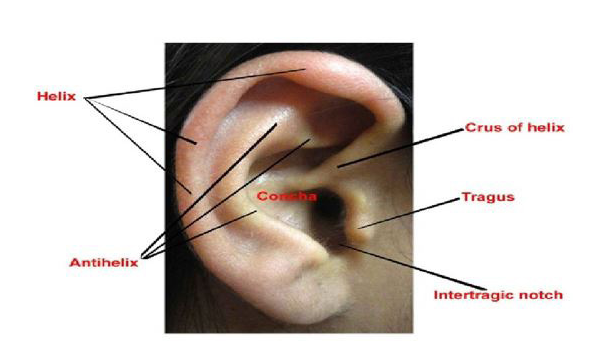
Figure 1: Terminology of structure of ear [48]
FIGURE 2
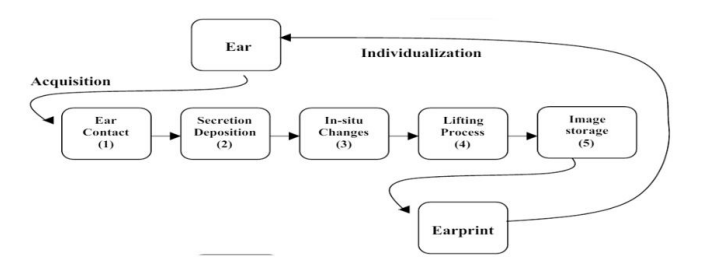
Figure 2: Procedure leading up to the realization of earprint evidence [50]
FIGURE 3
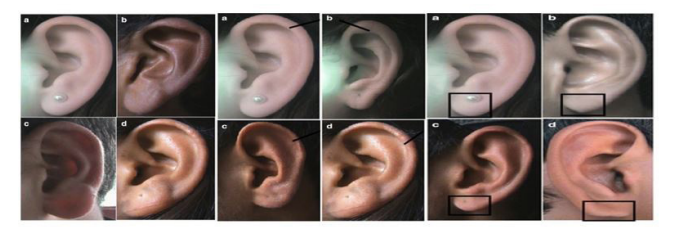
FIGURE 4
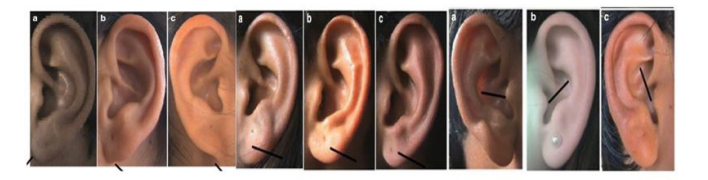
FIGURE 5
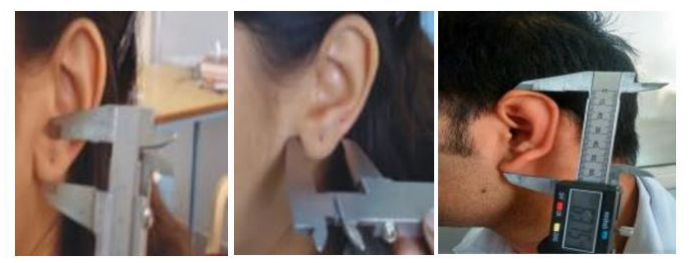
Figure 5: Measurement using vernier calipers [81, 82]
FIGURE 6
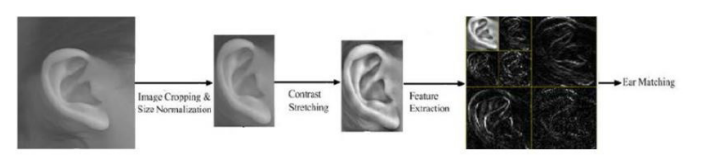
Figure 6: Human Ear Recognition Technology [95]
Tables at a glance
Figures at a glance