Graphical Abstract
| Substrate/Material | Typical Marking Method | Surface Groove Depth (µm) | Approx. Plastically Deformed Depth (µm) | Application |
| Lowcarbon steel | Mechanical stamping / roll | 80-140 | 140-520 | Firearm serial numbers, tools |
| Stainless steel | Mechanical stamping | 60-120 | 180-400 | Medical / industrial components |
| Cast / structural steel | Mechanical stamping | 100-300 | 300-800 | Frames, machinery parts |
| Aluminum alloys | Mechanical stamping | 50-150 | 150-450 | Vehicle VIN plates, engine parts |
| Copper / brass | Mechanical stamping | 40-120 | 120-360 | Nameplates, electrical components |
| Zinc / diecast alloys | Mechanical stamping | 70-200 | 200-500 | Engine blocks, housings |
| Steel (conventional laser) | Laser engraving (shallow) | May-25 | Localized, near surface | Logos, lowstress ID marks |
| Steel (deep laser) | Deep laser engraving | 50-500+ | Similar order as groove depth | Durable industrial / firearm markings |
| Aluminum / Mg alloys | Chemical / electrolytic etch | 10-100 | Comparable to etched depth | Nameplates, aerospace parts |
| Polycarbonate (PC) | Thermal / laser marking | ~100-150 | Very limited true plastic zone | Polymer serials; swelling/heat used in recovery |
| Polyethylene (PE) | Thermal / laser marking | ~200-250 | Very limited true plastic zone | Polymer casings; depth per moulding conditions |
| Nylon / PA | Thermal / laser marking | ~100-150 | Very limited true plastic zone | Functional polymer parts |
| Other engineering polymers | Laser / hot stamp | 20-200 | Minimal subsurface structural change | Consumer goods, IDs, labels |
Table 1: Typical depths of identification markings and associated deformation zones in common substrates
| Category | Technique | Principle | Key Notes | References |
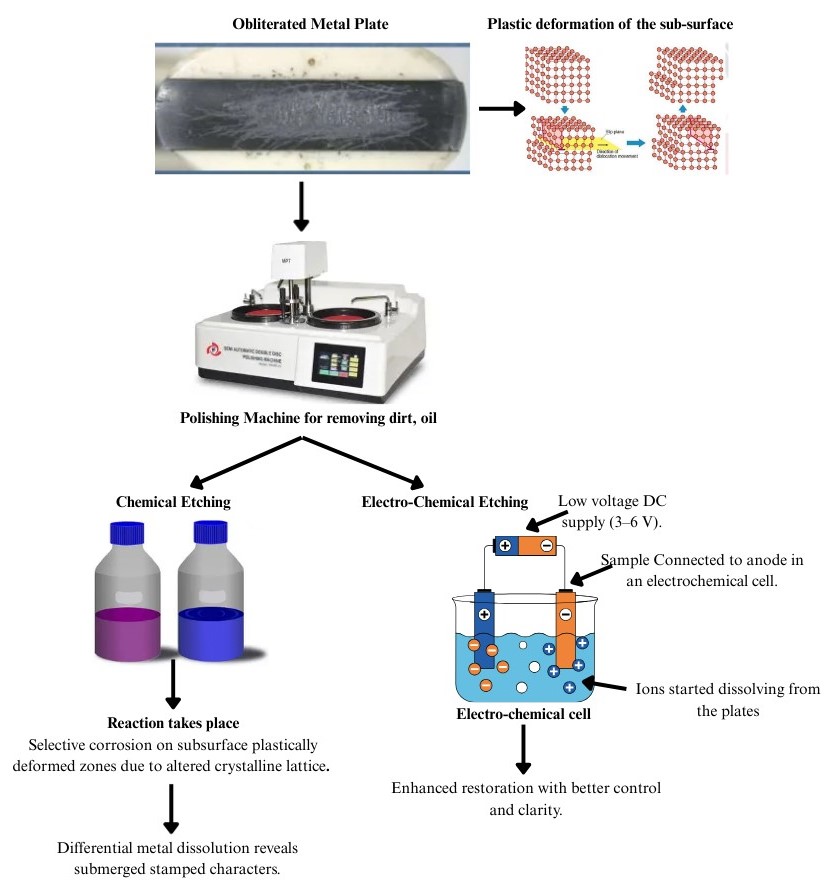
| Destructive Methods | Chemical Etching | Differential corrosion: plastically deformed zones are more chemically reactive than undeformed regions | Requires mirror-polished surface; etchant selection depends on substrate (e.g., Fry's reagent for steel, other acids/alkalis for Al, Zn); restoration fails if deformation zone fully removed | [18-20] |
| Electrochemical Etching | Anodic dissolution under applied current accelerates and controls etching in strained zones | Object serves as anode in cell; voltage ~3-6 V; electrolyte tailored to substrate; greater sensitivity & reproducibility vs. chemical etching, but still destructive | [21, 22] | |
| Non-Destructive Methods | Magnetic Particle Inspection (MPI) | Flux leakage: plastically deformed zones reduce magnetic permeability, attracting magnetic particles | Works on ferromagnetic materials (e.g., steel); particles cluster along erased characters; widely used as first-line before destructive methods | [23, 24] |
| Ultrasonic Methods | Cavitation bubbles collapse unevenly on distorted zones, eroding layers and enhancing contrast | Minimal surface preparation needed; applicable to metallic/non-metallic substrates; non-invasive and repeatable | [25, 26] | |
| X-ray Imaging / Micro-CT | Subsurface density differences detected via radiographic absorption and 3D volumetric reconstructions | Recovers structural deformation even if surface is obliterated; effective for metals, composites, bone, and delicate specimens | [29] | |
| Ultraviolet Illumination | Uses UV-induced fluorescence/ absorption differences in stressed areas | Reveals residual serials on polymers after abrasion via contrast in bright/dark | [27, 28] | |
| Infrared Imaging | Detects differences in IR emissivity and subsurface scattering | Visualizes hidden character patterns beneath smoothed polymer surfaces | [27, 28] | |
| Thermal Imprint detection | Monitors surface temperature patterns during controlled heating/cooling | Highlights shallow relief or density differences from original molded/embossed marks | [28] | |
| Digital Microscopy | High-resolution optical imaging of fine surface irregularities and restored features | Provides detailed images of faint or partially restored characters | ||
| 3D Surface Profilometry | Quantitative measurement of surface topography and relief variations | Produces objective, comparable datasets; complements optical microscopy for forensic interpretation |
Table 2: Restoration Techniques and their Principles
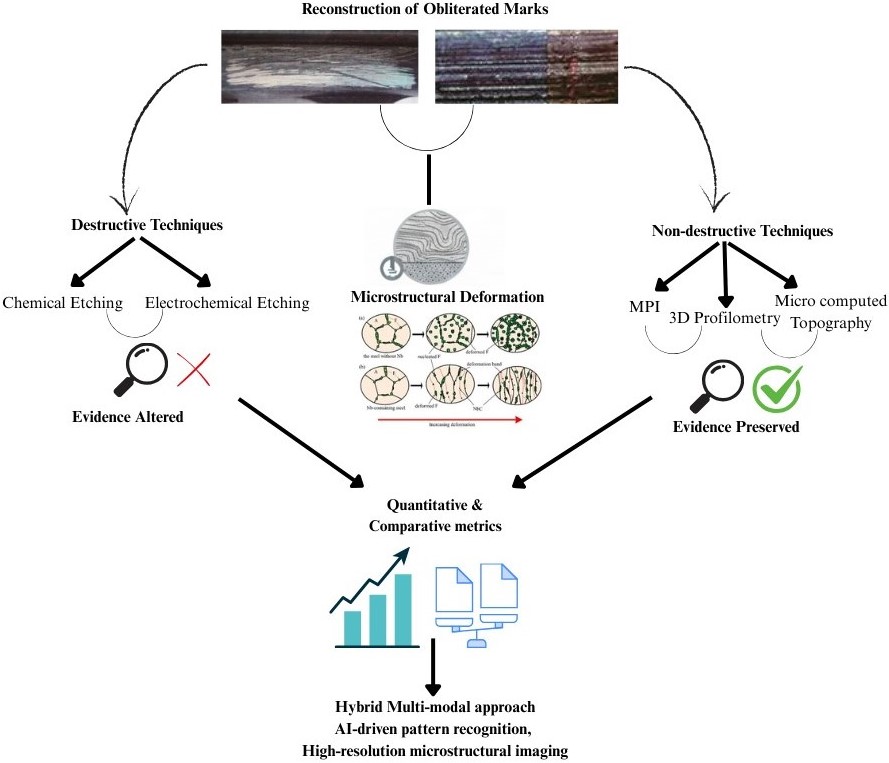
| Parameter | Non-Destructive Methods (MPI, Radiography, Ultrasonics, Optical Profiling) | Destructive Methods (Chemical/Electrolytic Etching, Heat Tinting) | References |
| Principle | Detect variations in magnetic flux, acoustic impedance, X-ray absorption, or surface relief caused by subsurface deformation | Exploit differential corrosion/electrochemical reactivity between strained and unstrained regions | [16, 17] |
| Preservation of Evidence | High, sample remains intact; repeatable analysis possible | Low, irreversible alteration; material surface often consumed | [23, 20] |
| Sensitivity (Depth of Recovery) | Moderate, typically effective for shallow obliterations (≤150-300 μm depending on alloy and method) | High, capable of detecting deeply deformed zones (>300-500 μm in steels, depending on reagent) | [25,19] |
| Resolution (Clarity of Marks) | Dependent on imaging modality: micro-CT and confocal microscopy achieve high spatial resolution (micron scale) | Limited by etchant penetration and risk of over-etching; resolution may degrade with excessive corrosion | [24,18] |
| Speed of Analysis | Rapid, especially with digital instrumentation (real-time imaging) | Slower, requires reagent preparation, controlled exposure, repeated steps | [26,20] |
| Skill Requirement | High, specialized equipment, calibration, and trained operators | Moderate, relies on forensic technician skill in reagent handling | [21] |
| Reproducibility | High, digital imaging/software enhances consistency (low operator bias) | Moderate, variations occur due to reagent strength, surface prep, operator technique | [17, 22] |
| Courtroom Acceptance | Increasing, digital and 3D datasets seen as objective and less invasive | Traditionally accepted but methods may face defense challenges due to destructive nature | [23,20] |
| Cost/Accessibility | Higher, requires advanced instruments, computing resources, maintenance | Lower, acids, salts, and basic lab setup sufficient | [37] |
| Best Suited For | Evidence requiring preservation (firearms, VINs, luxury goods, delicate specimens like bone) | Cases of deep obliteration where non-destructive fails (e.g., heavily abraded steel surfaces) | [29] |
Table 3: Comparative Evaluation of Destructive and Non-Destructive Methods for Restoration of Obliterated Identification Marks

Graphical Abstract

Figure 1: Schematic illustration of Chemical and Electrochemical Etching for Restoration of Obliterated marks
Tables at a glance
Figures at a glance