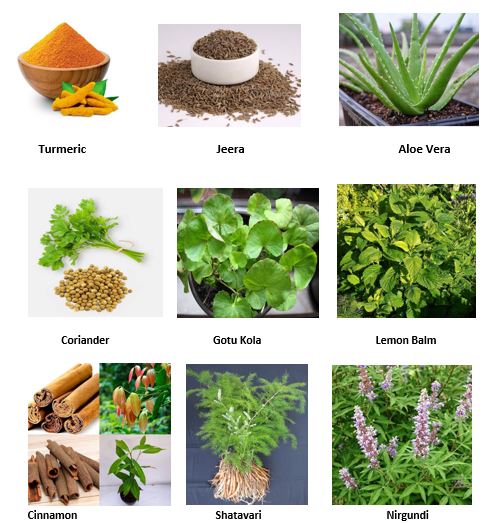
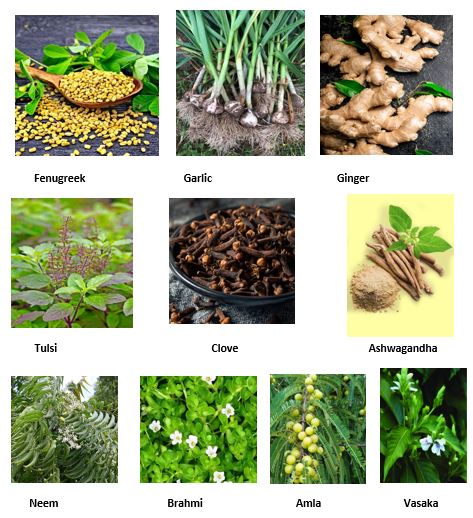
| Herbal plants | Biological name | Family | MOA | Uses |
| Ashwagandha | Withania somnnieri | Solanceae | Reduces stress by lowering cortisol (HPA axis modulation).Enhances GABA activity – calming and anti-anxiety effects.. | reduces stress and anxiety ,Enhances memory and cognition ,Protects brain cells , Supports mood and may reduce depression |
| Brahmi | Bacopa monnieri | Plantaginaceae | Antioxidant Neutralizes free radicals, protects neurons from oxidative stress. | Enhances memory and learning, Reduces anxiety and stress |
| Gotu kola | Centella asiatica | Apiaceae | Antioxidant action – Reduces oxidative stress and protects neurons. | enhances memory and cognitive function, reduces anxiety and stress |
| Lemon balm | Melissa officinalis | Lamiaceae (Mint family) | Antioxidant action – Protects neurons from oxidative damage. | Reduces stress, Improves sleep and treats insomnia |
| Tulsi | Ocium sanctum | Lamiaceae (Mint family) | Antioxidant action – Protects neurons from oxidative stress and free radical damage. | Reduces stress and anxiety, Improves memory and cognitive function |
Table 1
| Herbal Plants | Biological Name | Family | MOA | Uses |
| Garlic | Allium sativum | Amaryllidaceae | Inhibits platelet aggregation, | Lowers Blood Pressure – Acts as a natural antihypertensive, |
| Promotes vasodilation via increased nitric oxide | Reduces Cholesterol – Lowers total and LDL cholesterol. | |||
| Ginger | Zingiber officinale | Zingiberaceae | Inhibits platelet aggregation, | Antiplatelet Effect – Prevents blood clot formation, |
| Reduces blood clot formation | Improves Circulation – Enhances blood flow. | |||
| Turmeric | Curcuma longa | Zingiberaceae | Anti-inflammatory: Inhibits NF-κB, reducing vascular inflammation. | Anti-inflammatory – Reduces vascular inflammation, |
| Antioxidant: Scavenges free radicals, protecting blood vessels. | antioxidant – Protects heart cells from oxidative stress. |
Table 2
| Herbal plants | Biological name | Family | MOA | Uses |
| Ginger | Zingiber officinale | Zingiberaceae | Anti-nausea – Blocks serotonin receptors in the gut. Anti-inflammatory – Reduces gastrointestinal inflammation. | Reduces bloating and gas, Alleviates indigestion and heartburn, Calms stomach inflammation |
| Turmeric | Curcuma longa | Zingiberaceae | Antimicrobial – Fights harmful gut bacteria. Promotes healing – Supports repair of digestive tract lining. | Reats indigestion and bloating, Reduces gastric inflammation and ulcers |
| Fenugreek | Trigonella foenum- graecum | Fabaceae | Carminative – Reduces gas and bloating. Hypoglycemic – Slows carbohydrate absorption, aiding digestion. | Elieves constipation, Soothes gastric irritation, Reduces acid reflux and heartburn |
| Coriander | Coriandrum sativum | Aplaceae | Anti-inflammatory – Calms gut inflammation. | Relieves indigestion and bloating, Reduces intestinal cramps, Acts as a carminative to prevent gas |
| Antimicrobial – Fights harmful gut bacteria. | ||||
| Aloe Vera | Aloe barbadensis miller | Asphodellaceae | Demulcent – Protects and heals mucous membranes. | Treats constipation, Soothes gastritis and ulcers. Reduces inflammation in gut |
| Antimicrobial – Inhibits harmful gut bacteria. |
Table 3
| Herbal plants | Biological name | Family | MOA | Uses |
| Tulsi | Ocium sanctum | Lamiaceae | Antimicrobial – Fights respiratory pathogens (bacteria, viruses, fungi), Immunomodulatory – Enhances immune response against infections. | Acts as an expectorant, Fights respiratory infections |
| Vasaka | Adhatoda vasica | Acanthaceae | Mucolytic – Breaks down thick mucus for easier clearance, Anti-inflammatory – Reduces airway inflammation. | Acts as an expectorant |
| ,Clears mucus from lungs | ||||
| Ginger | Zingiber officinale | Zingiberaceae | Anti-inflammatory – Reduces airway inflammation, Antioxidant – Protects lung tissue from oxidative stress. | Relieves cough and cold, |
| Loosens mucus | ||||
| Turmeric | Curcuma langa | Zingiberaceae | Antioxidant – Neutralizes free radicals, protects lung tissue, Antimicrobial – Fights respiratory pathogens (bacteria, viruses, fungi). | Eases asthma and bronchitis |
| Helps clear mucus | ||||
| Clove | Syzygium aromaticum | Myrtaceae | Antitussive – Suppresses cough reflex, Expectorant – Aids in loosening and expelling mucus. | Relieves cough and sore throat |
| Acts as an expectorant |
Table 4
| Herbal plants | Biological name | family | MOA | Uses |
| Ashwagandha | Withania samnifera | Solanceae | Supports adrenal glands – Helps combat adrenal fatigue. Improves insulin sensitivity – Aids in blood sugar regulation. | Reduces cortisol – Manages stress and anxiety. |
| Supports thyroid function – Helps in hypothyroidism. | ||||
| Fenugreek | Trigonella foenum-graecum | Fabaceae | Increases insulin secretion – Stimulates pancreatic beta cells. | Boosts testosterone – Enhances male hormone levels, Supports lactation – Acts as a natural galactagogue, Regulates appetite – Influences metabolic hormones. |
| Improves insulin sensitivity – Enhances glucose uptake in tissues. | ||||
| Shatavari | Asparagus racemosus | Asparagaceae | Modulates cortisol – Reduces stress hormone levels. Enhances prolactin secretion – Promotes lactation. | Supports lactation – Acts as a natural galactagogue, Regulates menstrual cycle – Helps in PMS and irregular periods. |
| Turmeric | Curcuma longa | Zingiberaceae | Regulates cortisol – Modulates stress response via HPA axis. Supports thyroid function – May protect thyroid cells from oxidative stress. | Improves insulin sensitivity – Helps in diabetes management, Reduces . |
| Neem | Azadirachta indica | Meliaceae | Regulates thyroid hormones – May suppress T3/T4 levels (anti-thyroid effect). Reduces cortisol – Shows adaptogenic effects, modulating stress hormones. | Lowers blood sugar – Helps manage diabetes. |
| Modulates thyroid function – May reduce overactive thyroid activity. |
Table 5
| Herbal plants | Biological name | Family | MOA | Uses |
| Coriander | Coriandrum sativum | Apiaceae | Spasmolytic effect – Relieves bladder and ureter spasms. | Relieves bladder spasms – Provides spasmolytic effects, Supports kidney detoxification – Aids in toxin elimination. |
| Supports kidney detoxification – Promotes elimination of toxins. | ||||
| Tulsi | Ocimum sanctum | Lamiaceae | Diuretic effect – Increases urine production to aid flushing. Antimicrobial properties – Fights urinary tract infections. | Protects kidneys – Provides antioxidant support, Relieves urinary spasms – Acts as a spasmolytic. |
| Amla | Emblica officinals | Phyllanthaceae | Supports kidney function – Improves filtration and detoxification. | Protects kidneys – Provides antioxidant support, Supports detoxification – Enhances kidney function |
| Antimicrobial effects – Helps prevent urinary infections. | ||||
| Neem | Azadirachta indica | Meliaceae | Diuretic property – Increases urine flow to flush out toxins, Antioxidant activity – Protects kidney cells from oxidative damage. | Promotes urine flow – Acts as a mild diuretic ,Protects kidneys – Antioxidant properties, Relieves urinary spasms – Spasmolytic action. |
| Spasmolytic effect – Relieves urinary tract spasms. | ||||
| Jeera | Cuminum cyminum | Apiaceae | Anti-inflammatory action – Reduces urinary tract inflammation. Spasmolytic effect – Relaxes urinary tract muscles. | Increases urine output – Natural diuretic, Prevents urinary infections – Antimicrobial properties. |
Table 6
| Herbal plants | Biological name | Family | MOA | Uses |
| Tulsi | Ocium sanctum | Lamiaceae (Mint family) | Antioxidant effect – Protects immune cells from oxidative stress. | Boosts immunity – Enhances overall immune response. |
| Activates natural killer (NK) cells Improves pathogen clearance. | Fights infections – Antimicrobial against bacteria, viruses. | |||
| Turmeric | Curcuma longa | Zingiberaceae | Modulates immune cell activity – Regulates T cells, B cells, and macrophages. | Fights infections – Antimicrobial and antiviral effects. |
| Antioxidant action – Protects immune cells from oxidative damage. | Protects immune cells – Antioxidant defense against oxidative stress. | |||
| Amla | Phyllanthus emblica | Phyllanthaceae | Enhances antibody production – Boosts humoral immunity. | Enhances antibody production – Improves humoral immunity. |
| Stimulates macrophage activity – Improves pathogen clearance. | Reduces inflammation – Controls immune-related inflammation. | |||
| Ashwagandha | Withania somnifera | Solanaceae | Boosts natural killer (NK) cell activity – Improves pathogen defense. | 2. Reduces stress-induced immune suppression – Lowers cortisol levels. Modulates inflammation – Balances cytokine production. |
| Antioxidant effects – Protects immune cells from oxidative damage. | ||||
| Neem | Azadirachta indica | Meliaceae | Stimulates antibody synthesis – Boosts humoral immunity. | Supports detoxification – Helps clear immune system toxins. Protects immune cells – Provides antioxidant. |
| Antimicrobial action – Directly inhibits pathogens. |
Table 7
| Herbal plants | Biological name | Family | MOA | Uses |
| Ashwagandha | Withania somnifera | Solanaceae | Anabolic effect – Promotes muscle growth and strength, Adaptogenic – Reduces stress-related muscle fatigue. | Supports joint health, Aids in recovery from muscle injury, Relieves muscle and joint pain |
| Turmeric | Curcuma longa | Zingiberaceae | Analgesic – Reduces joint and muscle pain. Antioxidant – Prevents oxidative damage to muscles and joints. | Relieves arthritis pain, Protects bones and cartilage, Aids in muscle recovery, Improves joint mobility |
| Ginger | Zingiber officinale | Zingiberaceae | Analgesic – Reduces muscle and joint pain. | Reduces muscle and joint inflammation, Relieves arthritis and rheumatic pain, Eases muscle soreness |
| Antioxidant – Protects muscles and joints from oxidative damage | ||||
| Nirgundi | Vitex negunda | Lamiaceae | Analgesic – Reduces pain in joints and muscles. Muscle relaxant – Eases muscle spasms and stiffness. | Improves joint mobility, Acts as a natural analgesic |
| Fenugreek | Trigonella foenum-graecum | Fabaceae | Analgesic effect – Reduces pain in joints and muscles. Bone support – Enhances calcium retention and bone strength. | Reduces joint inflammation, Relieves arthritis pain |
Table 8
| Herbal plants | Biological name | Family | MOA | Uses |
| Ashwagandha | Withania somnifera | Solanaceae | Enhances sperm quality – Improves sperm count and motility, Supports fertility – Promotes reproductive health and function. | Reduces stress-related infertility, Boosts testosterone levels, Improves sperm count and motility |
| Ginger | Zingiber officinale | Zingiberaceae | Antioxidant – Protects reproductive cells from oxidative damage. Hormonal balance – Supports regulation of sex hormones. | Enhances fertility, Reduces inflammation in reproductive organs, Improves blood circulation to reproductive tissues |
| Turmeric | Curcuma longa | Zingiberaceae | Antimicrobial – Fights infections in reproductive organs. Enhances fertility – Improves sperm quality and ovulation. | Reduces reproductive inflammation, Supports hormonal balance, Enhances fertility and ovulation |
| Amla | Phyllanthus emblica | Phyllanthaceae | Improves fertility – Enhances sperm quality and ovulation. Supports tissue repair – Aids in reproductive organ health. | Enhances fertility, Balances reproductive hormones, Protects sperm and egg cells from oxidative damage |
| Tulsi | Ocium sanctum | Lamiaceae (Mint family) | Antioxidant – Protects reproductive cells from oxidative damage. Hormonal regulation – Supports normal hormone levels. | Reduces stress-related infertility, Supports hormonal balance, Enhances sperm quality and count |
Table 9
| Herbal plants | Biological name | Family | MOA | Uses |
| Aloe Vera | Aloe barbadensis miller | Asphodellaceae | Moisturizing – Retains skin moisture. Antimicrobial – Fights bacteria and fungi. Antioxidant – Protects from oxidative stress. | Heals burns and wounds, Moisturizes dry skin, Reduces inflammation and redness |
| Neem | Azadirachta indica | Azadirachta indica | Wound healing – Promotes tissue repair. Antioxidant – Protects skin cells from damage. | Heals wounds and cuts, Reduces skin infections, Controls oily skin |
| Turmeric | Ocium sanctum | Curcuma longa | Wound healing – Promotes tissue repair. Antioxidant – Protects skin cells from damage. | Treats acne and skin infections, Promotes wound healing, Brightens and evens skin tone |
| Tulsi | Ocium sanctum | Lamiaceae | Wound healing – Promotes skin repair, Soothing – Relieves itching and irritation. | Treats acne and pimples, Reduces skin inflammation, Heals wounds and cuts |
| Amla | Phyllanthus emblica | Phyllanthaceae | Antioxidant – Protects skin from free radical damage. Anti-inflammatory – Reduces skin inflammation. | Promotes skin healing, Brightens and evens skin tone, Reduces skin inflammation |
Table 10
| Area | Recent Advances | Future Prospects |
| System and network pharmacology | Herb-compound –target disease networks ; omics integration | Multi-omics synergy for deeper understanding of mechanism |
| Nanotechnology and delivery system | Nano-encapsulation ,liposomes, improved bioavailability and targeting | Precision ,system –specific delivery technologies |
| Phytomedicine and omics | Use of genomics , metabolomics, pharmacogenomics | More comprehensive profiling and tailored herbal therapeutics |
| Personalized herbal therapies | AI-driven models optimizing herbal formulation | Expansion of AI-based personalization across various disease |
| Neuro –phytoregulators | 34000+ayurvedic compounds screened ;multi –target neuroprotective agents identified | Drug development for neurodegenerative |
| Regulation and quality control | Advancing quality control | Full healthcare integration with standardized safety and efficacy protocols |
| Sustainability and conservation | growing concern over overharvesting; cultivation and conservation strategies | Expansion of ethical sourcing and biodiversity protection |
Summary Table


Tables at a glance
Figures at a glance