
Natrolite Pseudomorph Fossil Wood in Ugandan Alternative Medicine
Received Date: February 04, 2026 Accepted Date: February 10, 2026 Published Date: February 12, 2026
doi:10.17303/jmph.2026.5.101
Citation: José de la Fuente (2026) Natrolite Pseudomorph Fossil Wood in Ugandan Alternative Medicine. J Med Plant Herbs 5: 1-5.
Abstract
Fossil limestones provide information to explore the origin and evolution of ancient world. Natrolite pseudomorph (psm), a species subgroup of the zeolite, is a type of fossil wood from the Sipi Caves in Mount Elgon shield volcano, Uganda. Natrolite psm is a unique piece for science, traditional culture and alternative medicine. In Ugandan alternative traditional medicine, physical elements such as herbs and fossil minerals are used in ¨traditional, complementary and integrative medicine (TCI)¨ with potential effects and spiritual beliefs that can translate into helth benefits. The interdisciplinary study of alternative traditional medicine in ancient cultures may provide insights for new biomedical interventions but considering strict quality control to avoid toxic materials and address ethical and conservation-related concerns.
Keywords: Environment; Fossil; Limestones; Traditional medicine; Natrolite; Paleontology; Zeolite
According to the International Mineralogical Association – Commission on New Minerals, Nomenclature and Classification (IMA-CNMNC, https://www.mindat.org/min -2947.html), Natrolite is a tectosilicate mineral species subgroup of the zeolite group with the following characteristics: formula (Na2Al2Si3O10 · 2H2O), color (white, colorless, red, yellow, brown, green, bluish), luster (vitreous, pearly), hardness (5 - 5½), specific gravity (2.2 - 2.26), and Orthorhombic crystal system named in 1803 by Martin H. Klaproth from the Greek natron, "soda," in allusion to its sodium content and lithos, "stone" [1].
Natrolite pseudomorph (psm) fossil wood from the Sipi Caves in Mount Elgon shield volcano, Uganda, is a unique piece for science and culture (Figure 1). This preserved wood is a rare volcanic mineral specimen that shows the nature and the diversity of life that once lived in the Sipi Caves during pre-Pleistocene Epoch (ca. 5.3 to 2.6 million years ago) [2]. These fossil woods are carefully excavated and preserved featuring its natural appearance. The wood shows intricate structures replaced by white to colorless natrolite known as radial sprays or needles with glassy, acicular natrolite crystals, sometimes with amber calcite or magnetite, replacing or covering petrified wood [3] (Figure 1). The mineralization processes include the availability of dissolved elements, pH (acidity/alkalinity), Eh (redox potential) and burial temperature [3, 4].
In traditional culture, natural zeolites such as natrolite are used to improve soil quality by retaining moisture and releasing nutrients such as nitrogen and potassium in agricultural soils while trapping toxins [5]. Natrolite is also used for water purification by contributing to removal of ammonium and heavy metals from agricultural water in farming activities [5].
Natrolite-derived compounds are not considered toxic and thus used as feed additives to prevent lumping and ensure a free-flowing texture for animal species. In integrative and systemic approaches combining holistic (representing the whole system/interconnectedness) and metaphysical (beyond the physical/spiritual) contexts, petrified wood such as natrolite is considered to have properties for applications in crystal healing, spiritual and metaphysical practices for its earthing and transformative properties. Spiritual practices with petrified wood represent grounding, longevity, rebirth and ancestral connection. Fossil wood is also connected with the root chakra (Muladhara) as the first foundational energy center located at the base of the spine between the perineum and the coccyx, associated with the red color and the element of earth governing feelings of safety, security, stability, and survival. Accordingly, a balanced Muladhara provides grounding, protection and trust, while imbalances can cause anxiety, fear, or insecurity.
Fossil inclusions are found in amber and fossiliferous limestones with implications in alternative traditional medicine (e.g., [6, 7]). In alternative traditional medicine based on belief-based explanations, fossil petrified wood is associated with zodiac Leo (July 23 - August 22), symbolized by a lion and governed by the sun ruling the cardiovascular system, spine, and upper back. The alternative medical traditional/belief-based properties associated with petrified wood such as Natrolite include (a) helping physical healing in bones, spine, hair and muscles, (b) promoting safety and body grounding to reduce anxiety and stress, and (c) stimulating emotional balance through patience, calm and connection to earth [8].
Integrative medicine is based on the combination of conventional scientifically supported biomedical intervantions with holistic patient-centered care known as ¨traditional, complementary and integrative medicine (TCI)¨ considered by the World Health Organization (WHO, https://www.who.int/teams/integrated-health-services/traditional-complementary-and-integrative-medicine/global-strategies). The TCI approaches used for centuries to improve health are mainly associated with plant-based therapies but also use traditional materials such as Natrolite psm as a type of fossil wood where the original organic material was replaced by the zeolite mineral natrolite.
In conclusion, in Ugandan alternative traditional medicine, physical elements such as herbs and fossil minerals are integrated with spiritual beliefs that can translate into helth benefits. As previously addressed in prevention of infection [9], the interdisciplinary study of traditional medicine in ancient cultures may provide insights for new biomedical interventions. Nevertheless, to effectively integrate these materials into TCI, it is critical to apply strict quality control to avoid toxic materials such as mercury, lead and arsenic heavy metals and address ethical and conservation-related considerations.
Acknowledgements
The fossil piece is from J. de la Fuente author´s collection, KGJ Colección (Ciudad Real, Spain). The study was partially supported by University of Castilla La Mancha 2025-AYUDA-38326-Vaccines for the control of tick infestations in sub-Saharan Africa (ZENDAL)-01110DO064.
- Klapoth MH, XV (1803) Chemische Untersuchung des Natroliths, Ges Naturforsch Freunde Berlin Neue Schriften, V 4, pp 243-248.
- Davies, K.A. The building of Mount Elon (East Africa). In: Geological Survey of Uganda Memoir VII, Benham and Company: Colchester, UK, 1952; 72p. https://www.africabib.org/rec.php?RID=186892950
- Mustoe GE (2018) Mineralogy of non-silicified fossil wood. Geosciences 8(3):85. https://doi.org/10.3390/geossci ences8030085
- Lethbridge ZAD, Williams JJ, Walton RI, Evans KE, Smith CW (2005) Methods for the synthesis of large crystals of silicate zeolites. Microporous and Mesoporous Materials 79:339–352. In: Natrolite. https://www.sciencedirect.com/ topics/materials-science/natrolite
- van Straaten P (2002) Rocks for Crops: Agrominerals of sub-Saharan Africa. ICRAF, Nairobi, Kenya, 338 pp. https://apps.worldagroforestry.org/Units/Library/Books/PDFs/11_Rocks_for_crops.pdf
- de la Fuente J (2025) Fossil amber in biomedicine. Am J Biomed Sci Res 27(6):1019-1021. AJBSR.MS.ID.003629. https://biomedgrid.com/pdf/AJBSR.MS.ID.003629.pdf
- de la Fuente J (2025) Paleopharmaceuticals from fossil amber. Hektoen International. A Journal of Medical Humanities. Winter March 24, 2025. Section Anthropology. https://hekint.org/2025/03/24/paleopharmaceuticals-from-fossil-amber/
- Petrified wood healing properties (accessed February 3, 2026) Cristal Index. https://thecrysta lcompany.shop/pages/crystal-index/petrified-wood#Healing-Properties-Of-PetrifiedWood
- de la Fuente, J. 2024. Lessons in infection prevention from Ugandan culture. Hektoen International. A Journal of Medical Humanities. Summer 2024. Section Africa. https://hekint.org/2024/08/08/lessons-in-infection-prevention-from-ugandan-culture/
FIGURE 1
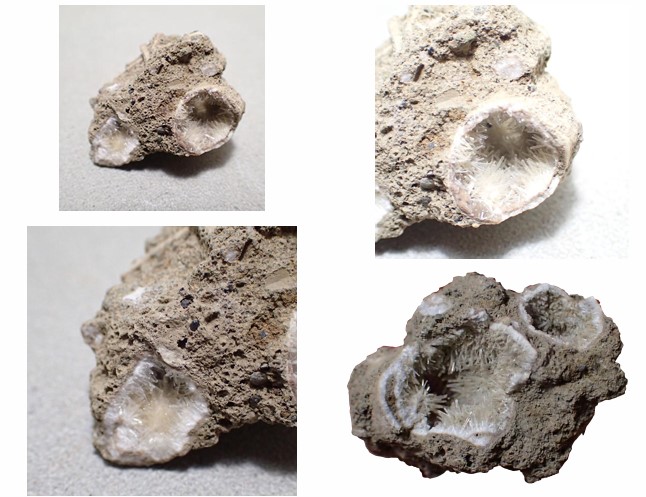
Figure 1: Natrolite pseudomorph. Fossil Wood from the Sipi Caves in Mount Elgon, Uganda. Pre-Pleistocene Epoch (ca. 5.3 to 2.6 million years ago). Dimensions, 3.8 x 2.7 x 3.8 cm.
Figures at a glance